However, selecting the right HDPE pipe requires more than just choosing a diameter. Key technical factors such as material grade, SDR, pressure rating, and applicable standards all play a crucial role in determining performance and lifespan. Among these, the choice between PE80 and PE100 is one of the most important decisions in pipeline design.
1. Material Grades: PE80 vs PE100
HDPE pipes are classified by material strength, with PE80 and PE100 being the most widely used grades in global markets.
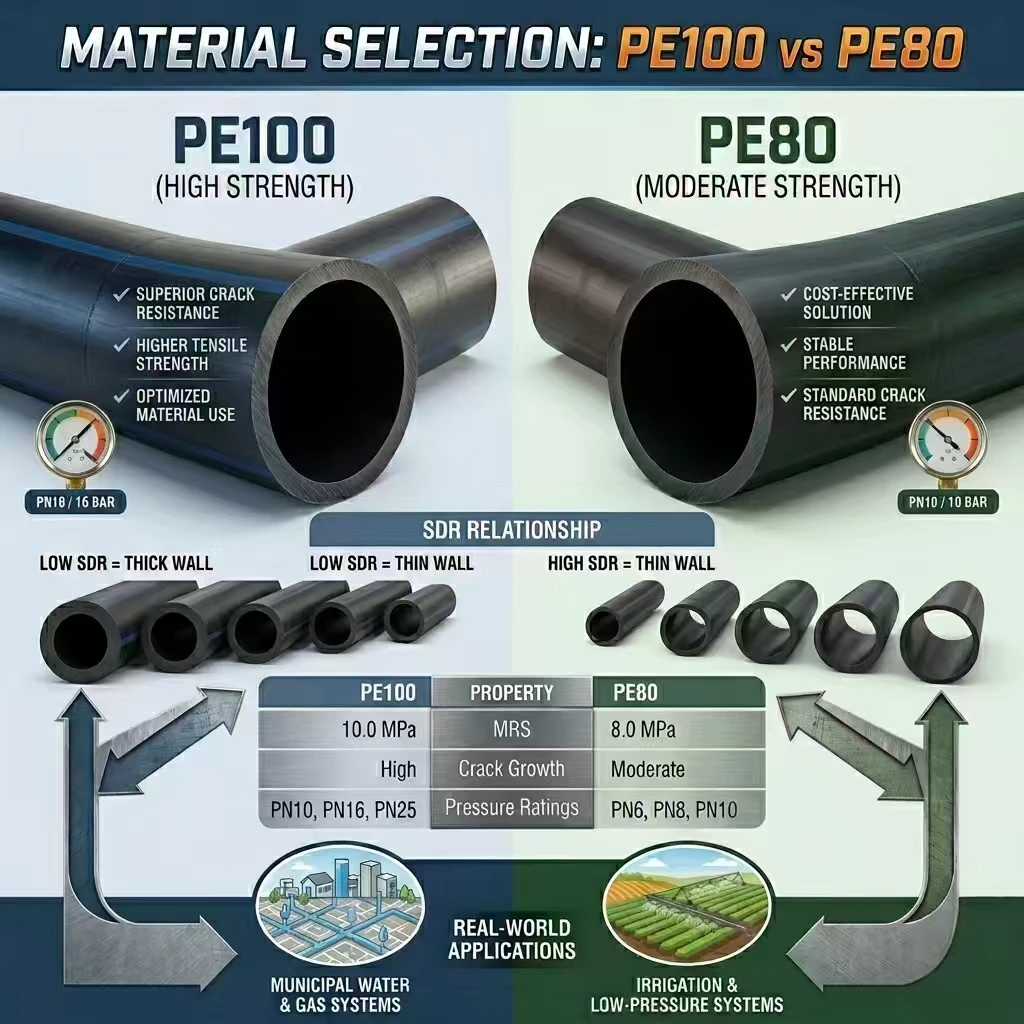
PE80 is an earlier-generation material with moderate strength and stable performance. It is commonly used in low to medium pressure systems such as agricultural irrigation, rural water supply, and non-critical pipelines. Its main advantage lies in cost-effectiveness, making it suitable for projects with limited budget requirements.
PE100 represents a newer and higher-performance material. It offers significantly improved tensile strength and resistance to slow crack growth, allowing it to withstand higher internal pressures and more demanding operating conditions. For example, under the same outer diameter, a PE100 pipe can achieve a higher pressure rating or use a thinner wall compared to PE80, improving both efficiency and material utilization.
In practical terms, PE100 has become the preferred choice for modern infrastructure projects such as municipal water supply and gas distribution systems. PE80 is still used in specific scenarios, but its application scope is gradually being replaced by PE100 in many regions.
2. Pipe Dimensions and the Role of SDR
HDPE pipe size is defined by its outer diameter and wall thickness. While the diameter determines flow capacity, the wall thickness directly affects pressure resistance.
The relationship between these two parameters is expressed through the Standard Dimension Ratio (SDR):
SDR=D/t
A lower SDR indicates a thicker wall and higher pressure capacity, while a higher SDR means a thinner wall and lower pressure resistance.
This is where the difference between PE80 and PE100 becomes especially important. For the same SDR value, PE100 pipes can handle higher pressure than PE80 pipes. Alternatively, to achieve the same pressure rating, a PE100 pipe can use a higher SDR (thinner wall), reducing weight and material cost.
For example, in many applications:
PE80 SDR11 ≈ medium pressure systems
PE100 SDR11 ≈ higher pressure systems (commonly PN16)
This flexibility makes PE100 more efficient for large-scale and long-distance pipeline projects.
3. Pressure Rating (PN) in Real Applications
Pressure rating, expressed as PN (Nominal Pressure), indicates the allowable working pressure of a pipe under standard conditions.
Common PN levels include PN6, PN10, PN16, and PN25. These values are closely related to both SDR and material grade.
For instance:
PE80 pipes are often used in PN6–PN10 systems
PE100 pipes are commonly used in PN10–PN16 or higher
This means that when higher pressure performance is required, PE100 is generally the better option.
It is also important to understand that PN is a standardized rating rather than a fixed operating value. Factors such as temperature, installation conditions, and long-term loading can affect the actual performance. PE100 performs better in these scenarios due to its improved resistance to long-term stress and environmental factors.
4. Applications and Engineering Considerations
HDPE pipes are widely used across different industries, but the choice between PE80 and PE100 often depends on the application environment.
PE80 is typically sufficient for low-pressure irrigation systems and short-distance pipelines where cost control is a priority. Its performance is reliable under stable conditions but may be less suitable for high-demand infrastructure.
PE100, on the other hand, is designed for more demanding applications. It is widely used in municipal water supply, gas distribution, and industrial pipelines where higher pressure, longer service life, and improved safety are required.
In addition, PE100 pipes perform better in challenging installation conditions such as underground environments, trenchless construction, and areas with soil movement. Their flexibility and crack resistance make them particularly suitable for large-scale infrastructure projects.
5. How to Choose the Right HDPE Pipe
Selecting the correct HDPE pipe requires balancing performance, cost, and application requirements.
If the project involves low pressure and limited budget, PE80 can still be a practical choice. However, for most modern projects—especially those involving long-term operation, higher pressure, or critical infrastructure—PE100 offers clear advantages.
From a long-term perspective, PE100 not only improves system reliability but can also reduce overall project costs by allowing thinner walls, lower transportation weight, and fewer maintenance requirements.
Therefore, while both materials have their place, PE100 has become the dominant solution in global pipeline systems.
Understanding HDPE pipe specifications involves more than just size and pressure rating. Material selection, particularly the choice between PE80 and PE100, plays a critical role in determining system performance and durability.
While PE80 remains suitable for certain low-pressure applications, PE100 provides superior strength, efficiency, and long-term reliability, making it the preferred choice for most modern pipeline projects.
By carefully evaluating SDR, PN rating, and material grade together, engineers and buyers can ensure optimal performance and cost efficiency in their pipeline systems.
916.webp)
204.webp)
659.webp)
185.webp)
312.webp)
849.webp)
587.webp)
767.webp)