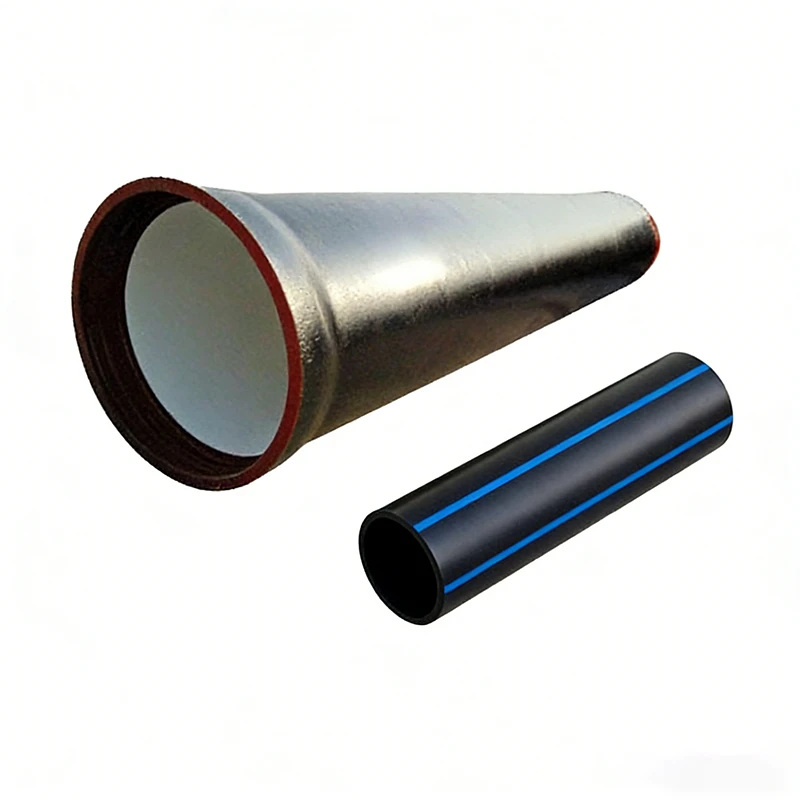
In this guide, we provide a clear comparison between plastic vs iron water pipesystems to help you determine the most suitable option for your project.
1. Material Overview
HDPE Pipe
HDPE pipe is a flexible thermoplastic pipe made from high-density polyethylene resin. It is widely used in municipal water supply, irrigation systems, gas distribution, and industrial fluid transport.
Key characteristics:
Lightweight and flexible
Excellent corrosion resistance
Welded joints for leak-free systems
Long service life (50+ years)
Ductile Iron Pipe
Ductile iron pipe is made from cast iron with improved ductility through magnesium treatment. It is commonly used in large-diameter water transmission systems and high-pressure municipal networks.
Key characteristics:
High mechanical strength
Strong external load resistance
Rigid structure
Internal cement lining for corrosion protection
2. HDPE vs Ductile Iron Pipe: Performance Comparison
2.1 Pressure Resistance
Ductile iron pipe offers very high compressive strength and is traditionally used in high-pressure main transmission lines.
HDPE pipe pressure capacity depends on SDR (Standard Dimension Ratio). Lower SDR means thicker walls and higher pressure rating.
While ductile iron handles high internal pressure well, HDPE performs better under dynamic pressure changes due to its flexibility and resistance to water hammer.
2.2 Corrosion Resistance
This is one of the biggest differences in plastic vs iron water pipe systems.
HDPE: Completely corrosion-resistant, suitable for aggressive soil, coastal areas, and chemical exposure.
Ductile iron: Requires internal lining and sometimes external coating. In corrosive soil, additional protection such as cathodic protection may be required.
In areas with high groundwater salinity, HDPE generally performs better long term.
2.3 Flexibility and Ground Movement
HDPE pipe is flexible and can adapt to:
Soil settlement
Seismic activity
Uneven terrain
Ductile iron pipe is rigid and may require more joints or special design considerations in unstable soil conditions.
For earthquake-prone areas, HDPE often shows superior performance.
2.4 Installation and Jointing
HDPE pipe:
Butt fusion or electrofusion welding
Forms a continuous leak-free pipeline
Lightweight and easier to transport
Ductile iron pipe:
Push-on joints or mechanical joints
Heavier, requires lifting equipment
Installation cost generally higher
Because HDPE is lighter, transportation and handling costs are typically lower, especially in remote projects.
2.5 Service Life
Under proper installation:
HDPE pipe: 50–100 years
Ductile iron pipe: 50–75 years (depending on corrosion protection)
Environmental conditions greatly influence the actual lifespan of ductile iron systems.
2.6 Cost Comparison
Initial material cost:
Ductile iron is usually more expensive per meter.
HDPE is generally more cost-effective.
Total lifecycle cost:
HDPE often has lower maintenance costs due to corrosion resistance and leak-free joints.
Ductile iron may require maintenance in corrosive environments.
For long-distance pipelines, HDPE frequently provides better overall cost efficiency.
3. Application Scenario Comparison
Rural Water Supply
HDPE is often preferred because:
It can be supplied in long coils
Fewer joints reduce leakage risk
Easy installation in remote areas
Urban Municipal Transmission
Ductile iron is commonly used in:
Large-diameter trunk mains
High load-bearing urban roads
Situations requiring high structural strength
Industrial and Chemical Transport
HDPE is usually better suited for:
Corrosive fluids
Mining applications
Seawater systems
4. Environmental Impact
HDPE is recyclable and does not require anti-corrosion coatings.
Ductile iron production is energy-intensive but remains widely used due to mechanical strength advantages.
When evaluating sustainability, long service life and maintenance requirements should be considered.
5. Which Should You Choose?
Choose HDPE pipe if:
Corrosion resistance is critical
Soil movement is expected
Lower installation cost is required
Leak-free welded joints are preferred
Choose ductile iron pipeif:
Very high structural strength is required
Heavy traffic load conditions exist
Project specifications require iron materials
Final Thoughts: HDPE vs Ductile Iron Pipe
The debate of HDPE vs ductile iron pipedepends on project requirements rather than material superiority. HDPE provides flexibility, corrosion resistance, and lower lifecycle costs, while ductile iron offers high rigidity and structural strength.
Understanding the differences between plastic vs iron water pipe systemshelps engineers and project planners make informed infrastructure decisions.
If you are planning a municipal water supply or industrial transmission project, selecting the right material at the design stage can significantly improve long-term performance and cost efficiency.
916.webp)
204.webp)
659.webp)
185.webp)
312.webp)
849.webp)
587.webp)
767.webp)