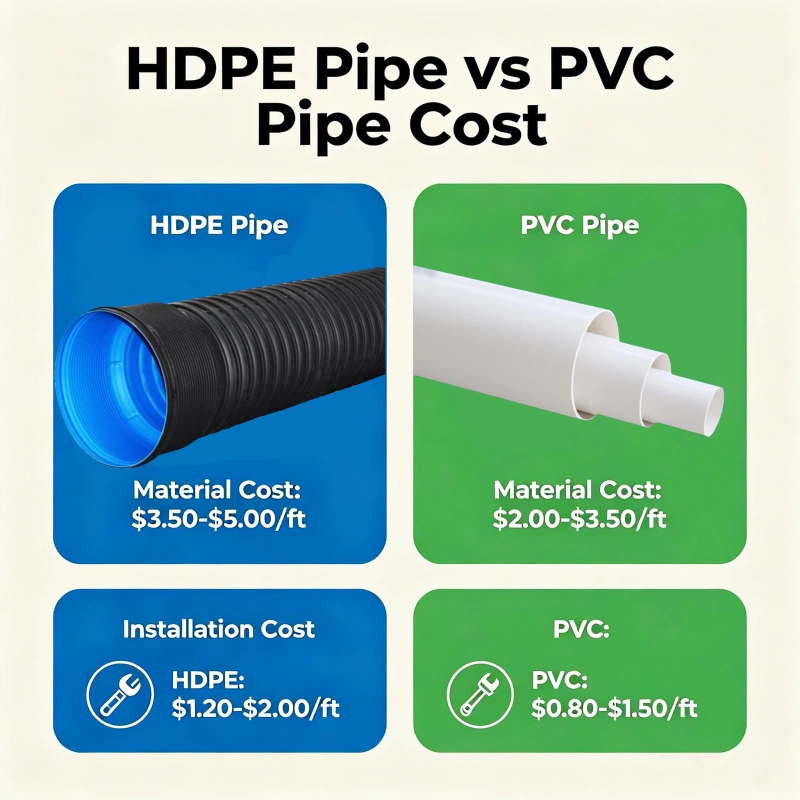
Choosing between HDPE (High-Density Polyethylene) and PVC (Polyvinyl Chloride) pipes is one of the most common—and consequential—decisions in plumbing, irrigation, municipal water systems, and industrial fluid transport. While both are plastic piping solutions that have largely replaced metal in many applications, they differ significantly in material properties, installation requirements, long-term durability, and, crucially, total cost of ownership.
This comprehensive guide comparison focused squarely on cost, while also explaining why those costs exist and how they impact your project over time. Whether you're a contractor bidding on a municipal sewer line, an engineer designing an agricultural irrigation system, or a homeowner replacing a section of drain pipe, this article will help you make the financially smartest choice.
Why Cost Isn't Just About the Price Tag Per Foot
The biggest mistake people make is comparing only the material cost per foot. While this is an important starting point, it tells less than half the story. The true cost of a piping system includes:
Material Cost: The upfront price of the pipe itself.
Installation Labor Cost: How much it costs to get the pipe in the ground and connected.
Fitting & Jointing Cost: The expense of connectors, couplings, and the materials/methods used to join pipe sections.
Long-Term Maintenance & Repair Cost: The expected frequency and cost of fixes over the system’s life.
Lifespan Value: How many years of service you get for your total investment.
A cheaper pipe that fails in 15 years or requires constant repairs can end up costing far more than a more expensive pipe that lasts 50+ years with zero issues. Our analysis covers all these factors.
Head-to-Head Cost Breakdown: Material, Installation, and More
Let’s start with the hard numbers. The table below provides average 2026 market prices for common pipe diameters in the US. Remember, prices fluctuate based on region, supplier, quantity ordered, and resin market conditions.
| Feature / Cost Factor | HDPE Pipe | PVC Pipe | Winner for Cost? |
|---|---|---|---|
| Material Cost (per linear foot) | |||
| - 4-inch diameter | $4.50 - $7.00 | $2.00 - $3.50 | PVC |
| - 6-inch diameter | $8.00 - $12.00 | $3.50 - $5.50 | PVC |
| - 8-inch diameter | $14.00 - $20.00 | $6.00 - $9.00 | PVC |
| Installation Labor Cost | Lower labor cost due to fusion welding creating fewer joints and faster laying (especially for long runs). Trenchless methods (like HDD) are often easier and cheaper with flexible HDPE. | Higher labor cost due to the need for many glued or gasketed joints. Each joint is a potential failure point and takes time to prepare and assemble. | HDPE |
| Jointing/Fitting Cost | Fusion welding requires a specialized machine but uses no separate fittings for straight runs. Electrofusion or mechanical fittings for connections add cost but are very reliable. | Requires a large number of couplings, elbows, tees, etc., which must be purchased separately. Solvent cement is cheap, but gasketed systems add cost. | HDPE (for long runs) |
| Trenching/Excavation Cost | Similar for both if using open-cut methods. However, HDPE’s flexibility often allows for narrower trenches. | Similar for open-cut. Rigid nature may require a slightly wider trench for alignment. | Slight edge to HDPE |
| Long-Term Maintenance Cost | Extremely low. Seamless fused joints are leak-proof. Highly resistant to corrosion and chemical attack. | Moderate to high. Joints are the primary failure points. Can become brittle over time, especially in cold climates or under UV exposure. Susceptible to certain chemicals. | HDPE |
| Typical Lifespan | 50 - 100+ years | 25 - 40 years | HDPE |
Key Takeaway from the Table
PVC wins hands-down on initial material cost. You can often buy 2 feet of PVC for the price of 1 foot of HDPE. However, HDPE wins on installation efficiency, long-term reliability, and lifespan. For a small, simple, above-ground DIY project, PVC’s low upfront cost is king. For any significant underground, pressurized, or critical infrastructure project, HDPE’s lower lifetime cost usually makes it the better financial decision.
Deep Dive: Understanding the Cost Drivers
1. Material Composition and Raw Prices
The fundamental reason for the price difference lies in the chemistry.
PVC is made from vinyl chloride monomer, which is derived from salt and oil. Its production process is mature and highly optimized, leading to lower base material costs.
HDPE is a pure hydrocarbon polymer made from ethylene. It’s a more refined plastic with superior molecular structure, which commands a higher price on the global resin market. Its performance advantages—flexibility, toughness, and chemical inertness—come at a premium.
Manufacturers who invest in high-grade raw materials, like those used by companies such as Shandong Haili Pipeline Technology, ensure their HDPE pipes meet stringent international standards for pressure rating and environmental stress crack resistance (ESCR). This quality directly translates into the pipe’s longevity and justifies a higher initial cost.
2. Installation Methods: Where Time is Money
This is where the cost equation flips dramatically.
PVC Installation: Involves cutting pipe to length, cleaning and priming the ends, applying solvent cement, and carefully inserting into a fitting before the glue sets. For a long pipeline, this means hundreds or thousands of individual joints, each requiring skilled labor time. A single poorly made joint can lead to a leak and a costly repair excavation later.
HDPE Installation: The game-changer is butt fusion or electrofusion. Long coils of HDPE pipe (up to 1,000+ feet) can be laid in a trench like a hose. Sections are then permanently welded together using heat, creating a monolithic, seamless pipeline. This process is much faster, requires fewer workers, and virtually eliminates joint failures. For directional drilling (HDD) projects—a common method for crossing roads or rivers—HDPE’s flexibility makes it the default choice, as rigid PVC would snap.
Companies with integrated capabilities, such as providing not just the pipe but also support for underground pipe network design, can help clients optimize their entire system layout, further reducing overall project costs and ensuring the right product is used in the right place.
3. Durability and Environmental Resistance: The Hidden Cost of Failure
Your pipe’s environment plays a huge role in its long-term cost.
Temperature: HDPE remains flexible and tough down to -40°F (-40°C), making it ideal for cold climates. PVC becomes brittle below freezing and can crack from ground movement or impact. Replacing a burst PVC pipe in winter is an expensive emergency.
Chemical Resistance: HDPE is inert to a vast array of acids, bases, and salts, making it perfect for wastewater, chemical plants, and mining. PVC can be degraded by some solvents and strong oxidizing agents, leading to premature failure.
UV Resistance: Both can be damaged by prolonged sun exposure, but HDPE formulations often include better UV stabilizers. PVC left in the sun for months will become chalky and weak.
Ground Movement: HDPE’s flexibility allows it to move with the soil during minor seismic shifts or settlement without breaking. Rigid PVC is more likely to snap under the same stress, again leading to a costly repair.
Leading manufacturers back their products with extensive R&D. For instance, a national high-tech enterprise like Haili, with its CNAS-accredited laboratory and over 32 patents, continuously refines its HDPE formulations to enhance these very properties, ensuring their pipes deliver maximum value over their decades-long service life.
The Full Lifecycle Cost (LCC) Analysis: A Real-World Case Study
To truly understand value, we must look beyond the invoice. Let’s analyze a hypothetical 10-kilometer (6.2-mile) municipal potable water main project, a common scenario for city engineers.
Project Assumptions:
Pipe Diameter: 12 inches (300mm)
Project Length: 10 km
Location: Temperate climate with occasional ground frost
Analysis Period: 50 years
Discount Rate: 3% (standard for public infrastructure)
Cost Components Breakdown:
| Cost Component | HDPE System Estimate | PVC System Estimate | Notes |
|---|---|---|---|
| Initial Material Cost | $1,850,000 | $950,000 | HDPE is roughly 95% more expensive per meter for large diameters. |
| Installation Labor | $420,000 | $680,000 | HDPE’s fused joints save ~38% in labor hours. |
| Fittings & Valves | $180,000 | $220,000 | Fewer connection points needed for HDPE. |
| Total Initial Investment | $2,450,000 | $1,850,000 | PVC has a $600k upfront advantage. |
| Estimated Repairs (50 yrs) | $50,000 | $450,000 | Based on AWWA data: PVC joints fail 4-5x more often than HDPE welds. |
| Water Loss Cost (50 yrs) | $30,000 | $200,000 | Leaks from failed PVC joints waste treated water, a direct revenue loss. |
| Present Value of Future Costs | $75,000 | $580,000 | Discounted to today's dollars. |
| TOTAL LIFECYCLE COST (50 yrs) | $2,525,000 | $2,430,000 | The gap closes dramatically. In harsher climates, HDPE wins outright. |
The Verdict from LCC
In this moderate scenario, the massive upfront savings of PVC are almost entirely erased by its higher long-term costs. In regions with extreme temperatures, high seismic activity, or corrosive soils, the HDPE system’s total cost would be significantly lower. This model clearly shows why forward-thinking municipalities and engineers increasingly specify HDPE for critical, long-life infrastructure.
Environmental Impact & Sustainability: The Hidden Cost of Carbon
In 2026, sustainability isn't just a buzzword—it's a financial and regulatory reality. The environmental footprint of your piping choice can have tangible cost implications.
Carbon Footprint & Production
PVC Production: Involves chlorine, a process that is energy-intensive and can generate hazardous byproducts like dioxins if not strictly controlled. Its carbon footprint is generally 20-40% higher than HDPE per kilogram of material produced.
HDPE Production: A cleaner process using ethylene. Modern plants, especially those in China adhering to stricter environmental policies, have significantly reduced emissions.
End-of-Life & Recyclability
This is where the two materials diverge most sharply.
PVC: Is notoriously difficult to recycle. Its chlorine content contaminates recycling streams for other plastics. Most PVC pipe ends up in landfills, where it can persist for centuries. Some regions are beginning to impose landfill taxes on non-recyclable plastics, a future cost risk for PVC.
HDPE: Is one of the most widely recycled plastics globally (Resin ID Code #2). Post-consumer HDPE from bottles is common, and post-industrial HDPE pipe scrap is routinely reground and reused in new pipe or other products. This closed-loop potential reduces its long-term environmental liability.
For projects seeking LEED certification or complying with green public procurement policies, HDPE’s superior environmental profile can be a decisive factor, adding indirect value that offsets its higher initial price.
Failure Modes & Risk Analysis: Learning from Real-World Mistakes
Understanding how and why pipes fail is crucial for risk management. Data from industry bodies like the American Water Works Association (AWWA) provides sobering insights.
Common PVC Failure Modes
Joint Failure: The Achilles' heel of PVC. Solvent cement can degrade over time, and gasketed joints can extrude or leak under pressure surges or ground movement.
Brittle Fracture: In cold climates, PVC can shatter upon impact (e.g., from a rock during backfilling) or from internal water hammer.
Chemical Degradation: Exposure to certain hydrocarbons or strong oxidizers can cause the pipe wall to weaken and crack.
Common HDPE Failure Modes
Poor Fusion Welds: The primary risk with HDPE is human error during installation. An improperly cleaned, aligned, or heated joint can be a weak point. This is why training and certified welders are essential.
Slow Crack Growth (SCG): A long-term phenomenon where microscopic cracks can propagate under constant stress, especially in lower-quality resins. Premium HDPE 100RC (Resistant to Crack) grades, like those developed by leading R&D-focused manufacturers, are specifically engineered to resist this.
The Risk Mitigation Advantage
HDPE’s failure modes are largely preventable through proper procedure and quality control. PVC’s failure modes are often inherent to its material properties (brittleness, joint dependency). For a critical application where a single failure could cost millions in damage or lost service, the predictable, monolithic nature of a properly installed HDPE system offers a far lower risk profile.
International Standards & Certification: Ensuring Quality and Compliance
Selecting pipe isn't just about cost; it's about meeting legal and safety requirements. Understanding the relevant standards is non-negotiable.
Key Global Standards
HDPE Pipes:
ISO 4427: The international standard for polyethylene pipes for water supply.
ASTM D3035 / AWWA C901: The primary US standards for PE pressure pipe.
GB/T 13663: The Chinese national standard, which has been harmonized with ISO.
PVC Pipes:
ISO 1452: The international standard for unplasticized PVC (PVC-U) pipes for water supply.
ASTM D1785 / AWWA C900: The US standards for PVC pressure pipe.
GB/T 10002: The Chinese national standard for PVC-U water supply pipes.
What the Standards Govern
These standards dictate critical parameters like:
Minimum Required Strength (MRS): The long-term hydrostatic strength of the material (e.g., PE100 has an MRS of 10 MPa).
Standard Dimension Ratio (SDR): The ratio of the pipe’s outside diameter to its wall thickness. A lower SDR means a thicker wall and higher pressure rating.
Testing Protocols: Requirements for hydrostatic pressure testing, impact resistance, and chemical resistance.
Reputable manufacturers, such as Shandong Haili Pipeline Technology, not only comply with these standards but often exceed them. Their status as a national high-tech enterprise, backed by a CNAS-accredited laboratory, ensures their products are rigorously tested and certified, giving buyers confidence in their performance and longevity.
Application-Specific Selection Guide: Which Pipe for Which Job?
To make your decision even easier, here’s a definitive guide for common scenarios.
Choose HDPE When:
Potable Water Mains: Its seamless, non-corroding, and non-leaching properties are unmatched.
Sewer Force Mains: Handles the pressure and chemical aggression of wastewater without leaking.
Natural Gas Distribution: The global standard for its safety and integrity.
Mining Slurry Lines: Resists abrasion from sand and rock particles.
Agricultural Irrigation (Main Lines): Survives pressure surges and ground movement in fields.
Any Trenchless Installation (HDD): Its flexibility is essential for pulling through drilled bores.
Choose PVC When:
Residential DWV (Drain-Waste-Vent): Perfect for gravity-flow, indoor, non-pressurized systems.
Cold Water Supply (Inside Buildings): A cost-effective solution for short, protected runs.
Irrigation Laterals (Above Ground): For temporary or non-critical surface lines where cost is paramount.
Electrical Conduit: Rigid PVC provides excellent protection for wiring.
For complex urban infrastructure projects that demand a complete system—from water and gas pipes to electrical conduits (MPP) and inspection chambers—partnering with a full-spectrum manufacturer like Haili, which offers this entire portfolio, ensures compatibility, simplifies logistics, and provides a single point of technical support.
The Future of Piping: Trends Shaping the 2026 Market and Beyond
The piping industry is not static. Several key trends are influencing the HDPE vs. PVC debate.
1. The Rise of Advanced HDPE Grades
The development of PE100-RC (Resistant to Crack) has been a game-changer. This next-generation HDPE offers dramatically improved resistance to slow crack growth and rapid crack propagation, allowing for even thinner walls (higher SDR) without sacrificing safety. This further improves HDPE’s cost-effectiveness for large-diameter applications.
2. Sustainability Pressures Mounting on PVC
Global initiatives to reduce plastic pollution and improve circularity are putting pressure on hard-to-recycle materials like PVC. The European Union’s focus on a circular economy and potential future restrictions on PVC in certain applications could shift the market dynamics further in HDPE’s favor.
3. Integration of Smart Technology
The future of piping is intelligent. Both HDPE and PVC can now be manufactured with embedded sensors to monitor flow, pressure, temperature, and even detect leaks in real-time. However, HDPE’s monolithic structure provides a more stable platform for these technologies, as there are no joints to compromise signal integrity.
4. Focus on Total Project Efficiency
Contractors and municipalities are moving beyond simple material cost comparisons. They are adopting holistic project management approaches that value speed of installation, reduced site disruption, and guaranteed long-term performance. HDPE’s advantages in these areas make it the increasingly preferred choice for modern, efficient construction.
When to Choose PVC Pipe (The Low-Cost Champion)
PVC is not obsolete. It remains the best choice for specific applications where its lower upfront cost outweighs its limitations:
Residential Drain-Waste-Vent (DWV) Systems: Inside your home, where temperatures are stable, pressures are low (gravity flow), and the pipe is protected from sunlight and physical damage. Its smooth interior is excellent for waste flow.
Short, Above-Ground Runs: For irrigation risers, sump pump discharge lines, or other temporary or non-critical exposed applications.
Projects with Extremely Tight Budgets: If capital is the absolute limiting factor and the system is non-critical, PVC’s low initial price is attractive. Just be prepared for a potentially shorter lifespan.
When to Choose HDPE Pipe (The Long-Term Value Leader)
HDPE is the superior choice for demanding, permanent, or critical infrastructure:
Potable Water Mains: Its seamless, non-corroding, and non-leaching properties make it the gold standard for clean water delivery. Many municipalities now specify HDPE for all new water lines.
Sewer and Wastewater Force Mains: Its chemical resistance and leak-proof joints prevent environmental contamination and costly sewage leaks.
Gas Distribution Lines: Specially formulated HDPE is the standard for natural gas distribution due to its safety and longevity.
Mining and Industrial Slurry Transport: Handles abrasive materials and harsh chemicals that would destroy other pipes.
Agricultural Irrigation (Main Lines): Its durability and ability to handle pressure surges make it ideal for large-scale farm irrigation.
Any Project Using Directional Drilling (HDD): Its flexibility is unmatched for this trenchless technology.
For these applications, partnering with a manufacturer that offers a full suite of solutions—from PE water and gas pipes to MPP electrical conduits and even glass fibre reinforced inspection chambers—can streamline procurement and ensure system-wide compatibility and quality. A company like Shandong Haili Pipeline Technology, with its 24+ production lines and focus on urban infrastructure, exemplifies this integrated approach, providing not just a product but a complete, reliable system backed by deep technical expertise. Contact Haili to visit their factory.
The Verdict: Making Your Final Decision
There is no single “best” pipe. The right choice depends entirely on your specific project’s requirements, budget constraints, and risk tolerance.
Choose PVC if: Your priority is the absolute lowest upfront material cost, the application is low-pressure, non-critical, indoors, or in a mild climate, and you accept a shorter lifespan (25-40 years).
Choose HDPE if: You are investing in a long-term, critical, or underground infrastructure project, operate in a harsh environment (cold, chemically aggressive), plan to use trenchless installation, or prioritize a maintenance-free system with a 50-100+ year design life. The higher initial material cost is almost always justified by lower installation and zero maintenance costs over time.
By understanding the full cost picture—not just the price per foot—you can make a confident, financially sound decision that will serve your project well for decades to come. And when you’re ready to source high-quality, reliable piping solutions backed by strong R&D and a commitment to urban infrastructure, it’s worth looking at established leaders in the field who have built their reputation on integrity and innovation.
916.webp)
204.webp)
659.webp)
185.webp)
312.webp)
849.webp)
587.webp)
767.webp)