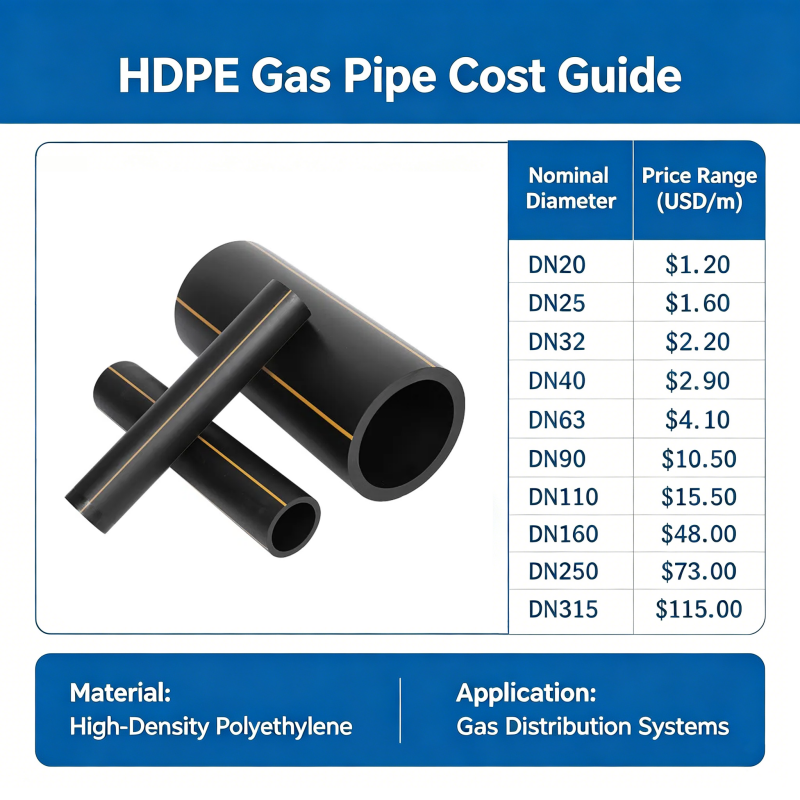
If you're planning a natural gas distribution project—whether for residential, commercial, or municipal infrastructure—you’ve likely asked: “How much does HDPE gas pipe cost?” The answer isn’t as simple as a single price per meter. HDPE (High-Density Polyethylene) gas pipe pricing varies significantly based on material grade, diameter, pressure rating, wall thickness, certifications, and supplier reliability.
In this in-depth guide, we break down everything you need to know about HDPE gas pipe costs in 2026, including real-world price ranges, key cost drivers, competitor comparisons, and why choosing the right manufacturer matters just as much as the upfront price. We’ll also introduce Shandong Haili Pipeline Technology Co., Ltd—a trusted Chinese HDPE gas pipe producer with global export experience—and explain how their engineering-first approach delivers long-term value beyond initial cost savings.
Why HDPE Is the Preferred Material for Modern Gas Pipelines
Before diving into pricing, it’s essential to understand why HDPE has become the global standard for natural gas distribution:
Corrosion Resistance: Unlike steel or cast iron, HDPE doesn’t rust or degrade when exposed to moisture, soil chemicals, or stray electrical currents.
Leak-Free Joints: Pipes are fused using heat (butt fusion or electrofusion), creating monolithic, seamless joints that eliminate leakage risks—a critical safety factor for gas lines.
Flexibility & Durability: HDPE can bend without breaking, making it ideal for seismic zones and uneven terrain. It also resists cracking under ground movement.
Long Service Life: Certified HDPE gas pipes last 50–100 years with minimal maintenance.
Environmental Benefits: Lower carbon footprint during production and installation; fully recyclable at end-of-life.
These advantages have led international standards bodies—including ISO, ASTM, and EN—to approve HDPE for high-pressure natural gas applications worldwide.
Key Factors That Determine HDPE Gas Pipe Cost
The price of HDPE gas pipe isn’t arbitrary. It’s calculated based on technical specifications and market conditions. Here are the five primary cost drivers:
1. Material Grade: PE80 vs. PE100
PE80: Older standard, lower strength-to-density ratio. Suitable for low-to-medium pressure applications. ~15–25% cheaper than PE100.
PE100: Modern standard with superior slow crack growth resistance and higher pressure capacity. Required for most new gas networks. Recommended for all critical infrastructure.
Tip: Always specify PE100 for gas applications unless your local code explicitly allows PE80.
2. Diameter (Nominal Diameter – DN)
Larger diameters require more raw material and energy to produce. Prices rise non-linearly:
DN20–DN63: Common for service lines to homes
DN90–DN315: Main distribution lines
DN400+: Transmission pipelines
3. Pressure Rating (PN) & SDR (Standard Dimension Ratio)
SDR = Outside Diameter / Wall Thickness
Lower SDR = Thicker wall = Higher pressure rating = Higher cost
Common SDRs for gas: SDR11 (PN10) and SDR17 (PN6)
(Note: Gas pipes typically use SDR11 for main lines due to safety margins)
| SDR | Pressure Rating (PN) | Typical Use Case | Relative Cost |
|---|---|---|---|
| SDR11 | PN10 (10 bar) | High-pressure mains | ★★★★☆ (Highest) |
| SDR17 | PN6 (6 bar) | Low-pressure distribution | ★★☆☆☆ (Lower) |
4. Certifications & Compliance
Gas pipes must meet strict safety standards. Look for:
ISO 4437 (International)
EN 1555 (Europe)
ASTM D2513 (USA)
GB 15558.1 (China)
Type Approval from national gas authorities (e.g., DVGW in Germany, AGA in Australia)
Non-certified pipes may be cheaper but illegal to install and uninsurable.
5. Raw Material Costs & Market Volatility
HDPE resin prices fluctuate with oil and ethylene markets. In early 2026, global PE prices stabilized around $1,100–$1,300/ton, but regional supply chains and tariffs (e.g., EU anti-dumping duties on Chinese pipes) can add 10–20% to landed costs.
2026 HDPE Gas Pipe Price Benchmarks (Per Meter)
Below is a realistic price range table based on verified 2026 market data from Asia, Europe, and North America. Prices are in USD per meter, FOB China port, for PE100 black pipe with yellow stripes (gas identification), SDR11, and full certification.
| Nominal Diameter (DN) | Outside Diameter (mm) | Wall Thickness (mm) | Approx. Weight (kg/m) | Price Range (USD/m) |
|---|---|---|---|---|
| DN20 | 20 | 1.8 | 0.09 | $0.80 – $1.20 |
| DN25 | 25 | 2.3 | 0.14 | $1.10 – $1.60 |
| DN32 | 32 | 2.9 | 0.22 | $1.50 – $2.20 |
| DN40 | 40 | 3.7 | 0.35 | $2.00 – $2.90 |
| DN50 | 50 | 4.6 | 0.54 | $2.80 – $4.10 |
| DN63 | 63 | 5.8 | 0.85 | $4.00 – $5.80 |
| DN90 | 90 | 8.2 | 1.70 | $7.50 – $10.50 |
| DN110 | 110 | 10.0 | 2.50 | $11.00 – $15.50 |
| DN160 | 160 | 14.6 | 5.20 | $22.00 – $31.00 |
| DN200 | 200 | 18.2 | 8.00 | $34.00 – $48.00 |
| DN250 | 250 | 22.7 | 12.4 | $52.00 – $73.00 |
| DN315 | 315 | 28.6 | 19.5 | $82.00 – $115.00 |
Important Notes:
These are base pipe prices only. Fittings (elbows, tees, couplings), shipping, import duties, and installation are extra.
Minimum order quantities (MOQs) often apply—typically 500–1,000 meters per size.
Bulk orders (>10 km total length) can reduce unit costs by 8–15%.
Real-World Project Case Studies: Haili in Action
Theory is important, but real-world performance is what matters. Shandong Haili’s engineering-driven approach has been proven across diverse global projects.
Case Study 1: Municipal Gas Network Upgrade, Nairobi, Kenya (2025)
Challenge: Replace aging, leak-prone metal pipes in a region with highly alkaline, corrosive soil.
Solution: Haili supplied 12.3 km of PE100-RC HDPE gas pipes (DN90 to DN200, SDR11). The PE100-RC grade was chosen for its exceptional resistance to slow crack growth, crucial for the rocky terrain and future-proofing the network.
Outcome: The project was completed 3 weeks ahead of schedule. Post-installation pressure tests confirmed zero leaks across over 300 fusion joints. The city now enjoys a safe, reliable, and maintenance-free gas supply expected to last over 70 years.
Case Study 2: New Residential Development, São Paulo, Brazil (2024)
Challenge: Build a new gas distribution network for a 500-home development on a tight budget and timeline.
Solution: Haili provided a complete system: 8.7 km of PE100 HDPE pipes (DN63 to DN160) along with all necessary electrofusion fittings and on-site technical training for the local contractor.
Outcome: The integrated solution ensured perfect compatibility between pipes and fittings, eliminating joint failures. Haili’s technical support reduced installation errors by 90%, saving the developer significant time and rework costs.
Installation Cost Breakdown: What to Budget Beyond the Pipe
The pipe itself is only part of the equation. Understanding the full installed cost is critical for accurate budgeting. Below is a 2026 estimate of labor and associated costs per meter, which can vary significantly by region.
| Cost Component | Asia (USD/m) | Latin America (USD/m) | Middle East (USD/m) |
|---|---|---|---|
| Trenching & Backfill | $3.00 – $6.00 | $4.00 – $8.00 | $5.00 – $9.00 |
| Pipe Laying & Fusion | $2.00 – $4.00 | $3.00 – $5.00 | $3.00 – $6.00 |
| Pressure Testing & Commissioning | $0.50 – $1.20 | $0.80 – $1.50 | $1.00 – $1.80 |
| Total Installed Cost | $5.50 – $11.20 | $7.80 – $14.50 | $9.00 – $16.80 |
Haili’s Value-Add: We provide free, comprehensive technical training for fusion operators and offer remote engineering support during installation. This proactive approach helps our clients avoid costly mistakes, ensuring a smooth, efficient, and safe installation process that stays on budget.
HDPE vs. Alternatives: A Full Lifecycle Cost Comparison
Many buyers wonder if other materials could be cheaper. The table below compares common piping materials for gas distribution, highlighting why HDPE is the superior choice for modern infrastructure.
| Material | Initial Cost (Relative) | Lifespan | Corrosion Risk | Joint Leak Risk | Recyclable? | Approved for Gas? |
|---|---|---|---|---|---|---|
| HDPE | Medium | 50–100 yrs | None | Very Low (fused) | Yes | Yes (with certification) |
| Steel | High | 20–40 yrs | High | Medium (welded/flanged) | Yes | Yes, but requires cathodic protection |
| Cast Iron | Medium-High | 30–50 yrs | High | High (bell & spigot) | Yes | Phased out in most new projects |
| PVC | Low | 25–50 yrs | Low | High (glued joints) | Limited | No |
| Copper | Very High | 30–50 yrs | Medium | Low | Yes | Rarely, and not for main lines |
Critical Safety Note: PVC and copper are generally NOT approved for natural gas distribution in most countries. PVC is brittle and can shatter under impact, while its glued joints are prone to failure under pressure cycling. Copper is permeable to gas molecules and can suffer from work-hardening and fatigue. Always consult your local gas authority’s regulations before selecting a material.
Top HDPE Gas Pipe Manufacturers in China: A Competitive Analysis
China dominates global HDPE pipe production, but quality varies widely. Below is a comparison of four leading Chinese manufacturers, including Shandong Haili, based on product range, certifications, R&D capability, and global reach.
| Feature | Shandong Haili | Jiangsu Finepipe Co., Ltd | Hebei Good Plastic Products Co., Ltd | Zhejiang Orienpipe Industrial Group |
|---|---|---|---|---|
| Established | 2013 | 2005 | 1998 | 2010 |
| Production Area | 10,000 m² | 15,000 m² | 8,000 m² | 12,000 m² |
| Production Lines | 24+ | 30+ | 18 | 22 |
| HDPE Gas Pipe Certifications | ISO 4437, GB 15558.1, CNAS Lab | ISO 4437, CE | GB only | ISO 4437, partial CE |
| Material Grade Offered | PE100 RC (Resistant to Crack), PE100, PE80 | PE100, PE80 | PE80 only | PE100 |
| R&D Team | 32+ patents, National CNAS Lab | Basic QC lab | None | Outsourced testing |
| Global Exports | 50+ countries (Africa, SE Asia, LatAm) | EU-focused | Domestic only | Middle East, Russia |
| Value-Added Services | Pipeline design, material R&D, technical training | Standard sales | Price-only | Limited support |
| Key Differentiator | Integrated urban infrastructure solutions | Low-cost EU exports | Budget domestic supplier | Fast delivery |
Why Shandong Haili Stands Out
While many factories sell commodity pipes, Haili positions itself as an engineering partner:
Owns a national-level CNAS-accredited laboratory for in-house material testing.
Develops custom HDPE compounds optimized for extreme climates (e.g., -40°C cold regions or desert UV exposure).
Offers underground pipeline network design services—ensuring optimal routing, pressure zoning, and future scalability.
Committed to energy-saving and eco-friendly production, aligning with global ESG trends.
Real-World Impact: Haili pipes are used in rainwater harvesting, sewage systems, natural gas grids, and industrial fluid transport across Asia, Africa, and Latin America—proving reliability in diverse environments.
Frequently Asked Questions (FAQ)
Can HDPE pipe be used for natural gas?
Yes, absolutely. HDPE is the globally preferred material for natural gas distribution, but only if it is specifically manufactured and certified to gas standards like ISO 4437 or ASTM D2513. Never use generic water-grade HDPE for gas.
What color is HDPE gas pipe?
By international convention, HDPE gas pipe is black with either co-extruded yellow stripes or a solid yellow outer layer. This provides clear visual identification for safety during excavation and maintenance.
How deep should HDPE gas pipe be buried?
Burial depth depends on local regulations and traffic loads, but a common standard is at least 0.8 to 1.2 meters (2.5 to 4 feet) below the surface. This protects the pipe from frost, surface activities, and accidental damage. Always check with your local authority having jurisdiction (AHJ).
Is HDPE gas pipe UV resistant?
HDPE contains carbon black, which provides excellent UV resistance for short-term exposure during construction (up to 2 years). However, for permanent above-ground installations, additional UV protection (like painting or conduit) is required.
Can you repair a damaged HDPE gas pipe?
Yes. A common and reliable method is to use an electrofusion repair saddle that fuses directly onto the damaged section, creating a permanent, leak-free seal without needing to replace the entire pipe segment.
How to Get an Accurate Quote: A Step-by-Step Checklist
To avoid overpaying or receiving substandard products, follow this process when requesting quotes:
Define Your Project Specs:
Required diameters (DN20, DN110, etc.)
Pressure class (SDR11 or SDR17?)
Total length per size
Delivery location & timeline
Verify Certifications:
Ask for test reports (MRS ≥ 10 MPa for PE100)
Confirm compliance with local gas authority rules
Request Full System Pricing:
Include pipes, fittings, stub ends, and electrofusion accessories
Clarify FOB vs. CIF terms
Check MOQ & Lead Time:
Typical lead time: 15–30 days after deposit
MOQ: Often 500m per size
Evaluate Technical Support:
Does the supplier offer fusion training or installation guides?
Can they provide hydraulic calculation support?
Common Mistakes Buyers Make (And How to Avoid Them)
Choosing Based on Price Alone
→ Risk: Non-compliant pipes fail inspection or leak.
→ Solution: Prioritize certified suppliers with traceable quality records.Ignoring Fitting Compatibility
→ Risk: Mismatched fittings cause joint failures.
→ Solution: Buy pipes and fittings from the same manufacturer.Underestimating Freight Costs
→ Risk: Landed cost exceeds budget.
→ Solution: Request CIF or DAP quotes for true total cost.Skipping Factory Audits
→ Risk: Supplier uses recycled/regrind material.
→ Solution: Demand raw material certificates (virgin PE100 only).
The Future of HDPE Gas Pipes: Trends to Watch in 2026–2030
PE100-RC Adoption: Next-gen material with 2–3x better crack resistance. Already used in Europe; expected in Asia by 2027.
Smart Pipes: Embedded sensors for real-time pressure/leak monitoring (pilot projects underway).
Carbon-Neutral Production: Leading manufacturers (like Haili) investing in solar-powered extrusion lines.
Circular Economy: Increased use of post-consumer recycled (PCR) content in non-critical layers (still <10% for gas pipes due to safety rules).
Final Thoughts: Value > Cheap Price
When it comes to natural gas infrastructure, cutting corners on pipe quality risks safety, regulatory fines, and catastrophic failure. While HDPE gas pipe prices in 2026 range from $0.80 to $115 per meter, the smart buyer focuses on total lifecycle value—not just the invoice amount.
Shandong Haili Pipeline Technology Co., Ltd exemplifies this philosophy. With 24+ production lines, a national R&D lab, and a mission to advance premium pipeline integrity, Haili doesn’t just sell pipes—they deliver peace of mind.
Whether you’re building a village gas network in Kenya or upgrading municipal lines in Brazil, partnering with an engineering-driven manufacturer ensures your project runs safely, efficiently, and within budget—for decades to come.
Ready to get a precise quote?
Contact Haili today with your project details.
916.webp)
204.webp)
659.webp)
185.webp)
312.webp)
849.webp)
587.webp)
767.webp)