Introduction
Connecting HDPE pipe to steel pipe is a common requirement in water supply systems, natural gas pipelines, mining projects, industrial fluid transportation, and municipal infrastructure. Although HDPE (High-Density Polyethylene) and steel pipes are both widely used pipeline materials, they have very different physical properties. HDPE is lightweight, flexible, corrosion-resistant, and chemically stable, while steel pipe provides excellent mechanical strength, pressure resistance, and structural stability.
Because these two materials behave differently under pressure, temperature changes, and external loads, connecting HDPE pipe to steel pipe requires the correct transition method and suitable fittings. A poor connection can lead to leakage, pipe movement, corrosion problems, and reduced service life.
This guide explains how to connect HDPE pipe to steel pipe, including the most common connection methods, installation procedures, advantages and disadvantages of each solution, key factors to consider, and how professional HDPE pipe manufacturers select reliable transition systems.
Why Connect HDPE Pipe to Steel Pipe?
Many pipeline projects use a combination of HDPE and steel pipes instead of choosing only one material. The reason is that each material offers unique advantages.
HDPE pipes are often selected for underground applications because they:
Resist corrosion and chemical damage
Have excellent flexibility
Require low maintenance
Provide a long service life
Handle ground movement better than rigid pipes
Steel pipes are commonly used because they:
Provide high mechanical strength
Handle high-pressure applications
Support above-ground pipeline structures
Perform well in extreme operating conditions
A typical project may use steel pipe near pumping stations, mechanical equipment, or exposed areas, then transition to HDPE pipe for underground distribution networks.
The connection between these two materials creates a complete pipeline system that combines strength, durability, and cost efficiency.
Common Methods for Connecting HDPE Pipe to Steel Pipe
There are several reliable ways to connect HDPE pipe with steel pipe. The correct method depends on pipe diameter, pressure rating, application requirements, and installation environment.
The four most commonly used connection methods are:
HDPE flange adapter connection
Mechanical transition coupling
Steel flange and HDPE stub end connection
Custom transition fittings
The following table summarizes the main differences.
| Connection Method | Best Application | Advantages | Limitations |
|---|---|---|---|
| HDPE flange adapter | Water supply, industrial pipelines, large diameter pipes | Easy installation, removable connection, reliable sealing | Requires proper flange alignment |
| Mechanical transition coupling | Repair work and small projects | Fast installation, no welding required | May have pressure limitations |
| Stub end and steel flange | Permanent pipeline systems | Strong connection, widely used internationally | Requires flange installation skills |
| Custom transition fitting | Special engineering projects | Designed for specific requirements | Higher cost and longer production time |
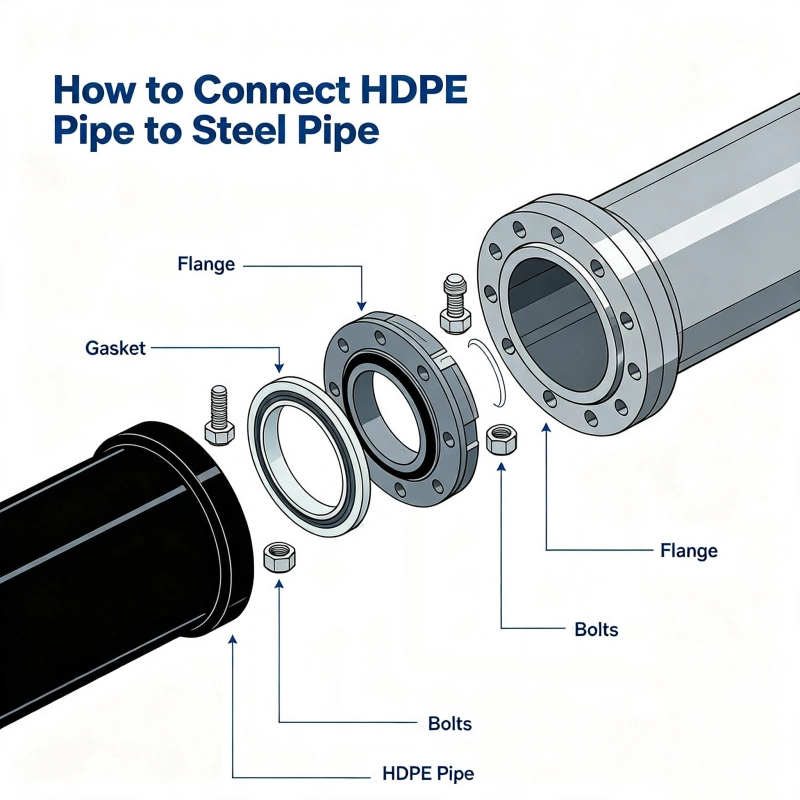
Method 1: Connecting HDPE Pipe to Steel Pipe Using Flange Adapters
The flange adapter method is one of the most popular solutions for HDPE-to-steel pipe connections, especially in municipal water systems, sewage pipelines, irrigation networks, and industrial applications.
A typical flange connection consists of:
Steel flange
Rubber gasket
Bolts and nuts
The HDPE flange adapter is fused directly to the HDPE pipe through butt fusion or electrofusion. The opposite side connects to a steel flange using bolts.
This creates a secure mechanical connection between the two materials.
Step-by-Step Installation Process
Step 1: Prepare the Pipes
Before installation, check:
Pipe diameter compatibility
Pressure rating
Flange size
Surface condition
The steel pipe flange should be clean and free from rust, oil, or debris. The HDPE pipe end should also be properly prepared before fusion.
Step 2: Fuse the HDPE Flange Adapter
The HDPE flange adapter is connected to the HDPE pipe using a qualified fusion process.
Common fusion methods include:
Butt fusion
Electrofusion
During butt fusion, the pipe end and flange adapter are heated and pressed together until they form a permanent joint.
A properly fused HDPE connection becomes a continuous polyethylene structure with excellent leak resistance.
Step 3: Install the Rubber Gasket
Place a suitable gasket between the HDPE flange adapter and the steel flange.
The gasket helps:
Prevent leakage
Compensate for minor surface differences
Improve sealing performance
The gasket material should match the transported fluid.
For example:
| Application | Recommended Gasket Material |
|---|---|
| Drinking water | EPDM rubber |
| Chemical pipelines | Chemical-resistant rubber |
| Industrial fluids | According to fluid characteristics |
| Gas pipelines | Approved gas sealing materials |
Step 4: Tighten Bolts Correctly
Bolts should be tightened gradually in a cross pattern.
Incorrect tightening may cause:
Uneven pressure
Flange deformation
Leakage
Do not over-tighten bolts because excessive force can damage HDPE components.
Method 2: Using Mechanical Transition Couplings
Mechanical transition couplings are another common method for connecting HDPE pipe to steel pipe.
These fittings contain different sealing areas designed for each pipe material.
A typical transition coupling includes:
Steel pipe connection side
HDPE pipe connection side
Rubber seals
Compression components
This method is often used when:
Welding equipment is unavailable
Fast installation is required
Temporary connections are needed
Advantages of Mechanical Couplings
Mechanical couplings provide several benefits:
Simple installation
Reduced installation time
No special fusion equipment required
Suitable for repair applications
However, engineers must carefully select the correct coupling because not all mechanical fittings are suitable for high-pressure applications.
Method 3: HDPE Stub End With Steel Flange Connection
The stub end method is widely used in large-diameter pipeline systems.
The connection structure includes:
HDPE stub end
HDPE backing flange
Steel flange
Bolts and gasket
Unlike a standard flange adapter, the stub end is usually welded to the HDPE pipe and then connected mechanically.
This method offers several benefits:
Easy maintenance
Simple disassembly
Good compatibility with steel pipeline systems
It is commonly used in:
Water treatment plants
Mining pipelines
Industrial water systems
Large municipal projects
HDPE Pipe vs Steel Pipe: Connection Considerations
Before selecting a connection method, engineers should evaluate the differences between HDPE and steel.
| Feature | HDPE Pipe | Steel Pipe |
|---|---|---|
| Material | Polyethylene plastic | Carbon steel or stainless steel |
| Corrosion Resistance | Excellent | Requires protection |
| Weight | Lightweight | Heavy |
| Flexibility | High | Low |
| Installation | Easy transportation and fusion | Requires lifting and welding equipment |
| Service Life | Often 50+ years | Depends on corrosion protection |
| Maintenance | Low | Higher maintenance requirements |
The connection between these materials must accommodate differences in:
Thermal expansion
Flexibility
External loading
Pressure changes
Key Factors to Consider Before Connecting HDPE Pipe to Steel Pipe
A successful HDPE-to-steel pipe connection depends on more than selecting a fitting. Engineers and installers need to consider several technical factors before installation.
1. Pipe Diameter Compatibility
The first step is ensuring that the HDPE pipe and steel pipe have matching connection dimensions.
HDPE pipes are usually classified according to:
Outside diameter (OD)
SDR (Standard Dimension Ratio)
Pressure rating (PN)
Wall thickness
Steel pipes are commonly classified according to:
Nominal diameter (DN)
Schedule number
Wall thickness
Pressure class
Because HDPE and steel pipes use different sizing systems, a suitable transition fitting is required.
For example:
| HDPE Pipe Size | Possible Steel Pipe Equivalent | Recommended Connection |
|---|---|---|
| DN100 HDPE | DN100 Steel Pipe | Flange adapter |
| DN200 HDPE | DN200 Steel Pipe | Stub end + flange |
| DN500 HDPE | DN500 Steel Pipeline | Custom transition solution |
Always confirm the actual outside diameter before ordering fittings.
2. Pressure Rating Compatibility
The connection component must withstand the operating pressure of the entire pipeline system.
A common mistake is selecting a fitting based only on pipe diameter while ignoring pressure requirements.
For example:
A PN10 HDPE pipe system requires fittings rated for PN10 or higher.
A high-pressure mining pipeline may require reinforced transition components.
The weakest part of the pipeline determines the overall system performance.
3. Temperature and Environmental Conditions
Temperature changes affect HDPE and steel differently.
HDPE has a higher thermal expansion coefficient than steel, meaning it expands and contracts more when temperatures change.
Engineers should consider:
Pipeline length
Installation temperature
Operating temperature
Underground conditions
Pipe support design
In long-distance pipelines, flexible transition designs can reduce stress concentration at the connection point.
4. Corrosion Protection
One major advantage of connecting HDPE with steel is reducing corrosion risks.
HDPE does not rust, while steel requires protection against:
Moisture
Chemicals
Soil corrosion
Electrochemical reactions
Proper installation may include:
Anti-corrosion coating
Cathodic protection for steel sections
Protective wrapping
Proper sealing around the transition area
Common Mistakes When Connecting HDPE Pipe to Steel Pipe
Even with high-quality materials, installation mistakes can reduce pipeline performance.
Below are the most common problems and solutions.
| Common Problem | Cause | Solution |
|---|---|---|
| Leakage at flange joint | Incorrect gasket installation or uneven bolt tightening | Use proper gasket and tighten bolts evenly |
| Pipe movement | Poor anchoring or unsuitable transition fitting | Install proper supports and restraints |
| Damaged HDPE pipe end | Incorrect fusion procedure | Follow approved fusion parameters |
| Corrosion near steel section | Lack of protection | Apply suitable anti-corrosion treatment |
| Connection failure under pressure | Wrong pressure rating | Select fittings based on system pressure |
Professional Installation Tips for HDPE to Steel Connections
To achieve a reliable connection, follow these professional recommendations.
Use Qualified Fusion Equipment
For HDPE flange adapters and stub ends, fusion quality directly affects connection strength.
Professional fusion requires:
Correct heating temperature
Proper fusion pressure
Clean pipe surfaces
Controlled cooling time
Poor fusion can create weak points that may fail after years of operation.
Avoid Excessive Mechanical Stress
HDPE is flexible, but the connection area between HDPE and steel is usually more rigid.
Avoid:
Forced alignment
Excessive bending
Uneven loading
The pipes should naturally align before tightening the connection.
Perform Pressure Testing
After installation, pressure testing should be completed before putting the pipeline into operation.
Testing helps identify:
Leakage
Weak joints
Installation problems
The testing pressure and duration should follow project specifications and applicable standards.
Comparison: HDPE-to-Steel Connection Solutions From Different Manufacturers
The global pipeline market includes many manufacturers providing HDPE fittings, transition solutions, and pipeline systems.
When choosing a supplier, customers usually compare:
Product quality
Manufacturing capability
Technical support
Certification
Project experience
Customization ability
The following table provides a general comparison of major supplier categories.
| Supplier Type | Strengths | Possible Limitations |
|---|---|---|
| Large international pipe manufacturers | Strong brand reputation, global standards, extensive product range | Higher product cost |
| Regional HDPE manufacturers | Competitive pricing, faster delivery, local support | Product range may vary |
| Specialized engineering suppliers | Custom solutions for complex projects | Usually higher engineering cost |
| General plastic fitting suppliers | Affordable standard products | Limited technical support |
For large infrastructure projects, customers increasingly prefer manufacturers that can provide not only fittings but also complete pipeline solutions.
Why Choose Haili for HDPE Pipe and Pipeline Solutions?
Shandong Haili Pipeline Technology Co., Ltd has become a trusted manufacturer of HDPE pipes and pipeline products by focusing on quality, innovation, and complete engineering support.
Founded in 2013, Haili covers an area of 10,000 square meters with a total investment of 65 million dollars. The company operates more than 24 plastic pipe production lines and provides a wide range of pipeline products, including HDPE pipes, fittings, and customized pipeline solutions.
Haili’s product portfolio includes:
PE sprinkler and irrigation pipes
MPP electrical conduit pipes
PVC-U water supply pipes
PE steel-reinforced drainage pipes
Glass fibre reinforced SMC inspection chambers
Domestic septic tanks
Various pipe fittings
These products are widely used in:
Rainwater collection systems
Sewage discharge networks
Water supply and reuse projects
Natural gas transportation
Industrial fluid transportation
Mining applications
Haili focuses on producing high-quality, energy-saving, and environmentally friendly pipeline products. The company has developed into a national high-tech enterprise integrating research and development, manufacturing, sales, and service.
With a professional R&D team consisting of international experts, senior engineers, masters, and technical specialists, Haili continues to improve pipeline technology. Its R&D center has been recognized as a national-level CNAS laboratory, and the company owns more than 32 patents.
For customers requiring HDPE pipe-to-steel pipe transition solutions, Haili provides:
Professional product selection support
Customized pipeline solutions
Reliable HDPE fittings
Engineering consultation
Long-term technical service
How to Choose the Right HDPE to Steel Transition Method?
The best connection method depends on the project requirements.
Use the following guide:
| Project Requirement | Recommended Connection Method |
|---|---|
| Municipal water supply | Flange adapter connection |
| Large diameter pipeline | Stub end and flange connection |
| Emergency repair | Mechanical transition coupling |
| Mining pipeline | Reinforced transition fitting |
| Industrial fluid transportation | Customized engineering solution |
For permanent infrastructure projects, flange-based connections are usually preferred because they provide:
High reliability
Easy maintenance
Long service life
Good compatibility with existing steel systems
Frequently Asked Questions About Connecting HDPE Pipe to Steel Pipe
Can HDPE pipe be directly connected to steel pipe?
No. HDPE and steel pipes generally cannot be directly fused together because they are different materials.
A transition fitting, flange connection, or mechanical coupling is required to create a reliable joint.
What is the best fitting for connecting HDPE to steel pipe?
The most common and reliable solution is an HDPE flange adapter combined with a steel flange.
For large pipeline systems, an HDPE stub end with a backing flange is also widely used.
The best option depends on pipe size, pressure, and application.
Can HDPE and steel pipes have different diameters?
Yes, but a suitable transition fitting must be selected.
The fitting should match:
HDPE outside diameter
Steel pipe diameter
Pressure requirements
Connection standard
Is HDPE better than steel pipe?
Neither material is universally better. They are suitable for different applications.
HDPE offers:
Excellent corrosion resistance
Lower installation cost
Flexibility
Steel offers:
Higher mechanical strength
Better performance in certain high-temperature applications
Many modern projects combine both materials to achieve the best performance.
How long does an HDPE-to-steel connection last?
A properly designed and installed connection can last for decades.
The service life depends on:
Material quality
Installation method
Operating pressure
Environmental conditions
Maintenance practices
Final Thoughts
Connecting HDPE pipe to steel pipe requires careful selection of fittings, proper installation techniques, and consideration of operating conditions. The most common solutions include flange adapters, stub end connections, and mechanical transition couplings.
For water supply, gas transportation, mining, industrial pipelines, and municipal infrastructure, a correctly designed HDPE-to-steel transition provides a durable and efficient pipeline system.
Choosing an experienced HDPE pipe manufacturer is essential for ensuring product quality, technical reliability, and long-term performance.
With advanced manufacturing capabilities, strong research and development experience, and a complete range of pipeline products, Haili continues to support global customers with reliable HDPE piping solutions for modern infrastructure development. Contact us today to discuss your next pipeline project.
916.webp)
204.webp)
659.webp)
185.webp)
312.webp)
849.webp)
587.webp)
767.webp)