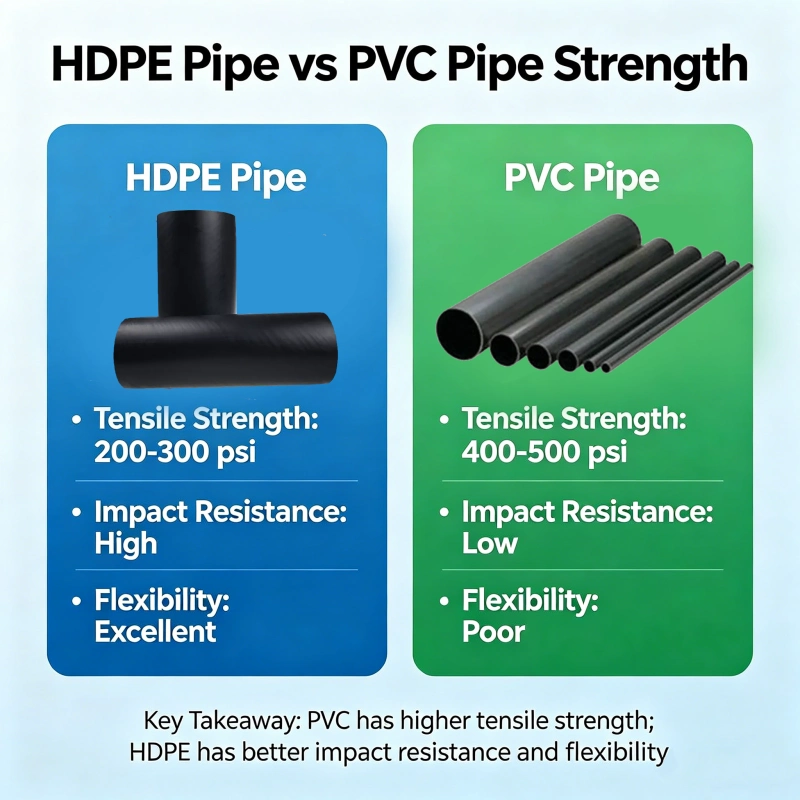
When selecting piping materials for any project—be it municipal water supply, agricultural irrigation, industrial fluid transport, or residential drainage—the question “Which pipe is stronger?” often arises. But strength isn’t just about how much weight a pipe can bear before breaking. True strength in piping systems encompasses tensile resistance, impact toughness, flexibility under stress, long-term durability, joint integrity, and performance under real-world conditions like temperature swings, ground movement, or chemical exposure.
This comprehensive guide comparison between HDPE (High-Density Polyethylene) and PVC (Polyvinyl Chloride) pipes—specifically focusing on strength-related properties as defined by ASTM, ISO, and real-world engineering data up to 2026. We’ll analyze their mechanical behaviors, failure modes, installation implications, and suitability across applications—so you can make the right choice for your next project.
And if you’re sourcing high-performance HDPE or PVCpiping systems, you’ll also discover why manufacturers like Shandong Haili Pipeline Technology Co., Ltd. have become trusted partners for infrastructure projects across Asia and beyond.
Understanding What “Strength” Really Means in Piping Systems
Before diving into numbers, it’s crucial to redefine “strength” in context. Unlike steel beams or concrete columns, plastic pipes rarely fail from pure compression. Instead, they face complex stresses:
Internal pressure (from fluids or gases)
External loads (soil, traffic, buildings)
Impact forces (during handling or backfilling)
Thermal expansion/contraction
Chemical degradation
Cyclic fatigue (from repeated stress)
Therefore, evaluating pipe strength requires looking at multiple mechanical properties:
| Property | What It Measures | Why It Matters |
|---|---|---|
| Tensile Strength | Maximum stress before breaking under pull | Indicates material integrity under tension (e.g., during pulling-in installation) |
| Impact Resistance | Energy absorbed before fracture (Izod/Charpy test) | Critical for cold climates or rocky soils where pipes get struck |
| Flexural Modulus | Stiffness (resistance to bending) | Affects deflection under load; too stiff = brittle, too flexible = buckling |
| Hydrostatic Design Basis (HDB) | Long-term pressure rating at 73°F (23°C) | Determines pressure class (e.g., DR11, Schedule 40) |
| Slow Crack Growth Resistance | Resistance to crack propagation over time | Predicts lifespan under constant stress (especially for PE) |
Now, let’s compare HDPE and PVC across these dimensions—and see how leading manufacturers ensure these properties translate into real-world reliability.
Material Composition: The Root of Their Differences
HDPE (High-Density Polyethylene)
Structure: Semi-crystalline thermoplastic with high molecular weight.
Key Traits: Flexible, ductile, excellent chemical resistance, no plasticizers.
Common Grades: PE80, PE100, PE100-RC (Resistant to Crack).
Joining Method: Heat fusion (butt, electrofusion)—creates monolithic, leak-free joints.
PVC (Polyvinyl Chloride – Specifically PVC-U or Rigid PVC)
Structure: Amorphous thermoplastic, rigid due to lack of plasticizers (in PVC-U).
Key Traits: Hard, brittle at low temps, good chemical resistance (except to some solvents), lower cost.
Common Standards: ASTM D1785 (pressure), ASTM D2665 (drain-waste-vent).
Joining Method: Solvent cement (glue) or gasketed push-fit—mechanical joints.
Key Insight: HDPE’s molecular structure allows it to deform without breaking, while PVC tends to crack suddenly once its elastic limit is exceeded. This fundamental difference shapes their entire performance profile.
Manufacturers who understand this distinction don’t just produce pipes—they engineer systems. Take Shandong Haili Pipeline Technology, for example. Since 2013, Haili has focused exclusively on urban infrastructure piping, investing $65 million in a 10,000 m² facility equipped with 24+ advanced production lines. Their portfolio includes not only standard HDPE and PVC-U water pipes but also specialized solutions like PE gas pipes, MPP electrical conduits, and steel-reinforced drainage systems—all developed with material science and field performance in mind.
Direct Strength Comparison: HDPE vs PVC (Technical Data)
Below is a side-by-side comparison based on ASTM/ISO test standards and manufacturer data (2025–2026):
| Property | HDPE (PE100) | PVC-U | Winner? | Practical Implication |
|---|---|---|---|---|
| Tensile Strength (MPa) | 20–30 | 40–60 | PVC | PVC appears stronger in lab pull tests—but this doesn’t reflect real-world behavior. |
| Elongation at Break (%) | 350–600% | 40–80% | HDPE | HDPE stretches dramatically before failing; PVC snaps abruptly. |
| Impact Strength (Notched Izod, J/m) | 600–900 (at 23°C) Still >300 at -20°C | 200–300 (at 23°C) Drops to <50 at -10°C | HDPE | HDPE remains tough in freezing conditions; PVC becomes dangerously brittle. |
| Flexural Modulus (GPa) | 0.8–1.0 | 2.4–4.0 | PVC (stiffer) | PVC resists bending better—but that stiffness increases risk of cracking under point loads. |
| Hydrostatic Design Basis (HDB) | 1,000 psi (PE100) | 4,000 psi (for pressure-rated PVC) | PVC | For high-pressure water mains, PVC can use thinner walls—but only if temperature stays below 60°C. |
| Max Continuous Temp | 60°C (140°F) | 60°C (140°F) | Tie | Both degrade above this. However, PVC softens faster near limit. |
| Min Service Temp | -60°C (-76°F) | -10°C (14°F) | HDPE | HDPE is safe in Arctic conditions; PVC risks shattering. |
| Joint Strength | 100% of pipe body (fused) | 60–80% of pipe (cemented) | HDPE | Fused HDPE has no weak points; glued PVC joints are common failure sites. |
Critical Note: While PVC shows higher tensile strength on paper, HDPE’s ductility makes it far more resilient in dynamic environments—like earthquake zones, frost-heaving soils, or areas with heavy machinery vibration.
Companies like Haili recognize this nuance. Their R&D center—certified as a national-level CNAS laboratory—doesn’t just replicate industry standards; it pushes beyond them. With a team of international experts and over 32 patents, Haili develops HDPE formulations with enhanced slow crack growth resistance and PVC compounds optimized for impact toughness in moderate climates. This is engineering, not just manufacturing.
Real-World Performance: Where Each Pipe Excels (and Fails)
✅ HDPE Shines In:
Trenchless installations (directional drilling): Its flexibility allows snaking through curved bores.
Seismic or unstable soils: Bends without breaking during ground shifts.
Cold climates: No risk of winter cracking during backfill or operation.
Corrosive environments: Resists acids, alkalis, and salts that degrade metal or concrete.
Long-distance pipelines: Fewer joints = fewer leak points over miles.
Case Study (2025, Alberta, Canada): A 12-km rural water line replaced aging cast iron with HDPE. Despite -35°C winter temps and rocky terrain, zero breaks occurred in first 18 months—whereas a parallel PVC section (installed for comparison) suffered 3 joint failures due to frost heave.
In China, similar logic drives municipal choices. Haili’s PE water and gas pipes are now deployed in rainwater harvesting networks, reclaimed water systems, and natural gas distribution across dozens of smart cities—precisely because they perform reliably under variable soil and climate conditions.
✅ PVC Dominates In:
Indoor DWV (Drain-Waste-Vent) systems: Smooth interior, low cost, easy glue joints.
Short-run pressurized water lines (within buildings): Where temperature is controlled.
Budget-sensitive municipal projects: Lower material cost per foot.
Vertical stacks: Stiffness prevents sagging over height.
Haili also produces high-quality PVC-U water supply pipes for these exact applications—ensuring dimensional accuracy, smooth bore finish, and compliance with potable water standards (NSF/ANSI 61 equivalent). Their approach? Use only premium resin and strict process control so that even “standard” PVC meets elevated expectations.
Case Study (2026, Florida Subdivision): PVC was chosen for 500 homes’ internal plumbing due to fast glue assembly and compatibility with existing fixtures. No issues reported after 1 year—thanks to stable temps and minimal ground movement.
❌ Where They Struggle:
HDPE: Not ideal for high-temp hot water (>60°C). Can creep under constant high load (requires proper bedding).
PVC: Avoid in areas with freeze-thaw cycles, rocky backfill, or seismic activity. UV exposure degrades surface unless protected.
Common Misconceptions About HDPE and PVC Strength (Debunked)
When it comes to plastic piping, assumptions often override facts—especially around strength. Let’s clear up three of the most persistent myths that lead engineers and contractors astray:
Myth #1: “PVC is stronger because it’s rigid.”
Reality: Rigidity ≠ strength in buried applications. While PVC has higher tensile strength on paper, it’s brittle. Under soil settlement, frost heave, or impact, it cracks without warning. HDPE, by contrast, yields and redistributes stress—making it far more resilient in dynamic environments. Think of it like comparing glass (PVC) to rubber (HDPE): one shatters, the other bounces back.
Myth #2: “HDPE pipes can’t handle high pressure.”
Reality: Modern PE100 and PE100-RC HDPE pipes meet or exceed pressure requirements for water and gas distribution (up to 16 bar in some DR classes). Their fused joints—100% as strong as the pipe body—eliminate the weak points that plague mechanical or glued connections.
Myth #3: “All HDPE or PVC pipes perform the same if they meet ASTM standards.”
Reality: Standards set minimums, not maximums. Raw material quality, extrusion control, and additive packages vary widely. A pipe made from recycled content may pass basic tests but fail prematurely under slow crack growth.
At Shandong Haili, our field engineers regularly encounter clients who assume rigid pipes are “stronger.” But as our 32-patent R&D team confirms through accelerated aging and field monitoring: ductility often outperforms rigidity in real-world buried infrastructure. That’s why we source only virgin-grade PE100 resin and enforce tighter internal specs than required by ISO 4427.
How Temperature Affects HDPE and PVC Performance
Temperature dramatically influences how HDPE and PVC behave—especially in extreme climates. While both materials are rated for continuous use up to 60°C (140°F), their performance diverges sharply at temperature extremes.
Below is a simplified comparison of impact strength (notched Izod) across temperatures—a key indicator of toughness:
| Temperature | HDPE (PE100) Impact Strength | PVC-U Impact Strength |
|---|---|---|
| 23°C (73°F) | 850 J/m | 250 J/m |
| 0°C (32°F) | 720 J/m | 120 J/m |
| -10°C (14°F) | 580 J/m | <50 J/m (brittle) |
| -30°C (-22°F) | 410 J/m | Fractures on impact |
As the table shows, PVC becomes dangerously brittle below freezing, making it unsuitable for cold regions unless heavily insulated. HDPE, however, retains usable toughness even below -30°C—critical for winter installations or arctic infrastructure.
Thermal expansion is another factor: HDPE expands about 10 times more than PVC per degree Celsius. While this requires proper loop design or expansion joints in above-ground runs, it actually helps underground pipes accommodate ground movement without cracking.
Haili’s CNAS-certified laboratory tests every production batch across -40°C to 60°C—ensuring our PE100 pipes maintain >80% of room-temperature impact strength even in northern China’s harsh winters. For PVC-U lines, we recommend them only in controlled, non-freezing environments and always with UV protection during storage.
Installation & Handling: Strength Beyond the Lab
How a pipe behaves on-site matters more than lab specs.
| Factor | HDPE | PVC |
|---|---|---|
| Weight | Lighter (0.95 g/cm³ density) | Heavier (1.4 g/cm³) |
| Cutting/Fitting | Requires fusion equipment (training needed) | Simple saw + glue (DIY-friendly) |
| Handling Damage Risk | Very low—can be dropped, bent, coiled | High—chips or cracks easily if mishandled |
| Backfill Sensitivity | Tolerant of imperfect bedding due to flexibility | Requires careful compaction; sharp rocks cause stress cracks |
| Joint Reliability | Near-perfect if fused correctly | Highly dependent on surface prep, glue quality, curing time |
Field Reality: A 2024 study by the Plastic Pipe Institute found that 70% of PVC pipe failures in buried applications originated at joints, whereas HDPE failures were almost always due to external damage (e.g., excavation strikes)—not material weakness.
That’s why forward-looking suppliers go beyond selling pipe. Haili, for instance, offers underground pipeline network design support and technical guidance on fusion parameters or bedding requirements—ensuring the system performs as engineered, not just as shipped.
Long-Term Durability & Lifecycle Cost
Strength isn’t just initial—it’s how performance holds up over decades.
| Metric | HDPE | PVC |
|---|---|---|
| Design Life | 50–100+ years (tested via ASTM D2837) | 50–75 years (but joint degradation accelerates failure) |
| Chemical Resistance | Excellent against acids, bases, salts | Good, but attacked by hydrocarbons, ketones, some solvents |
| UV Resistance | Poor (requires carbon black or coating) | Moderate (degrades slowly; usually stored indoors) |
| Recyclability | Fully recyclable (#2 resin) | Recyclable but less infrastructure (#3 resin) |
| Total Cost of Ownership | Higher upfront, lower maintenance | Lower upfront, potential repair costs |
Cost Example (2026, 6-inch Diameter, 1,000 ft Run):
HDPE: $8,500 material + $3,000 fusion labor = $11,500
PVC: $6,200 material + $1,800 glue labor = $8,000
But if PVC requires 2 repairs over 20 years ($2,500 each), HDPE becomes cheaper long-term.
Manufacturers committed to sustainability—like Haili, which positions itself as a producer of energy-saving and environmentally friendly infrastructure products—design for longevity. Their glass fiber-reinforced SMC inspection chambers and domestic septic tanks, for example, complement their pipe systems to create fully integrated, leak-resistant underground networks that reduce water loss and maintenance burden.
Environmental & Safety Considerations
HDPE: Non-toxic, used in potable water and food-grade applications. No chlorine content.
PVC: Contains chlorine; when burned (e.g., in fires), can release dioxins. Not recommended for potable water in some regions unless certified (NSF/ANSI 61).
Sustainability Edge: HDPE’s flexibility reduces need for fittings (less material), and its leak-free joints conserve water—a growing priority in drought-prone areas.
Haili’s dedication to eco-friendly innovation is reflected in its status as a national high-tech enterprise, blending self-developed technology with global best practices to minimize environmental impact without sacrificing performance.
When to Choose HDPE Over PVC (Decision Flowchart)
Ask yourself:
Will temperatures drop below 0°C (32°F)? → Choose HDPE
Is the soil rocky, expansive, or seismic? → Choose HDPE
Is this a long-distance or trenchless install? → Choose HDPE
Do you need maximum joint reliability? → Choose HDPE
Is budget extremely tight and conditions mild? → PVC may suffice
Rule of Thumb:
Use HDPE for buried, outdoor, or critical infrastructure.
Use PVC for indoor, non-freezing, short-run applications.
And when you’re ready to source, consider partners who offer more than catalog items. Shandong Haili Pipeline Technology—with its integrated capabilities in R&D, manufacturing, and technical service—has built the “Haili Pipe” brand into a symbol of premium pipeline integrity in China. Whether you need standard PE100 water pipe or custom MPP conduit for high-voltage cable protection, their focus on urban infrastructure ensures every product is engineered for real-world demands.
Conclusion: Strength Is Contextual—Choose Wisely
In the battle of HDPE vs PVC pipe strength, there’s no universal winner. PVC wins on stiffness and short-term tensile numbers—but HDPE dominates in toughness, flexibility, joint integrity, and real-world resilience.
For engineers and contractors in 2026, the trend is clear: HDPE is becoming the default for demanding applications, while PVC remains viable for controlled, low-risk environments. The key is matching material behavior to site conditions—not just comparing spec sheets.
By understanding the true nature of strength—ductility over brittleness, system integrity over isolated metrics—you’ll avoid costly failures and build piping systems that last generations.
And when it comes to turning that understanding into reliable infrastructure, companies like Haili—with their blend of innovation, scale, and customer-centric service—offer more than pipes. They offer peace of mind. Please contact us to obtain our product catalog.
Final Tip: Always consult local codes and manufacturer guidelines. New HDPE grades like PE100-RC offer even better slow crack growth resistance—worth specifying for high-stakes projects. And if you’re evaluating suppliers, look for those with certified labs, field experience, and a portfolio that matches your application—like Haili’s comprehensive range for water, gas, drainage, and power sectors.
916.webp)
204.webp)
659.webp)
185.webp)
312.webp)
849.webp)
587.webp)
767.webp)