With the advancement of technology and the rapid growth of the petrochemical industry, plastic pipes are increasingly being used in water supply and drainage systems, replacing conventional cast iron, galvanized, and plastic-lined steel pipes. Compared to traditional pipes, plastic pipes offer significant advantages such as light weight, corrosion resistance, low flow resistance, energy conservation, ease of installation, and low cost, making them a popular choice within the plumbing industry. Furthermore, significant progress and refinement in architectural design theory and construction techniques, along with extensive practical experience, have contributed to their significant importance in building water supply and drainage projects, creating an unstoppable growth trend.
1. Material Composition and Parameter Analysis of the Three Materials
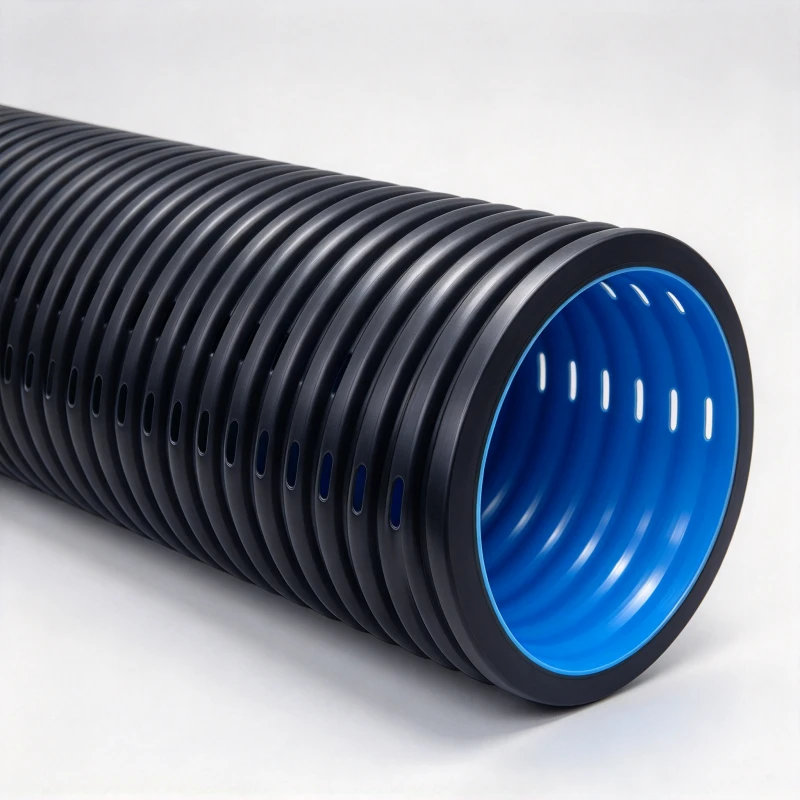
PE Pipe: Polyethylene, also known as "polythylene," is a thermoplastic resin produced by the polymerization of ethylene and exhibits excellent resistance to industrial chemicals. PE pipes and their raw materials are strictly classified based on their long-term hydrostatic strength, with five grades: PE32, PE40, PE63, PE80, and PE100. PE80 and PE100 are primarily used in water supply and natural gas systems, allowing for the production of large-diameter pipes.
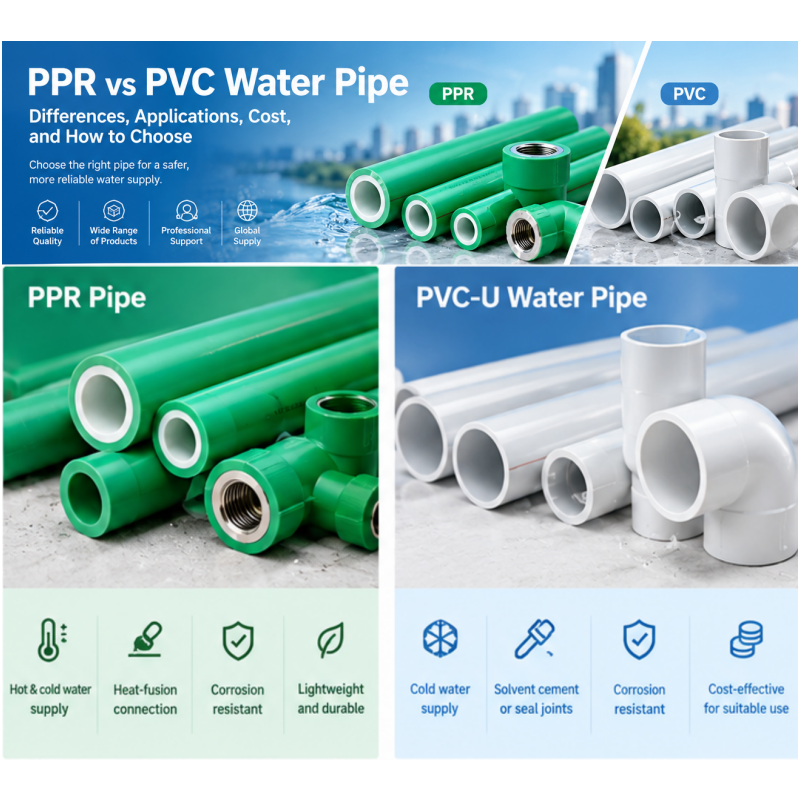
PVC pipe: PVC, the full name for "Polyvinylchloride," or PVC for short, is primarily composed of polyvinyl chloride, with other ingredients added to enhance its heat resistance, toughness, and ductility. Specifications range from De16 to De630, and are divided into three types: water supply, drainage, and conduit pipe.
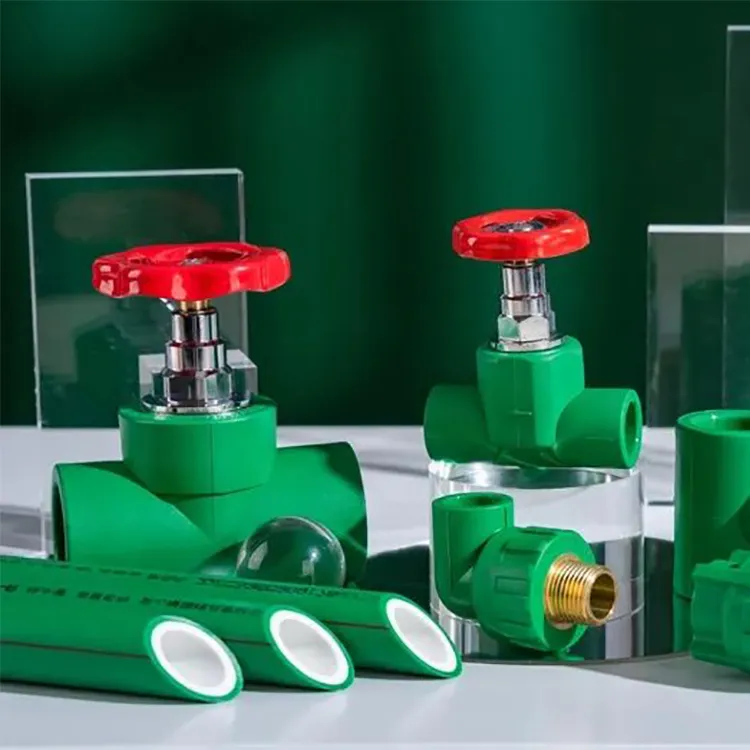
PPR pipe: The full name is Type III random polypropylene pipe. It is a copolymer (Poly Propylene Random Copolymer) formed by the polymerization of propylene monomers Propylene and ethylene monomers Ethene. It is a new energy-saving and environmentally friendly plastic product that reached international standards in the 1990s. As a new material, PPR pipe is available in specifications ranging from De20 to De110 and is used in domestic water supply, hot water, and purified drinking water projects.
2. Advantages and commonalities of the three materials
(1) Advantages of PPR water supply pipes
In addition to the characteristics of general plastic pipes, such as light weight, good strength, corrosion resistance and long service life, PP-R pipes are also non-toxic (containing only two elements, carbon and hydrogen, which will not cause any toxic side effects to the human body and are well-deserved environmentally friendly and healthy materials), rust-proof and scale-proof (with smooth inner and outer walls, strong corrosion resistance and little flow resistance to flowing liquids), heat-resistant, anti-freezing, heat-insulating, and waste can be recycled. Therefore, they can be used as hot and cold water pipes, pure water pipes and drinking water pipes, etc., and also have the following main characteristics:
① Heat-resistant, heat-insulating, and energy-saving products. The Vicat softening temperature of PP-R pipe is 131.3℃, the maximum operating temperature is 95℃, and the long-term (50 years) operating temperature is 70℃. The thermal conductivity of this product is 0.24W/m℃, which is only 1/200 of the thermal conductivity of steel pipe. It has excellent energy-saving effect when used for hot water pipe insulation.
② Easy to install and reliable. It adopts hot melt connection. A joint connection can be completed in a few seconds. It uses high-quality metal nickel-plated inserts to connect with metal pipes and water devices, which is safe and reliable.
③ Easy to recycle and use
(2) Advantages of PE water supply pipes
① PE pipe material is non-toxic, non-corrosive, and non-scaling, which can effectively improve the water quality of the pipe network; it is resistant to chemical corrosion, internal, external and microbial corrosion, has strong corrosion resistance, and is healthy; PE pipes have good resistance to water hammer pressure, and the welded joints integrated with the pipe and the PE pipe have effective resistance to underground movement and end loads, which greatly improves the safety and reliability of water supply.
② It is easy to form a closed anti-seepage system by butt welding and electric fusion welding. When laying along the trench, the amount of trench excavation and the number of accessories can be reduced.
③ Lightweight and easy to install and handle; the angle of the pipe fittings can be processed at will.
④ Strong wear resistance and excellent hydraulic properties, no outer layer protection is required for buried pipes. It is suitable for earthquake and mining area soil subsidence areas, and can also be laid at the bottom of rivers by sinking method.
⑥ Good environmental adaptability and frost resistance. It can be used for indoor and outdoor water supply pipes.
⑦ Long service life, with a service life of more than almost 50 years;
⑧ Easy to recycle.
(3) Advantages of PVC pipes
① Among general resin production, PVC resin has the lowest ethylene consumption and the lowest production cost. Domestic production of PVC requires 0.5314 tons of ethylene per ton, while the average ethylene consumption per ton of polyethylene is 1.042 tons. The domestic ethylene consumption per ton of PVC resin is about 50% less than that of polyethylene. The raw material chlorine used in the production of PVC is an important way to balance the production of chlorine with the production of caustic soda. Caustic soda is an essential and very important raw material for the national economy. In addition, from the perspective of plastic products, PVC has good compatibility with various additives, and a large amount of low-cost fillers can be added to the production pipes, which greatly reduces the production cost.
②PVC pipes have good mechanical properties and excellent corrosion resistance. They are light in weight during use, easy to install, and require no maintenance. Well-processed PVC pipes have a service life of up to 50 years. Therefore, PVC pipes are a good plastic product with low production cost, high strength, and corrosion resistance.
③Connection method - bonding, convenient and fast.
④Easy to recycle and use.
All three materials can be used in domestic water supply systems, process circulating water systems, and general water supply systems.
3. Comparison of the disadvantages of the three materials
(1) Disadvantages of PPR water supply pipes
①Few pipe specifications and accessories. The accessories and valve types are not complete, and there is a problem of inconvenience in connecting with metal doors. The largest large-size pipe is currently Dn160, and there is no larger specification. It changes greatly due to temperature.
②Rigidity and impact resistance are worse than metal pipes and are easily damaged.
③ The linear expansion coefficient of the pipe is large.
④ Poor UV resistance. Under long-term exposure to sunlight and in a UV environment, PPR pipes are prone to aging, which reduces their service life.
(2) Disadvantages of PE:
① When PE is used for hot water pipes, PERT material should be used, which belongs to the PE series modified material.
② High pressure is required for hot melt welding, and the cooling time is long.
③ It is easy to age when exposed to outdoor sunlight.
(3) Disadvantages of PVC pipes:
① Few pipe specifications and accessories. The accessories and valve types are not complete, and there is a problem of inconvenience in connecting with metal doors.
② The rigidity and impact resistance are worse than metal pipes and are easily damaged.
③ The buried connection has low compressive strength and is easy to break.
The three types of pipes mentioned above are widely used in water supply systems (fire water supply systems use steel skeleton plastic composite pipes). PPR pipes can be used for hot water pipes. Outdoor large-diameter water supply networks use PE pipes.
4. Comparison of Three Pipe Connection Methods
PE: For DN ≤ 63, use injection-molded hot-melt socket-and-spigot joints or hot-melt butt-melt joints; for DN ≥ 75, use hot-melt butt-melt joints or electric-melt socket-and-spigot joints; flanges or threaded connections are used when connecting to different materials.
PPR: Use injection-molded hot-melt socket-and-spigot joints; flanges or threaded connections are used when connecting to different materials.
PVC: Use a special adhesive for socket-and-spigot bonding; flanges or threaded connections are used when connecting to different materials.
For pipe diameters 75mm or greater, PE is preferred due to cost (higher fitting prices). Outdoor pipes generally have larger diameters, so PE is primarily used for outdoor piping.
5. Comparison of Three Pipe Aesthetics
PE is currently primarily available in black and black with a blue stripe (for UV protection). PPR is primarily available in white and gray.
PVC is primarily available in white and blue.
For aesthetic reasons, PPR or PVC pipes are preferred for indoor piping.
916.webp)
204.webp)
659.webp)
185.webp)
312.webp)
849.webp)
587.webp)
767.webp)