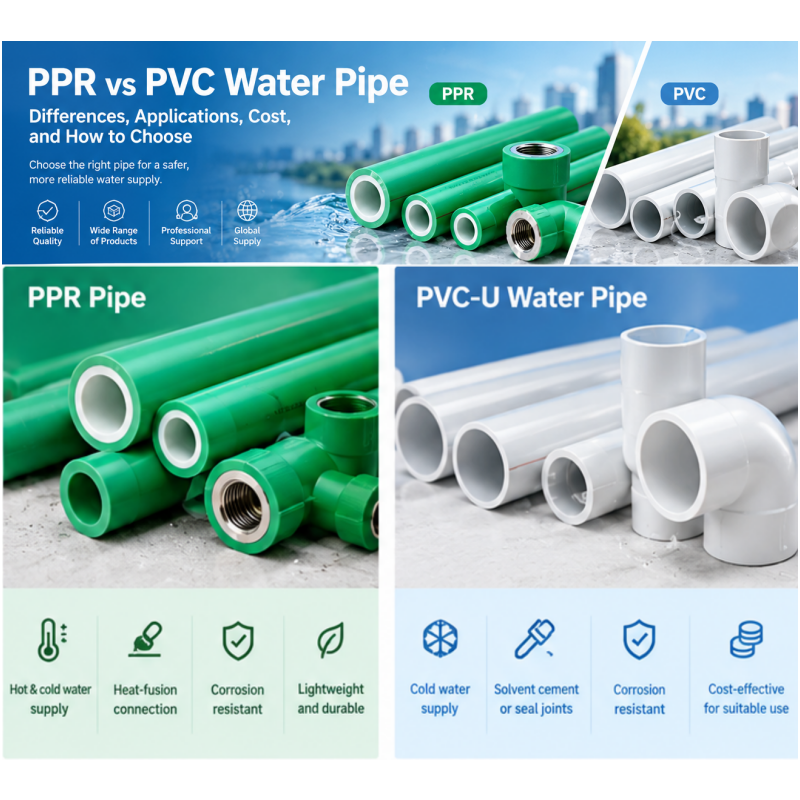
Choosing the right water pipe is essential for ensuring reliable water supply, long-term performance, and cost-effective installation. Among the most widely used plastic piping materials, PPR and PVC are popular choices for residential plumbing, commercial buildings, and water supply projects. However, they differ in temperature resistance, joining methods, mechanical properties, and typical applications.
So, when comparing PPR vs PVC water pipe, which material is better for your project?
In general, PPR pipes are commonly used for hot and cold water distribution in buildings, while PVC-U pipes are widely used for suitable cold-water supply applications. The right choice depends on operating temperature, design pressure, installation conditions, local regulations, and the technical specifications of the piping system.
In this guide, we compare PPR and PVC-U water pipes, explain their key differences, examine their costs and applications, and provide practical advice to help contractors, engineers, distributors, and project buyers select the appropriate piping solution.
PPR vs PVC Water Pipe: Key Differences at a Glance
PPR and PVC-U are both plastic piping materials used in water supply systems, but they are manufactured from different polymers and have different performance characteristics.
PPR stands for polypropylene random copolymer, a thermoplastic material commonly used in building hot and cold water systems. PVC-U stands for unplasticized polyvinyl chloride, a rigid plastic material widely used in cold-water supply and other applications specified by the relevant product standards.
The following table summarizes their main differences.
| Comparison Factor | PPR Pipe | PVC-U Water Pipe |
|---|---|---|
| Full name | Polypropylene Random Copolymer | Unplasticized Polyvinyl Chloride |
| Main applications | Building hot and cold water distribution | Cold-water supply and other specified water systems |
| Temperature performance | Available for hot-water service when designed and rated accordingly | Standard pressure PVC-U water pipes are generally intended for cold-water service |
| Pressure performance | Depends on pipe series, dimensions, temperature, and service conditions | Depends on pressure class, dimensions, temperature, and product specifications |
| Joining methods | Commonly socket heat fusion | Commonly solvent cement or elastomeric-seal joints, depending on the system |
| Material characteristics | Relatively flexible compared with rigid PVC-U; thermal expansion must be considered | Rigid, with generally lower thermal expansion than PPR |
| Installation requirements | Requires compatible fusion equipment and trained installation personnel | Requires compatible jointing materials, preparation, and installation procedures |
| Initial cost | Varies by size, pressure class, fittings, and supplier | Often competitive for suitable cold-water applications |
| Typical selection priority | Indoor hot and cold water systems | Cold-water supply systems where PVC-U is approved and suitable |
Neither material is universally better. PPR is often a strong candidate for building plumbing systems that require hot-water distribution, whereas PVC-U can be a practical choice for cold-water supply applications.
For engineering and procurement purposes, buyers should compare complete piping systems rather than evaluating the material name alone.
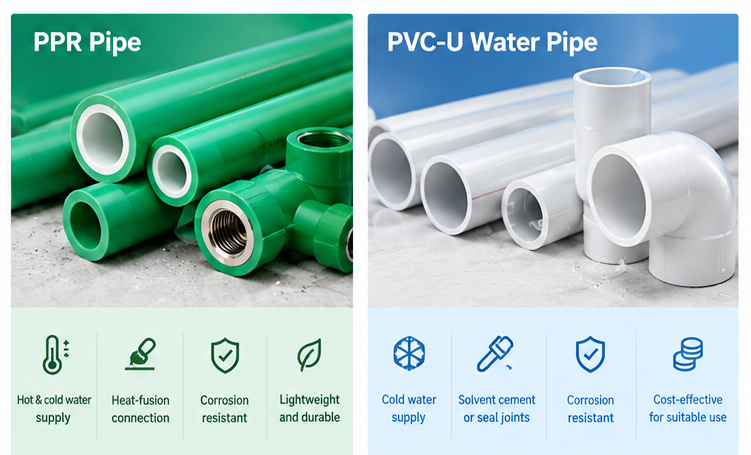
PPR and PVC-U
What Is PPR Pipe?
PPR pipe is manufactured from polypropylene random copolymer, a thermoplastic material used in a variety of water distribution systems.
PPR piping is commonly selected for residential buildings, hotels, offices, commercial properties, and other facilities requiring hot and cold water supply.
One of its main advantages is that properly specified PPR systems can serve both hot-water and cold-water applications. This makes PPR a versatile option for building plumbing projects.
Key Advantages of PPR Pipes
1. Suitable for hot and cold water systems
PPR pipes designed for the relevant service conditions can be used for hot-water distribution as well as cold-water supply. Buyers should check the specified application class, design pressure, and temperature limits.
2. Heat-fusion connections
PPR pipes are commonly joined using socket heat fusion. When performed with compatible components and the correct procedures, this method creates a fused connection between the pipe and fitting.
3. Resistance to corrosion
Unlike conventional metallic pipes, PPR does not rust. Its resistance to the transported fluid depends on the material formulation, operating conditions, and chemical compatibility.
4. Relatively lightweight construction
PPR pipes are generally easier to handle than many traditional metal piping systems, potentially simplifying transportation and installation.
5. Versatile plumbing applications
PPR is commonly used in building water distribution systems, including installations that require separate hot-water and cold-water lines.
Limitations of PPR Pipes
PPR is not automatically the best choice for every water supply project.
Its installation requires suitable fusion equipment and trained personnel. Incorrect fusion temperatures, preparation, or joining procedures can compromise connection quality.
PPR also has relatively high thermal expansion compared with rigid PVC-U. Long pipe runs may therefore require appropriate expansion allowances, supports, and installation design.
For outdoor and underground applications, project designers should evaluate the specific product's suitability rather than assuming that a PPR pipe intended for building plumbing is appropriate for every environment.
What Is PVC-U Water Pipe?
PVC-U stands for unplasticized polyvinyl chloride. It is a rigid thermoplastic material widely used in water supply, drainage, and other piping applications.
PVC-U water pipes are available in different dimensions and pressure classes, depending on the applicable product standard and intended application.
They are frequently considered for cold-water distribution, outdoor water supply, and other systems where the selected pipe specification meets the required operating conditions.
Key Advantages of PVC-U Water Pipes
1. Competitive material cost
PVC-U can offer an economical solution for suitable cold-water applications. Actual costs depend on diameter, wall thickness, pressure class, fittings, order quantity, and supplier.
2. Rigid structure
PVC-U maintains a relatively rigid shape, which can be beneficial in piping systems designed around its mechanical characteristics.
3. Established joining methods
Depending on the system design, PVC-U pipes may use solvent-cement joints or elastomeric-seal joints. The appropriate method depends on the pipe and fitting specifications, applicable standards, and installation requirements.
4. Corrosion resistance
PVC-U does not rust like steel. Its chemical resistance and suitability for a particular fluid should nevertheless be verified against the operating conditions.
5. Broad cold-water applications
PVC-U pressure pipes are commonly used in suitable water distribution projects, including certain outdoor and underground systems.
Limitations of PVC-U Water Pipes
Standard PVC-U pressure water pipes are generally intended for cold-water service. They should not be assumed to be suitable for continuous hot-water applications.
PVC-U is also relatively rigid, so designers must consider pipe routing, support, external loading, impact conditions, and connection details.
For underground installations, the performance of the complete system depends on factors such as soil conditions, bedding, backfill, installation quality, joint design, and external loads.
It is also important to distinguish PVC-U from CPVC. CPVC is chlorinated polyvinyl chloride and has different temperature capabilities and product specifications. The performance of CPVC should not be attributed to standard PVC-U pipes.
PPR vs PVC Pipe: 8 Key Differences
Understanding the main performance differences between PPR and PVC-U helps buyers select the appropriate piping system for their projects.
1. Temperature Resistance and Hot Water Performance
Temperature resistance is one of the most important differences between PPR and PVC-U water pipes.
PPR systems are widely used for building hot and cold water distribution. Products designed for hot-water service can operate under specified temperature and pressure conditions according to their application class and technical ratings.
Standard PVC-U pressure water pipes are generally used for cold-water applications. Their allowable operating conditions must be checked before use, particularly where elevated temperatures may occur.
For projects involving domestic hot water, heated water distribution, or other elevated-temperature applications, a suitably rated PPR system is often an appropriate option to evaluate.
For cold-water applications, both PPR and PVC-U may be suitable, depending on the product specification and project requirements.
Selection tip: Do not choose a pipe based on a maximum temperature figure alone. Evaluate continuous operating temperature, peak temperature, pressure, expected service life, and the applicable product standard together.
2. Pressure Rating and Operating Conditions
Both PPR and PVC-U pipes are available in different pressure specifications. However, pressure ratings cannot be compared accurately without considering the material, dimensions, wall thickness, and operating temperature.
For PPR systems, pressure performance is influenced by the pipe series, design conditions, temperature, and intended service life.
For PVC-U pressure pipes, allowable pressure depends on the specified pressure class, pipe dimensions, temperature, and applicable design requirements.
Temperature is particularly important in hot-water systems because sustained elevated temperatures can affect the allowable pressure and service life of thermoplastic pipes.
When purchasing either material, buyers should confirm:
Nominal outside diameter and wall thickness.
Pressure class or relevant pipe series.
Operating and design temperatures.
Applicable product and installation standards.
Manufacturer's pressure-temperature data and technical documentation.
A pipe with a higher nominal pressure designation is not necessarily the better option if it is unsuitable for the intended temperature or application.
3. Jointing Methods and Installation
PPR and PVC-U systems generally use different joining techniques, which can affect installation labor, equipment requirements, and connection procedures.
PPR pipe connections
PPR pipes are commonly joined using socket heat fusion. The pipe and fitting are heated with compatible equipment and joined according to the manufacturer's specified procedure.
Proper preparation, heating time, insertion depth, alignment, and cooling are essential for connection quality.
PVC-U pipe connections
PVC-U systems may use solvent-cement joints or elastomeric-seal joints, depending on the product design and application.
Solvent-cement connections require appropriate surface preparation, compatible products, and sufficient curing time. Elastomeric-seal connections require correct seal placement and proper insertion.
For project buyers, the installation method should be evaluated alongside the availability of tools, qualified installers, local labor costs, and maintenance requirements.
Neither joining method is automatically superior in every situation. The best option is the one that can be installed correctly and consistently under the project's conditions.
4. Material Strength and Flexibility
PPR and PVC-U have different mechanical characteristics.
PPR generally has more flexibility than rigid PVC-U, although its stiffness varies with pipe dimensions, formulation, and temperature. Its relatively high thermal expansion must be considered when designing long runs and hot-water installations.
PVC-U is a rigid material that can maintain its shape effectively in appropriately designed piping systems. Its performance under impact, bending, and external loading depends on the product specification and installation environment.
For underground projects, material selection should consider soil conditions, pipe stiffness where applicable, bedding, backfill, burial depth, external loads, and connection design.
For building plumbing, designers should also consider support spacing, thermal movement, and routing requirements.
The appropriate choice depends on the mechanical demands of the complete piping system rather than on a general claim that one material is always stronger.
5. Corrosion and Chemical Resistance
Both PPR and PVC-U offer resistance to corrosion, which is one reason plastic pipes are widely used in water distribution systems.
Unlike conventional steel pipes, neither material rusts through the same electrochemical process.
However, chemical compatibility is not identical for all plastic piping materials. Resistance depends on the fluid composition, concentration, temperature, exposure duration, and material formulation.
For drinking water applications, buyers should also verify that the selected pipe and fittings comply with the relevant potable-water requirements in the destination market.
For industrial fluid transportation, the chemical composition and operating conditions should be reviewed before selecting either material.
6. PPR vs PVC Pipe Cost
Cost is a major consideration for contractors, distributors, importers, and infrastructure project buyers.
PVC-U may provide a competitive initial material cost for suitable cold-water applications. PPR can be a suitable investment where hot-water distribution and the associated system requirements make it an appropriate choice.
However, there is no universal price difference that applies to all PPR and PVC-U pipes.
A meaningful cost comparison should include the following factors.
| Cost Factor | What Buyers Should Evaluate |
|---|---|
| Pipe material | Raw material, diameter, wall thickness, and specification |
| Pressure requirements | Required pressure class or pipe series |
| Fittings | Number, type, compatibility, and unit cost |
| Installation | Labor, tools, jointing time, and training |
| Transportation | Packaging, shipping volume, weight, and delivery location |
| Maintenance | Expected inspection, repair, and replacement requirements |
| Project lifecycle | Suitability for the required service conditions and expected design life |
For example, PVC-U may be a cost-effective option for a cold-water distribution project where its specifications satisfy the design requirements.
For a building that requires hot-water distribution, a suitable PPR system may be more appropriate even if the initial material cost differs.
The most economical piping solution is not necessarily the one with the lowest price per meter. It is the one that meets the technical requirements at an appropriate total installed and lifecycle cost.
7. Expected Service Life and Maintenance
Both PPR and PVC-U can provide long service when the selected system is properly designed, manufactured, installed, and operated.
However, service life cannot be determined by material name alone.
Important factors include:
Material quality and manufacturing consistency.
Operating pressure and temperature.
Fluid characteristics and environmental exposure.
Installation and jointing quality.
Support, burial, and external loading conditions.
Compliance with the relevant design and installation standards.
For PPR hot-water systems, sustained temperature and pressure are especially important when evaluating long-term performance.
For PVC-U systems, correct pressure selection, installation, joint integrity, and suitability for the service environment are essential.
Rather than assuming that all pipes have the same service life, project buyers should request relevant technical data and verify the design assumptions for the intended application.
8. Drinking Water Suitability and Standards
When selecting pipes for potable water supply, material type alone is not enough to establish compliance.
The pipe, fittings, seals, and any other components in contact with drinking water must meet the applicable requirements of the destination market and project specification.
Relevant international standards include ISO 15874 for polypropylene piping systems used for hot and cold water installations and ISO 1452 for plastics piping systems for water supply and related pressure applications made from PVC-U.
The applicable edition, scope, national adoption, and product requirements should be verified for each project.
Depending on the market, buyers may also need specific potable-water approvals, third-party test reports, conformity documentation, or other regulatory evidence.
When requesting a quotation, clearly identify the required standard, dimensions, pressure class, intended application, and destination country. This helps the supplier determine whether its available products meet the project's requirements.
PPR vs PVC: Which Pipe Is Better for Different Applications?
The best piping material depends on the application. A pipe suitable for indoor hot-water distribution may not be the best choice for an outdoor municipal water network.
The following scenarios can help narrow down the options.
Residential Hot and Cold Water Supply
For residential plumbing systems that require both hot and cold water distribution, PPR is a common option because suitable systems can serve both applications.
Buyers should evaluate the required temperature class, pressure conditions, fittings, installation method, and local building regulations.
PVC-U may be suitable for specified cold-water applications, but standard PVC-U pressure pipes should not be selected for hot-water distribution without explicit confirmation that the product is approved for the intended conditions.
Commercial Building Plumbing
Hotels, office buildings, schools, hospitals, and commercial properties may have complex water distribution requirements.
PPR can be considered for suitable hot and cold water systems, while PVC-U may be suitable for specified cold-water lines and other approved applications.
The final choice should account for system layout, operating pressure, temperature, maintenance access, fire and building regulations, and the compatibility of all components.
Municipal and Outdoor Water Supply
For outdoor and municipal water supply projects, PVC-U may be an appropriate option where the specified product meets the pressure, installation, and environmental requirements.
PPR may be suitable for certain applications, but its suitability for a particular outdoor or buried network should be confirmed against the relevant product specifications and design conditions.
Other materials, such as HDPE, may also be worth evaluating for certain underground water supply projects.
For municipal procurement, compare not only pipe material but also joint reliability, external loading, installation conditions, required standards, and the availability of compatible fittings.
Agricultural Water Supply and Irrigation
Agricultural water supply systems require careful consideration of flow requirements, operating pressure, environmental exposure, installation method, and maintenance access.
PVC-U may be suitable for specified cold-water distribution applications. Other piping materials, including PE and HDPE, may be appropriate depending on the system design.
PPR should be considered where its technical characteristics and product approvals match the application rather than selected solely because it is a plastic pipe.
Industrial Fluid Transportation
Industrial piping projects require a more detailed assessment of fluid compatibility, operating temperature, pressure, and potential chemical exposure.
PPR and PVC-U may be suitable for certain industrial water services, but neither should be assumed to be appropriate for every industrial fluid.
Engineers should review the chemical compatibility data, pressure-temperature limitations, connection systems, applicable regulations, and relevant manufacturer documentation before finalizing the material selection.
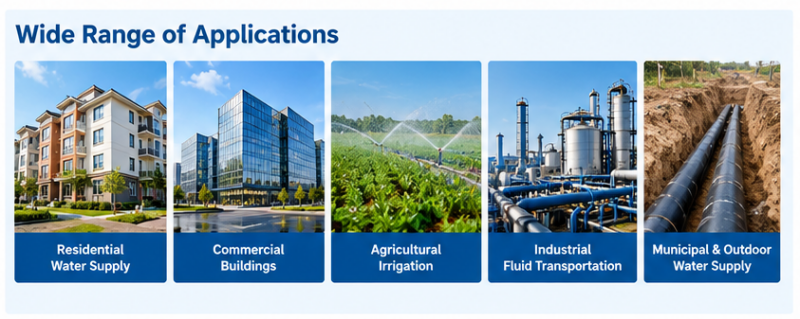
Wide Range of Applications
PPR vs PVC Pipe Cost: How to Compare Total Project Expenses
For bulk buyers, importers, wholesalers, and construction contractors, evaluating total project expenses can provide a more useful comparison than focusing on the unit price alone.
A practical comparison should include the following steps.
Step 1: Standardize the specifications.
Compare pipes with equivalent application requirements, dimensions, pressure performance, and relevant compliance requirements. Comparing products with different specifications can produce misleading cost conclusions.
Step 2: Calculate the complete material requirement.
Include straight pipes, fittings, valves where applicable, connection components, and any required accessories.
Step 3: Estimate installation expenses.
Consider the tools, labor, installation time, training, and connection procedures associated with each system.
Step 4: Include logistics and procurement conditions.
For international orders, evaluate packaging, shipping, delivery lead time, order quantity, and any other relevant procurement expenses.
Step 5: Assess lifecycle considerations.
Review expected service conditions, inspection needs, repair access, and the consequences of choosing a piping system that does not meet the project's requirements.
A structured comparison allows buyers to evaluate PPR and PVC-U more objectively and select a solution that balances technical performance and overall project cost.
How to Choose Between PPR and PVC Water Pipes
Before placing a bulk order or specifying a pipe for an engineering project, use the following checklist.
1. Identify the Fluid and Operating Temperature
Determine whether the system will transport cold water, hot water, or another fluid.
For hot-water applications, verify that the pipe system is specifically rated for the intended service conditions.
2. Confirm Design Pressure and Pipe Specifications
Establish the required diameter, wall thickness, pressure class or pipe series, operating temperature, and design requirements.
Request the manufacturer's technical documentation to verify that the proposed product meets the project specification.
3. Check Local Standards and Potable Water Requirements
Confirm the applicable product standards, building regulations, and potable-water approvals for the destination market.
Do not assume that a product's compliance with one standard automatically establishes compliance with every national or project requirement.
4. Evaluate Installation Conditions
Consider the available joining equipment, installer skills, working environment, pipeline layout, and maintenance access.
For underground projects, also evaluate bedding, backfill, external loads, burial conditions, and jointing requirements.
5. Compare Complete Procurement Costs
Request comparable quotations that clearly identify pipe dimensions, specifications, fittings, packaging, order quantity, and delivery terms.
For international procurement, confirm the quotation basis and shipping arrangements so that supplier offers can be compared consistently.
6. Assess the Manufacturer's Capabilities
A reliable pipe supplier should be able to provide clear product specifications, relevant test reports, quality documentation, and information about its manufacturing and quality-control processes.
For large projects, also consider production capacity, product consistency, delivery planning, technical support, and the availability of compatible fittings.
Following these steps can help reduce specification mismatches and improve procurement decisions.
Why Choose Haili for PPR and PVC-U Water Pipe Solutions?
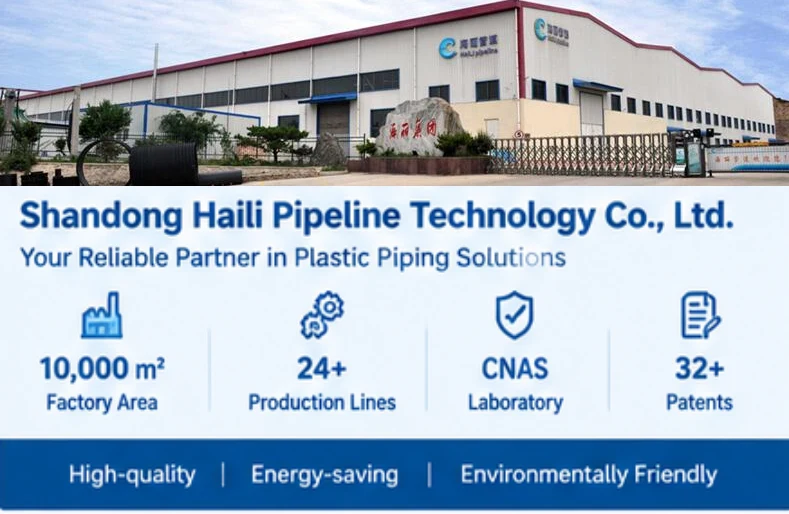
Shandong Haili Pipeline Technology Co., Ltd. was established in 2013 and focuses on the research, development, and manufacturing of plastic piping products for water supply, drainage, gas transportation, irrigation, mining, and infrastructure applications.
The company occupies an area of 10,000 square meters and has more than 24 plastic pipe production lines. Its product portfolio includes PPR pipes, PVC-U water supply pipes, PE water pipes, HDPE pipes, PE gas pipes, MPP electrical conduit pipes, pipe fittings, and other plastic piping solutions.
Haili Pipeline
Integrated Manufacturing and Technical Development
Haili integrates research and development, manufacturing, sales, and service. The company reports a technical research and development team comprising international experts, senior engineers, and other technical professionals.
Its research and development resources support ongoing product development and technical improvement across its piping portfolio.
A Broad Range of Plastic Piping Products
Different projects require different piping materials. Haili's product range allows buyers to explore PPR, PVC-U, PE, HDPE, and other piping options according to the intended application.
For building hot and cold water systems, buyers can evaluate the company's PPR pipe offerings. For suitable cold-water supply applications, PVC-U water supply pipes may be an appropriate option.
The final selection should always be based on the specific product specifications, applicable standards, and project requirements.
Quality and Product Documentation
Haili identifies quality, technical development, and customer service as important parts of its manufacturing approach. The company also reports national high-tech enterprise status, a CNAS-accredited laboratory, and more than 32 patents.
For procurement projects, buyers should confirm the scope of relevant laboratory accreditation, the validity and applicability of supporting certificates, and the technical documentation available for the specific products being considered.
These checks help establish whether a proposed piping system meets the project's quality and compliance requirements.
Support for International Procurement
For international buyers, product selection involves more than choosing between two materials. Specifications, pipe dimensions, compatible fittings, packaging, delivery arrangements, and documentation can all influence procurement decisions.
Haili's broad plastic piping portfolio provides a starting point for discussing these requirements and identifying products suited to different infrastructure and water supply applications.
Frequently Asked Questions
Is PPR better than PVC for water supply?
PPR is commonly used for hot and cold water distribution in buildings, while PVC-U is widely used for suitable cold-water supply applications. Neither is universally better. The right choice depends on operating conditions, product specifications, installation requirements, and local regulations.
Can PPR pipes replace PVC pipes?
Not in every application. PPR may be suitable for certain water supply systems, but replacing PVC-U requires checking operating pressure, temperature, dimensions, jointing methods, and applicable standards. The replacement should be approved for the intended service conditions.
Which is better for hot water, PPR or PVC?
PPR systems specifically designed and rated for hot-water service are generally suitable candidates for building hot-water distribution. Standard PVC-U pressure water pipes are generally intended for cold-water service. Always verify the manufacturer's technical specifications before making a selection.
Which is cheaper, PPR or PVC-U pipe?
PVC-U can offer a competitive initial cost for suitable cold-water applications, but actual prices depend on pipe dimensions, pressure class, fittings, order quantity, and supplier. Installation and lifecycle expenses should also be considered.
How long do PPR and PVC-U pipes last?
The service life of either material depends on operating conditions, material quality, installation, and maintenance. Buyers should refer to applicable design standards and product-specific technical documentation rather than assuming a universal service life for every pipe.
Can PPR and PVC-U pipes be connected directly?
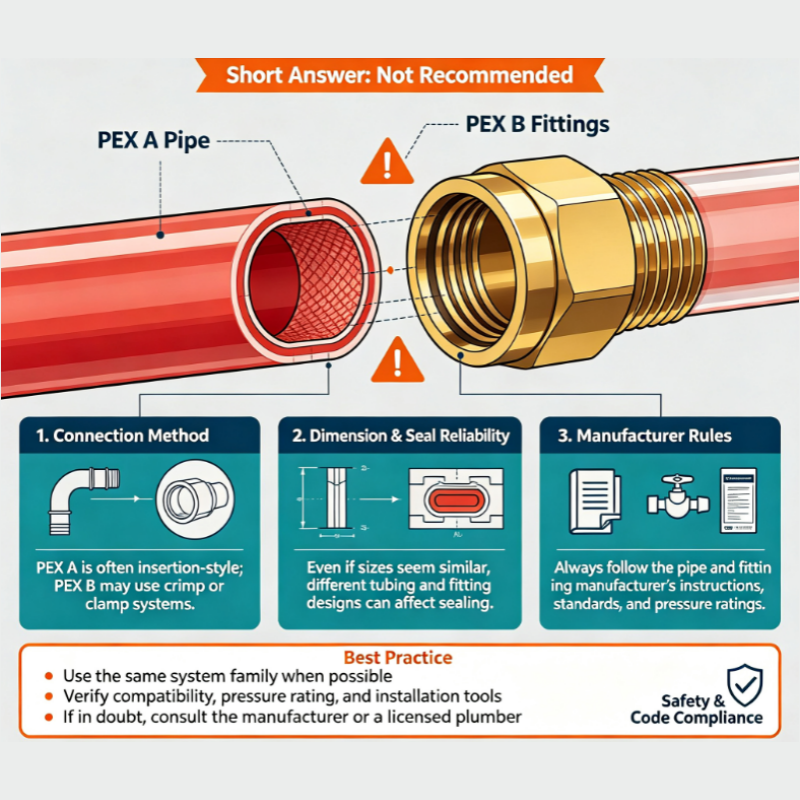
They generally use different joining methods, so direct compatibility should not be assumed. A suitable transition fitting or approved connection system should be selected according to the pipe materials, dimensions, pressure requirements, and intended service conditions.
Are PPR and PVC-U pipes suitable for drinking water?
They can be suitable for drinking water applications when the specific products and associated components meet the applicable potable-water requirements. Buyers should verify the relevant approvals, test reports, and regulatory documentation for the destination market.
What should buyers check before ordering PPR or PVC-U pipes in bulk?
Buyers should confirm the intended application, dimensions, wall thickness, pressure requirements, temperature conditions, product standards, fittings, quantity, packaging, delivery terms, and required quality documents. Clear specifications help manufacturers prepare more accurate quotations and reduce procurement misunderstandings.
Conclusion
When comparing PPR vs PVC water pipe, the most important consideration is the intended application.
PPR is commonly used for building hot and cold water distribution, while PVC-U is widely used for suitable cold-water supply systems. Their differences in temperature suitability, joining methods, mechanical characteristics, and installation requirements influence their selection and overall project costs.
For contractors, engineers, distributors, and importers, the best approach is to evaluate the complete piping system against the project's operating conditions, applicable standards, installation requirements, and procurement budget.
With its range of PPR pipes, PVC-U water supply pipes, PE products, HDPE pipes, and other plastic piping solutions, Shandong Haili Pipeline Technology Co., Ltd. supports buyers exploring piping options for water supply and infrastructure projects.
Need a suitable piping solution for your next project? Contact Haili to discuss your technical specifications and sourcing requirements.
916.webp)
204.webp)
659.webp)
185.webp)
312.webp)
849.webp)
587.webp)
767.webp)