Case Study: HDPE / PEAD Piping System for Brazilian Wastewater Treatment Plant
What is HDPE or PEAD piping system?
An HDPE or PEAD piping system is a piping solution made from high-density polyethylene and used to transport water, wastewater, gas, industrial fluids, slurry, and other suitable media. HDPE pipes are known for their flexibility, corrosion resistance, low weight, and leak-resistant fusion connections.
Engineering & Supply of DN225 PN8 SDR21 PE100 Fabricated Fittings, Electrofusion Couplers, and Butt-Welded Assemblies for a Multi-Lane Decanter Installation
Project Overview | |
Client Location | Brazil |
Industry | Wastewater Treatment / Municipal Sewage |
Application | Decanter (Clarifier) Suction & Sludge Removal System |
Pipe Material | HDPE / PEAD (Polietileno de Alta Densidade) |
Pipe Specification | DN225 PN8 SDR21 PE100, 6m Standard Length |
Connection Methods | Butt Fusion Welding, Electrofusion (EF), Flanged |
Key Components | Fabricated Elbow 45°, Side Suction A/A1, Central Suction -0.35/-1.33, Junction A/A1, Central Junction, EF Couplers, Long Stubends, Carbon Steel Flanges |
Standards | ISO 4427 | EN 12201 | ASTM D2206 | NBR 15593 | DIN 16963 | ISO 12944 C5M |
Project Scale | 6 Decanter Modules (1,080 meters of pipe, 108 EF couplers, 72 fabricated assemblies) |
Delivery Time | Engineering 2 weeks + Fabrication 6 weeks + Sea Freight 4 weeks |
1. Client Challenge: Corrosion, Complexity, and Tight Deadlines
Our Brazilian client, a leading municipal wastewater treatment operator, was upgrading six circular decanter (clarifier) basins to improve sludge removal efficiency and extend asset life. The existing metal piping system — fabricated from carbon steel with internal epoxy coating — had suffered severe corrosion after only 8 years of service due to aggressive hydrogen sulfide (H₂S) exposure and cyclic wet-dry conditions. Replacement with another metal system was ruled out because of high maintenance costs, long lead times for specialty cast fittings, and the risk of repeated corrosion failure.
The client needed a piping solution that could:
• Resist chemical corrosion and biological attack for a 50-year design life;
• Be fabricated into complex 3D geometries (45° elbows, Y-junctions, multi-level suction headers) that were not available as molded standard fittings;
• Be delivered on a 12-week overall schedule to align with the dry-season construction window;
• Comply with both international standards (ISO 4427, EN 12201) and Brazilian norms (NBR 15593, NBR 7675).
2. Solution: Turnkey HDPE / PEAD Piping System with Shop-Fabricated Assemblies
After a joint technical review of hydraulic models, structural constraints, and installation logistics, we proposed a complete HDPE (PEAD) piping system in DN225 PN8 SDR21 PE100. This specification was selected because SDR21 provides a lightweight yet pressure-rated wall for PN8 service, while PE100 resin delivers superior slow-crack growth resistance and long-term hydrostatic strength (MRS 10 MPa). The 6-meter standard pipe length optimizes transport containerization and minimizes field fusion joints.
The system was engineered as three distinct piping zones per decanter:
• Central Lane — the main suction header running through the center of the basin;
• Side Lane 1 — intermediate lateral branches;
• Side Lane — outer perimeter suction lines.
All specialty fittings were shop-fabricated using CNC-guided butt-fusion welding to ensure dimensional accuracy within ±2 mm and full-penetration joints that match the parent pipe’s pressure rating. This approach eliminated the need for on-site fabrication of complex geometries, reducing installation time by an estimated 30% and improving joint quality consistency.
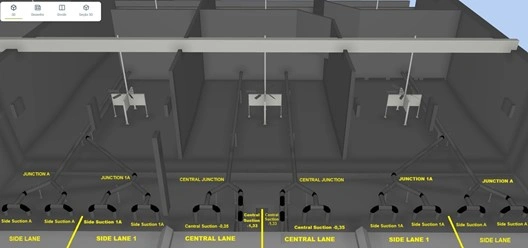
Figure 1: 3D Isometric Overview — complete HDPE piping layout for one decanter module showing Central Lane, Side Lane 1, Side Lane, and all junction/suction assemblies.
3. Technical Deep Dive: Central Lane, Suction Assemblies & Fabricated Fittings
3.1 Central Lane & Suction Headers
The Central Lane serves as the primary sludge collection manifold. It incorporates two elevation-specific suction assemblies per decanter:
• Central Suction -0.35 — designed for the shallower sludge blanket zone, using 2 elbows 90° + 1 tee + 1 elbow 45° + straight pipe sections 225mm;
• Central Suction -1.33 — designed for the deeper, denser sludge zone, using 3 elbows 90° + 1 tee + 1 elbow 45° + straight pipe sections 225mm.
The numerical suffix (-0.35 and -1.33) denotes the invert elevation relative to the decanter floor, ensuring each suction point draws from the optimal sludge concentration layer without disturbing the clarified water above.
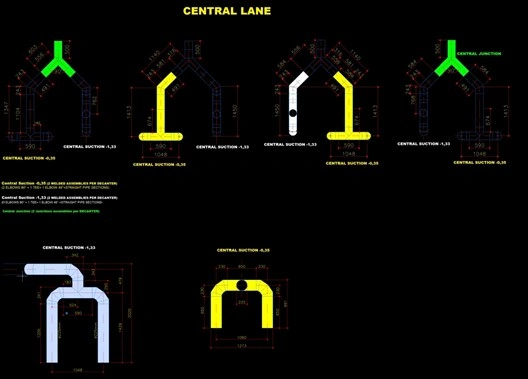
Figure 2: Central Lane Detail — dimensional drawings for Central Suction -0.35, Central Suction -1.33, and Central Junction assemblies with full callouts in millimeters.
3.2 Side Suction A & A1 Assemblies
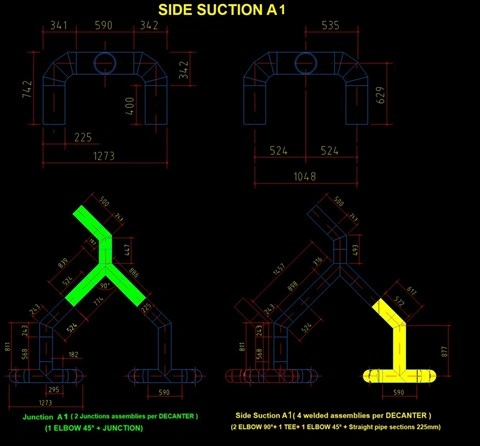
Side Suction A and Side Suction A1 are the lateral branch assemblies that distribute suction evenly across the basin floor. Each decanter requires 4 welded assemblies of each type:
• Side Suction A — 2 elbows 90° + 1 tee + 1 elbow 45° + straight pipe sections 225mm, connected via a standard Junction A (2 welded Y-junctions per decanter);
• Side Suction A1 — same component count but connected via Junction A1, which incorporates an additional 45° elbow at the Y-junction to accommodate offset inlet alignment.
The difference between A and A1 is subtle but critical: A1’s 45° elbow integration allows the lateral pipe to approach the junction at an angle, avoiding interference with structural beams and optimizing hydraulic flow distribution.
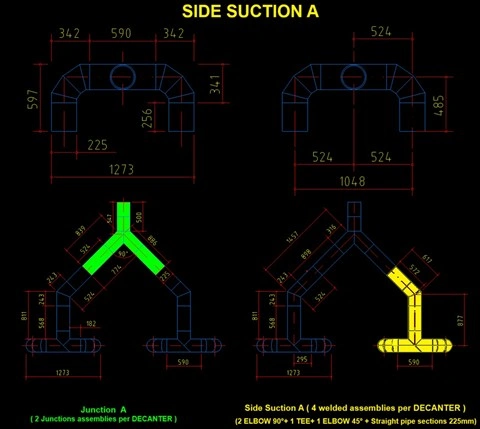
Figure 3: Side Suction A — complete welded assembly detail showing Junction A (2 per decanter) and suction header geometry with all segment dimensions.
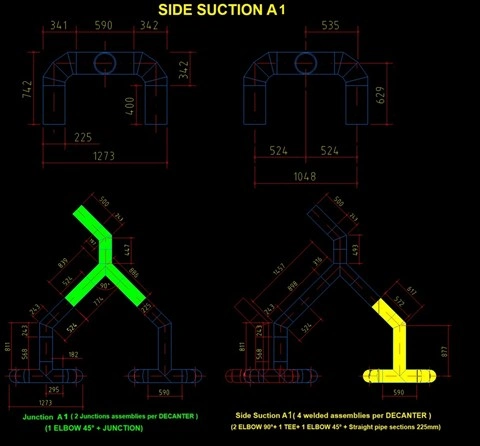
Figure 4: Side Suction A1 — note the 45° elbow integration at Junction A1, enabling angled approach piping and avoiding structural interference.
3.3 Fabricated Elbow 45° & Connection Philosophy
All directional changes in the suction headers and risers use 225mm HDPE fabricated elbow 45° segments. Unlike molded elbows — which are limited to standard angles and diameters — fabricated elbows are cut from straight DN225 pipe and butt-fused into smooth, long-radius curves. For this project, each 45° elbow assembly consists of 1 elbow 45° + straight pipe sections, with 2 assemblies required per decanter. The 45° angle was specifically chosen over 90° to reduce hydraulic losses by 50–70%, minimizing pump energy consumption and wear.
Connection methodology follows a three-tier approach:
• Butt fusion — for all straight pipe joints and shop-fabricated assemblies (monolithic, leak-free, full strength);
• Electrofusion (EF) couplers — 18 pieces per decanter for final field connections, repairs, and tight-access locations;
• Flanged joints — 6 sets per decanter using 225mm HDPE long stubends paired with carbon steel backing flanges (epoxy coating ISO 12944 320µm C5M, NBR 7675/15593, PN10) for pump and valve interfaces.
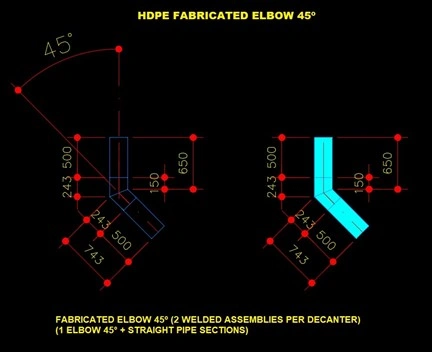
Figure 5: HDPE Fabricated Elbow 45° — fabrication drawing showing segment dimensions for DN225 SDR21 PE100 pipe, with front and side views.
4. Material List (BOM): Precision Quantification for 6 Decanter Modules
To eliminate field surprises and ensure just-in-time delivery, we prepared a detailed Bill of Materials (BOM) in both English and Portuguese, cross-referenced against the 3D isometric model and 2D floor plan. The BOM was structured into two categories: conventional fittings (commodity items) and special welded assemblies (shop-fabricated custom items).
Description / Descrição | Qty per Decanter | Total (6 Modules) | Category |
HDPE Pipe DN225 PN8 SDR21 PE100 6m / TUBO PEAD DN225 PN8 SDR21 PE100 6M | 30 | 180 | Conventional |
225mm HDPE Fabricated Elbow 45° / Curva Fabricada em PEAD 225 mm – 45° SDR 21 | 2 | 12 | Conventional |
225mm HDPE Long Stubend / Colarinho Flange NBR 15593 PEAD SDR21 225mm | 6 | 36 | Conventional |
Carbon Steel Flange ISO 12944 C5M PN10 225mm / Flanges DIN 16963 PN10 Aço SAE 1020 | 6 | 36 | Conventional |
225mm HDPE EF Coupler / Luva de Eletrofusão (EF) em PEAD 225 mm SDR17/11 | 18 | 108 | Conventional |
Side Suction A (4 welded assemblies per decanter) / Lado de Sucção A | 4 | 24 | Special Assembly |
Side Suction A1 (4 welded assemblies per decanter) / Lado de Sucção 1A | 4 | 24 | Special Assembly |
Central Suction -0.35 (2 welded assemblies per decanter) / Sucção Central -0,35 | 2 | 12 | Special Assembly |
Central Suction -1.33 (2 welded assemblies per decanter) / Sucção Central -1,33 | 2 | 12 | Special Assembly |
Junction A (2 welded assemblies per decanter) / Junção A | 2 | 12 | Special Assembly |
Junction A1 (2 welded assemblies per decanter) / Junção A1 | 2 | 12 | Special Assembly |
Central Junction (2 welded assemblies per decanter) / Junção Central | 2 | 12 | Special Assembly |
The total scope for six decanter modules reached 1,080 meters of pipe, 108 EF couplers, and 72 shop-fabricated specialty assemblies. All conventional items were sourced from ISO 4427-certified mills with full traceability certificates, while special assemblies were fabricated in our facility under ASTM D2206 quality protocols with 100% visual inspection and 10% random hydrostatic testing.
5. Floor Plan Integration: From 2D Layout to 3D Reality
The 2D floor plan served as the master reference for pipe routing, structural clearance checks, and installation sequencing. It detailed the vertical risers (HDPE long stubends connecting to the bridge-mounted pump headers), the horizontal distribution network, and the precise locations of each EF coupler and flanged joint. By overlaying the 3D isometric model onto the floor plan, our engineers identified three potential pipe-to-beam conflicts before fabrication began, saving an estimated 5 days of field rework and preventing costly shutdowns of adjacent basins.
6. Results & Benefits: Performance Beyond Expectations
After 18 months of continuous operation, the HDPE / PEAD piping system has delivered measurable benefits across four key dimensions:
• Corrosion Resistance — Zero corrosion incidents, zero coating maintenance, and no scaling compared to the previous steel system which required annual recoating and patch repairs.
• Hydraulic Efficiency — The 45° fabricated elbows and smooth butt-fusion joints reduced head loss by an estimated 15%, allowing the existing pump station to operate at lower speed and saving approximately 8% in annual energy costs.
• Installation Speed — Shop-fabricated assemblies arrived pre-assembled and color-coded (green for junctions, yellow for suction headers, blue for straight runs), enabling the contractor to install each decanter in 4 days versus an estimated 6 days for on-site fabricated metal piping.
• Total Cost of Ownership — While the initial HDPE material cost was 12% higher than coated steel, the 50-year lifecycle cost projection — factoring in zero corrosion maintenance, reduced energy, and no replacement fittings — shows a 35% net saving over the design life.
The client’s operations manager reported: “The PEAD system eliminated our biggest maintenance headache. The pre-fabricated assemblies fit perfectly on the first try, and we have not touched a wrench on the piping since startup.”
7. Conclusion: A Proven Model for Decanter Modernization
This Brazilian case study demonstrates that HDPE / PEAD piping systems — when engineered with precision-fabricated fittings, detailed 3D/2D documentation, and rigorous quality control — can outperform traditional metal systems in corrosion resistance, hydraulic efficiency, and total lifecycle cost. The combination of DN225 PN8 SDR21 PE100 pipe, shop-welded Side Suction A/A1 assemblies, Central Suction headers at multiple elevations, and a three-tier connection strategy (butt fusion + electrofusion + flanged) provides a replicable template for decanter upgrades worldwide.
Whether your project is in São Paulo, São Luís, or any global wastewater hub, our team delivers end-to-end HDPE / PEAD solutions: from hydraulic modeling and 3D isometric design, through ISO-certified fabrication, to on-site technical support and commissioning. Contact us to discuss your next decanter or clarifier piping project.
Contact us today for a free technical consultation and project-specific BOM for your HDPE / PEAD decanter piping system.
FAQ
Welcome to our comprehensive FAQ on HDPE (High-Density Polyethylene) / PEAD (Polietileno de Alta Densidade) piping systems engineered for decanter and wastewater treatment plants. Whether you are sourcing HDPE pipe DN225 PN8 SDR21 PE100, 225mm HDPE fabricated elbow 45°, electrofusion (EF) couplers, or custom butt-fusion welded assemblies such as Side Suction A, Central Suction -0.35, and Junction A1, this guide answers the most searched questions to help you specify, purchase, and install with confidence. All products comply with ISO 4427, EN 12201, and ASTM 2206 standards.
Q1: What is an HDPE / PEAD Piping System and Why Is It Preferred for Decanter Applications?
HDPE (High-Density Polyethylene) — known as PEAD in Portuguese and Spanish-speaking markets — is the material of choice for modern decanter and wastewater treatment infrastructure due to its exceptional corrosion resistance, chemical inertness, and 50+ year service life. Unlike metal pipes, HDPE does not rust, scale, or degrade when exposed to aggressive effluents, sludge, or biogas. Our HDPE pipe DN225 PN8 SDR21 PE100 6m lengths are specifically selected for large-scale decanter projects because they offer a balanced pressure rating (PN8 / 80 psi) with a Standard Dimension Ratio of 21, ensuring lightweight handling and cost-effective transport without sacrificing structural integrity.
Figure 1: 3D Isometric Overview of HDPE Piping Layout for Decanter System — showing Central Lane, Side Lane, and Junction assemblies.
Q2: What Are the Key Specifications of HDPE Pipe DN225 PN8 SDR21 PE100?
DN225 (nominal diameter 225 mm) HDPE pipes in PN8 pressure class with SDR21 and PE100 resin are among the most searched specifications in the global water and wastewater market. SDR21 means the outside diameter is 21 times the minimum wall thickness, delivering a consistent pressure rating across all diameters. PE100 indicates a Minimum Required Strength (MRS) of 10 MPa, giving the pipe superior resistance to slow-crack growth and rapid crack propagation. For decanter projects requiring 6-meter standard lengths, this specification strikes the optimal balance between flow capacity, pressure containment, and ease of butt-fusion welding on site.
Q3: What Is a 225mm HDPE Fabricated Elbow 45° and When Should It Be Used?
A 225mm HDPE fabricated elbow 45° is a custom-welded fitting manufactured from straight HDPE pipe segments cut and butt-fused together to create a smooth 45-degree directional change. Unlike molded elbows, fabricated elbows are ideal for diameters above 630 mm and for projects requiring non-standard angles or long-radius sweeps. In decanter suction layouts, the 45° elbow reduces fluid resistance by 50–70% compared to 90° elbows, minimizing turbulence, energy loss, and wear on pump systems. Our fabricated elbows comply with ASTM D2206 and ISO 4427, with each assembly traceable to its PE100 raw-material batch.
Figure 2: HDPE Fabricated Elbow 45° — detailed fabrication drawing with segment dimensions for DN225 SDR21 PE100 pipe.
Q4: What Are Side Suction A, Side Suction A1, and Central Suction Assemblies?
These are pre-engineered, butt-fusion welded HDPE assemblies designed to distribute suction evenly across a decanter basin. Side Suction A and Side Suction A1 each consist of 4 welded assemblies per decanter, typically combining 2 elbows 90°, 1 tee, 1 elbow 45°, and straight pipe sections 225mm. The difference between A and A1 lies in the junction geometry: A uses a standard Y-junction, while A1 incorporates an additional 45° elbow at the junction for offset inlet configurations. Central Suction -0.35 and Central Suction -1.33 refer to elevation-specific central suction headers — the numbers denote the invert level relative to the decanter floor. Central Suction -1.33 uses 3 elbows 90° for deeper draw-off, while -0.35 uses 2 elbows 90° for shallower suction zones. All assemblies are fabricated in-shop and delivered ready for electrofusion or butt-fusion connection to the main manifold.
Figure 3: Side Suction A — welded assembly detail showing Junction A and suction header geometry with full dimensions.
Figure 4: Side Suction A1 — note the 45° elbow integration at the junction for offset inlet alignment.
Q5: What Are Junction A, Junction A1, and Central Junction in HDPE Decanter Piping?
Junction A and Junction A1 are fabricated Y-branch fittings (also called wyes or bifurcations) that split flow from the main header into lateral suction lines. Each decanter requires 2 Junction A assemblies and 2 Junction A1 assemblies. Junction A is a straight HDPE fabricated Y 225mm, while Junction A1 adds a 45° elbow to the Y-body to accommodate angled approach pipes. The Central Junction is a specialized assembly combining a 225mm HDPE fabricated Y, one 45° elbow, and straight pipe sections, serving as the primary flow divider for the central lane. These custom fabricated fittings are manufactured using automated butt-fusion welding cells to ensure uniform bead geometry and full-penetration joints that match the parent pipe’s pressure rating.
Figure 5: Central Lane Detail — showing Central Suction -0.35, Central Suction -1.33, and Central Junction assemblies with dimensional callouts.
Q6: What Connection Methods Are Used — Butt Fusion, Electrofusion, or Flanged?
Our decanter piping systems utilize three primary connection technologies. Butt fusion welding is used for joining straight pipe lengths and fabricating large-diameter elbows, tees, and wyes; it creates a monolithic, leak-free joint with strength equal to the pipe wall. Electrofusion (EF) couplers — we supply 18 pieces per decanter in DN225 — are used for final field connections, repairs, and locations where butt-fusion equipment cannot access. For interfaces with metal valves, pumps, or concrete wall penetrations, we provide 225mm HDPE long stubends paired with carbon steel backing flanges featuring epoxy coating ISO 12944 320µm C5M (NBR 7675/15593) PN10. This flanged assembly allows easy disassembly for maintenance while protecting against corrosive environments.
Q7: How Do ISO 4427, EN 12201, and ASTM 2206 Ensure Product Quality?
ISO 4427 and EN 12201 define the dimensional, mechanical, and performance requirements for PE100 pipes and fittings used in water and wastewater pressure applications. ASTM D2206 (Standard Specification for Fabricated Fittings of Butt-Fused Polyethylene Plastic Pipe) governs the design, manufacturing, and testing of segmented welded fittings such as our 45° elbows, Y-junctions, and suction assemblies. Every batch undergoes hydrostatic pressure testing, melt-flow indexing, and visual inspection of fusion beads. Compliance with these standards ensures that our DN225 PN8 SDR21 system delivers a 50-year design life with a safety factor of 1.25, even under cyclic thermal and hydraulic loads typical of decanter operations.
Q8: Can Custom HDPE Fabricated Fittings Be Manufactured for Unique Decanter Layouts?
Absolutely. While molded HDPE fittings are limited to standard angles and diameters up to approximately 1200 mm, fabricated fittings offer unlimited customization. We can produce elbows from 11.25° to 90°, offset tees, reducing wyes, and multi-plane suction headers tailored to your decanter’s hydraulic model and structural constraints. Using CNC-guided fusion cells, we manufacture from OD50 mm up to OD1600 mm in pressure classes from PN6 to PN16. Whether your project requires a non-standard Central Suction elevation, a modified Junction A1 angle, or a specialized manifold for multi-lane decanters, our engineering team can deliver shop drawings, 3D models, and material lists (BOMs) in English, Portuguese, or Spanish within 48 hours.
Q9: What Is Included in a Typical HDPE Decanter Material List (BOM)?
A complete material list for one decanter module typically includes: 30 lengths of HDPE Pipe DN225 PN8 SDR21 PE100 6m (180 meters total per module); 2 pieces of 225mm HDPE fabricated elbow 45°; 6 pieces of 225mm HDPE long stubend; 6 sets of carbon steel flange for HDPE stub end with epoxy coating ISO 12944 320µm C5M PN10; 18 pieces of 225mm HDPE EF coupler; and the special welded assemblies: 24 Side Suction A, 24 Side Suction A1, 12 Central Suction -0.35, 12 Central Suction -1.33, 12 Junction A, 12 Junction A1, and 12 Central Junction. For a 6-decanter plant, this scales to 1,080 meters of pipe and 108 EF couplers. All quantities are verified against 3D isometric models and 2D floor plans to eliminate field surprises and reduce installation time by up to 30%.
Q10: How Do I Request a Quote for HDPE Piping for My Wastewater Treatment Project?
To receive an accurate quotation, provide the following: decanter quantity and dimensions; required pipe specification (e.g., DN225 PN8 SDR21 PE100); connection preference (butt fusion, electrofusion, or flanged); and any custom fabricated fitting requirements. Attach your P&ID, floor plan, or 3D model if available. Our team will cross-reference your needs against ISO 4427 / EN 12201 / ASTM D2206 standards, optimize the BOM for cost and lead time, and deliver a formal proposal with shop drawings, inspection certificates, and shipping options. We serve clients across Latin America, Europe, the Middle East, and Southeast Asia with PEAD solutions that meet local norms including NBR 15593 and DIN 16963.
Ready to upgrade your decanter piping system? Contact us today for engineered HDPE / PEAD solutions that last.

916.webp)
204.webp)
659.webp)
185.webp)
312.webp)
849.webp)
587.webp)
767.webp)