If you are working with PEX plumbing or looking for the right PEX pipe fittings, you may have asked:
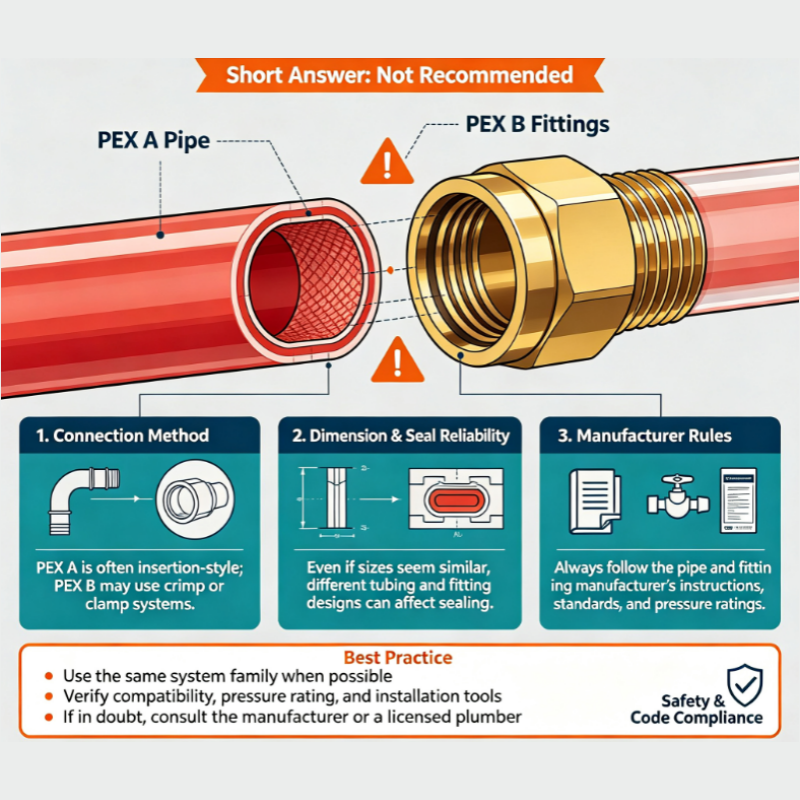
Can you use PEX B fittings on PEX A pipe?
The short answer is: in many cases, yes—but you should not determine compatibility simply by whether a product is called a “PEX-A fitting” or a “PEX-B fitting.”
PEX-A and PEX-B primarily describe different manufacturing methods for PEX tubing. Fittings, on the other hand, are usually identified by their connection method, fitting standard, dimensions, and approved pipe system.
For example, some PEX-A pipes can be connected using ASTM F1807 crimp fittings, while suitable PEX tubing can also be used with ASTM F1960 cold-expansion fittings. ASTM F1807 covers metal insert fittings for SDR9 PEX and PE-RT tubing, while ASTM F1960 covers cold-expansion fittings with PEX reinforcing rings.
Therefore, the better question is not simply:
“Can I use a PEX-B fitting on PEX-A pipe?”
Instead, ask:
“Is this specific fitting system approved for this specific PEX-A pipe?”
That distinction can help prevent leaks, installation problems, and compatibility issues.
Quick Answer: Can PEX B Fittings Be Used on PEX A Pipe?
Yes, a PEX-A pipe can often be used with fitting systems commonly used with PEX-B pipe, provided that the fitting, pipe size, connection method, applicable standard, and manufacturer instructions allow the combination.
For example, a PEX-A pipe may be compatible with a conventional crimp fitting system. The fact that a particular fitting is commonly used with PEX-B does not automatically make it incompatible with PEX-A.
However, you should never assume that all PEX fittings are interchangeable.
The following factors should be checked before installation:
PEX pipe type
Nominal pipe size
SDR/dimensional specification
Fitting type
Connection method
Applicable ASTM or other standard
Manufacturer's compatibility information
Certification and listing
Local plumbing requirements
Correct installation tools and procedures
Quick Compatibility Overview
| PEX Pipe | Fitting / Connection Type | Can It Be Used? | What to Check |
|---|---|---|---|
| PEX-A | F1960 expansion fitting | Yes, when approved | Pipe approval, ring and fitting system |
| PEX-A | F1807 crimp fitting | Often yes | Pipe specification and manufacturer approval |
| PEX-A | Stainless-steel clamp fitting | Often possible | Fitting standard and pipe compatibility |
| PEX-A | Compression fitting | Depends | Fitting design and required insert |
| PEX-A | Push-fit fitting | Depends | Product listing and manufacturer's instructions |
| PEX-B | F1807 crimp fitting | Common application | Correct size and installation |
| PEX-B | F1960 expansion fitting | Do not assume | Confirm specific pipe approval |
| PEX-A + random fitting | Unknown | Do not assume | Verify complete system compatibility |
The key takeaway is simple:
Connection standard and manufacturer approval are more important than the label “PEX-A” or “PEX-B” on the fitting.
What Is the Difference Between PEX-A and PEX-B?
Before discussing fitting compatibility, it is important to understand what PEX-A and PEX-B actually mean.
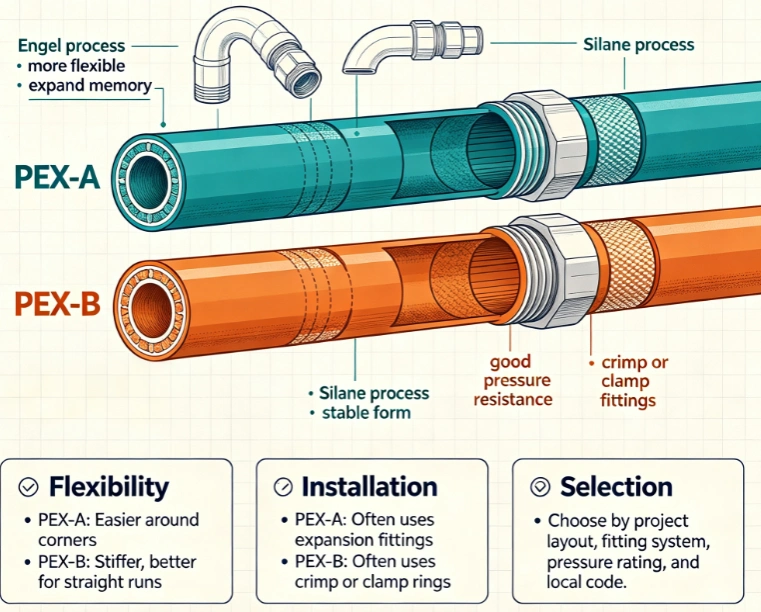
Both PEX-A and PEX-B are forms of cross-linked polyethylene tubing, but they are produced using different crosslinking processes.
The manufacturing process can influence properties such as flexibility, crosslinking characteristics, and the way the pipe behaves during installation.
One of the most important practical differences is the behavior of PEX-A during expansion.
PEX-A is commonly used with cold-expansion connection systems because suitable PEX-A tubing can expand and then recover around the fitting.
PEX-B is commonly associated with mechanical connection systems such as crimp or clamp fittings.
However, this does not mean:
PEX-A = expansion only
PEX-B = crimp only
That is an oversimplification.
The actual compatibility depends on the particular pipe and fitting system.
PEX-A vs. PEX-B at a Glance
| Feature | PEX-A | PEX-B |
|---|---|---|
| Material | Cross-linked polyethylene | Cross-linked polyethylene |
| Manufacturing method | Different crosslinking process | Different crosslinking process |
| Typical characteristics | Highly flexible; commonly used with expansion systems | Often used with mechanical crimp/clamp systems |
| Expansion connection | Common application | Do not assume compatibility |
| Crimp connection | Can be compatible with approved systems | Common application |
| Clamp connection | May be compatible | Common application |
| Fitting selection | Based on connection system | Based on connection system |
| Main compatibility consideration | Manufacturer approval + fitting standard | Manufacturer approval + fitting standard |
This is why the phrase “PEX-B fitting” can be misleading.
A fitting itself is not necessarily manufactured using the same process as PEX-B pipe. In the marketplace, people often use “PEX-B fitting” to describe a fitting system that is commonly used with PEX-B pipe.
PEX-A and PEX-B
Why PEX-A and PEX-B Fittings Are Not Simply Interchangeable
The most important concept is that PEX pipe compatibility is system-based.
A piping connection consists of more than just a pipe and a fitting.
It may include:
PEX tubing
Fitting body
Crimp ring or clamp
Expansion ring
Connection tool
Installation procedure
Each component needs to work correctly with the others.
For example, ASTM F1807 specifies metal insert fittings utilizing copper crimp rings or alternate stainless-steel clamps for SDR9 PEX and PE-RT tubing.
ASTM F1960, by contrast, covers cold-expansion fittings used with PEX reinforcing rings and qualifying PEX tubing. The current ASTM family of requirements also identifies specific nominal tubing sizes and applications.
This means that the fitting standard provides much more useful information than simply calling something a “PEX-B fitting.”
What Fittings Can Be Used With PEX-A Pipe?
PEX-A pipe can potentially be used with several different connection technologies.
The appropriate option depends on the particular product system.
1. PEX-A Expansion Fittings
Expansion fittings are one of the most recognizable connection systems associated with PEX-A.
During installation, the end of the pipe and the expansion ring are enlarged using an appropriate expansion tool. The fitting is then inserted into the expanded pipe.
The pipe contracts around the fitting and creates the connection.
ASTM F1960 covers cold-expansion fittings with PEX reinforcing rings for qualifying PEX and, in its current scope, certain PE-RT tubing systems.
Advantages
Excellent fit for suitable PEX-A systems
No copper crimp ring required
Large internal fitting diameter can be advantageous in some designs
Fast installation with the correct tools
Important consideration
Not every PEX pipe should automatically be used with every expansion system.
Always check the manufacturer's product documentation.
2. PEX Crimp Fittings
Crimp fittings are widely used in PEX plumbing.
A typical crimp connection consists of:
PEX pipe
Metal insert fitting
Copper crimp ring
Crimping tool
The ring is compressed around the pipe and fitting to create the connection.
ASTM F1807 specifically addresses metal insert fittings using copper crimp rings or alternative stainless-steel clamps for SDR9 PEX and PE-RT tubing.
Can You Use Crimp Fittings on PEX-A?
Often yes, when the specific PEX-A pipe is approved for the fitting system.
This is one of the most important answers to the original question.
A fitting commonly associated with PEX-B does not necessarily become unusable just because the pipe is PEX-A.
The correct question is whether the PEX-A pipe + fitting + ring + tool combination is an approved system.
3. Clamp or Cinch Fittings
Clamp fittings use a stainless-steel clamp to secure the fitting to the PEX pipe.
The basic installation process involves:
Positioning the fitting inside the pipe
Placing the clamp correctly
Compressing the clamp with the appropriate tool
ASTM F1807 includes alternate stainless-steel clamp configurations for the covered metal insert fittings.
Again, the pipe and fitting combination must be verified.
4. Compression Fittings
Compression fittings use mechanical compression to create a connection.
They may be useful in certain plumbing applications where a removable or mechanically secured connection is desired.
However, not every compression fitting is designed for every PEX pipe.
Some systems require an internal stiffener or insert to support the pipe wall.
Always follow the fitting manufacturer's instructions.
5. Push-Fit Fittings
Push-fit fittings allow PEX tubing to be connected without traditional crimping or expansion tools.
They can be convenient for repairs and certain installation applications.
However, convenience does not eliminate the need to verify compatibility.
The fitting must be listed or approved for the specific type and size of tubing being used.
PEX-A Fittings vs. PEX-B Fittings: What's the Real Difference?
The terms “PEX-A fitting” and “PEX-B fitting” are often used in product marketing, but they should be interpreted carefully.
A more technically useful classification is:
Expansion fitting
Crimp fitting
Clamp fitting
Compression fitting
Push-fit fitting
Comparison Table
| Factor | PEX-A Expansion System | PEX Crimp System |
|---|---|---|
| Typical connection | Cold expansion | Mechanical crimp |
| Common standard | ASTM F1960 | ASTM F1807 |
| Main components | Pipe + ring + expansion fitting | Pipe + insert fitting + crimp ring |
| Typical tool | Expansion tool | Crimp tool |
| Pipe behavior | Relies on suitable expansion/recovery characteristics | Relies on mechanical compression |
| Can be used with PEX-A? | Yes, for approved systems | Often yes |
| Can be used with PEX-B? | Must be verified | Commonly used |
| Main risk | Incorrect expansion procedure or incompatible pipe | Incorrect crimp/tool/ring or incompatible pipe |
The important point is that PEX-A and PEX-B should not be treated as two completely separate fitting ecosystems.
ASTM F1807 vs. ASTM F1960: What's the Difference?
This is one of the most valuable sections to include for SEO because users searching about PEX fitting compatibility often encounter these two standards.
F1807 vs. F1960
| Characteristic | ASTM F1807 | ASTM F1960 |
|---|---|---|
| Connection concept | Insert fitting + mechanical ring/clamp | Cold expansion |
| Typical ring | Copper crimp ring or approved stainless-steel clamp | PEX reinforcing ring |
| Typical tool | Crimping/clamping tool | Expansion tool |
| Pipe system | SDR9 PEX/PE-RT within applicable scope | Qualifying PEX/PE-RT systems within applicable scope |
| Common association | Crimp / clamp | PEX-A expansion |
| Key consideration | Correct crimp/clamp installation | Correct expansion procedure |
| Compatibility | Must be verified | Must be verified |
ASTM's F1807 specification specifically addresses metal insert fittings using copper crimp rings or alternate stainless-steel clamps for SDR9 PEX and PE-RT tubing.
ASTM F1960 addresses cold-expansion fittings with PEX reinforcing rings and specifies applicable PEX/PE-RT tubing requirements and sizes.
Can You Use F1807 Fittings on PEX-A Pipe?
In many cases, yes.
This is probably one of the most important long-tail questions related to the main keyword.
PEX-A pipe is not automatically restricted to expansion fittings.
If the specific PEX-A product is designed, listed, or approved for an F1807 crimp connection, an F1807 fitting system can be used according to the manufacturer's instructions.
Before installation, check:
| Item | What to Verify |
|---|---|
| Pipe | PEX-A and applicable specification |
| Size | Correct nominal size |
| SDR | Correct dimensional ratio |
| Fitting | Applicable F1807 product |
| Ring | Correct crimp ring |
| Tool | Correct crimp tool |
| Certification | Required product listing |
| Application | Potable water, heating, etc. |
| Local code | Applicable plumbing requirements |
The important point is:
Do not decide compatibility based solely on the phrase “F1807 fitting.” Verify the complete system.
Can You Use F1960 Fittings on PEX-B Pipe?
This question requires more caution.
F1960 is a cold-expansion fitting standard. The connection relies on expanding the tubing and then allowing it to recover around the fitting.
Therefore, you should not assume that any PEX-B tubing is suitable for an F1960 expansion connection.
Instead, check whether the particular PEX-B product is specifically approved for the intended connection system.
This is a good example of why the following rule is useful:
Never assume compatibility based only on the PEX-A or PEX-B designation.
Check the pipe manufacturer's documentation.
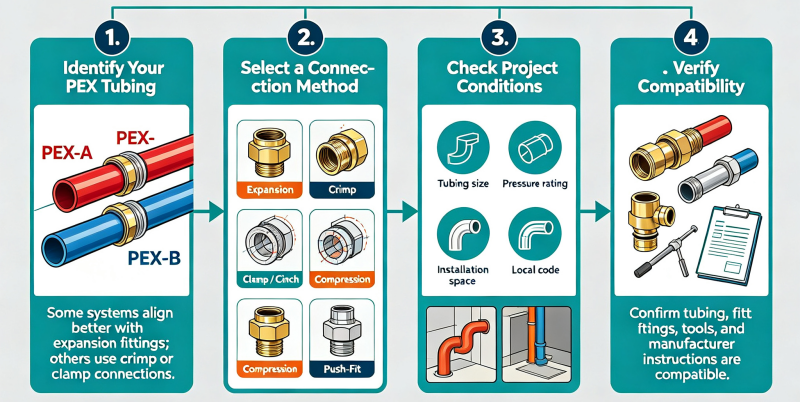
How to Determine Whether a PEX Fitting Is Compatible
If you are unsure whether a fitting can be used with PEX-A pipe, use the following process.
Step 1: Identify the Pipe
Read the markings printed on the PEX pipe.
Look for information such as:
Manufacturer
Nominal diameter
PEX classification
SDR
Applicable standard
Certification
Production information
Do not rely only on pipe color.
Step 2: Identify the Fitting
Determine exactly what type of fitting you have.
For example:
F1807 insert fitting
F1960 expansion fitting
Clamp fitting
Compression fitting
Push-fit fitting
Avoid relying on informal descriptions such as “PEX-B fitting.”
Step 3: Match the Pipe Size
The pipe and fitting must have matching dimensions.
For example:
1/2-inch PEX pipe → 1/2-inch compatible fitting
Do not assume that fittings with similar-looking dimensions are interchangeable.
Step 4: Check the Connection Standard
Look for the applicable standard or certification.
Examples include:
ASTM F1807
ASTM F1960
ASTM F2080
Other applicable fitting standards
ASTM F2080 is another cold-expansion fitting specification using metal compression sleeves for cross-linked polyethylene pipe and SDR9 PE-RT pipe.
Step 5: Check Manufacturer Compatibility
This is one of the most important steps.
If the pipe and fitting come from different manufacturers, do not assume that the combination is approved.
Look for:
Compatibility charts
Installation manuals
Technical data sheets
Product certifications
Approved fitting lists
Step 6: Check Local Plumbing Requirements
The technically compatible combination may still need to meet local regulations.
Requirements can vary depending on:
Country
State
Province
Building type
Potable water application
Heating application
Commercial vs. residential installation
Common Mistakes When Using PEX Pipe and Fittings
Mistake 1: Assuming All PEX Products Are Universal
PEX is a material family, not a guarantee that every component can be mixed.
A PEX pipe, fitting, ring, and tool must form a suitable connection system.
Mistake 2: Thinking PEX-A Only Uses Expansion Fittings
This is one of the most common misconceptions.
Some PEX-A products can be used with other approved connection systems, including crimp fittings.
The manufacturer's specifications determine the permitted connections.
Mistake 3: Thinking PEX-B Can Never Use Expansion
The opposite assumption can also be problematic.
You should not decide compatibility based on the manufacturing designation alone.
If an expansion system is being considered, verify that the particular tubing is approved for that system.
Mistake 4: Mixing Rings and Fittings Without Verification
A fitting may look compatible with a ring, but visual similarity is not enough.
The ring, fitting, pipe, and tool must be appropriate for the connection system.
Mistake 5: Using the Wrong Tool
A correct fitting can still fail if it is installed incorrectly.
For example:
Incorrect crimp tool
Incorrect crimp dimension
Incorrect expansion head
Incorrect insertion depth
Damaged pipe
Incorrect ring position
Installation quality is just as important as component selection.
PEX Fitting Compatibility Checklist
Before starting a project, you can use this checklist:
| Question | Yes/No |
|---|---|
| Do I know whether the pipe is PEX-A or PEX-B? | ☐ |
| Do I know the pipe size? | ☐ |
| Do I know the SDR/specification? | ☐ |
| Do I know the fitting connection method? | ☐ |
| Is the fitting designed for this pipe specification? | ☐ |
| Have I checked the applicable standard? | ☐ |
| Has the manufacturer confirmed compatibility? | ☐ |
| Do I have the correct installation tool? | ☐ |
| Am I using the correct ring/clamp? | ☐ |
| Does the installation comply with local requirements? | ☐ |
If you cannot answer several of these questions, it is better to verify the system before installation.
How to Choose the Right PEX Fitting for Your Project
The right fitting depends on more than pipe type.
Consider the following factors:
1. Application
Is the pipe being used for:
Potable water
Hot water
Hydronic heating
Radiant floor heating
Residential plumbing
Commercial plumbing
Industrial applications
Different applications can have different requirements.
2. Pipe Size
Make sure the fitting matches the pipe's nominal size and dimensional specification.
3. Connection Method
Choose between:
Expansion
Crimp
Clamp
Compression
Push-fit
based on the pipe system and project requirements.
4. Tools
If a project already has a particular tool system, it may influence fitting selection.
5. Certification
For drinking-water applications, make sure the products have the required certifications and listings for the target market.
6. Supplier Support
For larger projects, supplier technical support can be important.
A professional pipe and fitting manufacturer should be able to provide:
Product specifications
Technical drawings
Installation instructions
Material information
Certification documents
Compatibility information
Project support
Choose the Right PEX Fitting
Frequently Asked Questions About PEX-A and PEX-B Fittings
Can you use PEX B fittings on PEX A pipe?
Yes, potentially. Many fitting systems commonly used with PEX-B pipe can also be used with suitable PEX-A pipe. However, compatibility must be verified based on the specific pipe, fitting, connection method, standard, and manufacturer requirements.
Can you use crimp fittings on PEX-A?
In many cases, yes. Some PEX-A products are compatible with crimp fitting systems such as ASTM F1807. Always check the pipe manufacturer's documentation before installation.
Are PEX-A and PEX-B fittings interchangeable?
Not automatically. The terms PEX-A and PEX-B primarily describe pipe manufacturing classifications. Fittings should instead be evaluated according to their connection system, dimensions, applicable standards, and approved applications.
What fittings are best for PEX-A?
PEX-A is commonly used with expansion fittings, but suitable PEX-A products may also be compatible with crimp, clamp, compression, or push-fit systems. The correct choice depends on the specific product and application.
Can PEX-A use F1807 fittings?
Some PEX-A pipes can use F1807 fittings. Verify that the specific pipe is approved for the applicable F1807 connection system.
Can PEX-B use F1960 fittings?
Do not assume that all PEX-B tubing is compatible with F1960 expansion fittings. Confirm compatibility for the specific pipe and fitting system.
Is PEX-A better than PEX-B?
PEX-A and PEX-B have different manufacturing characteristics and may be preferred for different applications. Instead of treating one type as universally better, compare flexibility, connection method, installation requirements, cost, certification, and project requirements.
Do PEX fittings need to be the same brand as the pipe?
Not necessarily in every application, but mixing products from different manufacturers requires careful compatibility verification. Follow the manufacturers' instructions and applicable certification requirements.
Can you mix PEX-A and PEX-B pipe in the same system?
It can be possible when the connection components and system are appropriately selected. The important issue is not simply whether both pipes are PEX, but whether each connection complies with the applicable fitting and installation requirements.
PEX Pipe and Fittings: What Should Buyers Look For?
For distributors, contractors, plumbing companies, and infrastructure buyers, fitting compatibility is only one part of product selection.
When purchasing PEX pipe and fittings in bulk, consider:
| Purchasing Factor | Why It Matters |
|---|---|
| Raw material quality | Influences long-term pipe performance |
| Dimensional consistency | Important for reliable fitting connections |
| Production control | Helps maintain batch-to-batch consistency |
| Standards compliance | Supports market access and project requirements |
| Certification | Important for regulated applications |
| Fitting compatibility | Reduces installation problems |
| Product range | Makes sourcing easier |
| Technical support | Useful for project specification |
| Production capacity | Important for large orders |
| Quality control | Supports consistent product performance |
| OEM capability | Useful for distributors and brands |
| Export experience | Helps with international projects |
For B2B buyers, the best supplier is not simply the company offering the lowest unit price. Product consistency, technical documentation, quality management, production capability, and communication can all affect the total project cost.
Why Work With an Experienced PEX Pipe Manufacturer?
For a small residential repair, fitting selection may be relatively simple.
For a large construction, municipal, plumbing, irrigation, or infrastructure project, however, pipe and fitting selection can involve much more than choosing a product from a catalog.
A qualified manufacturer should be able to support customers with:
Product selection
Pipe specifications
Fitting compatibility
Technical documentation
Customized production
Quality control
Packaging
Logistics
Project consultation
After-sales support
This is especially important for international buyers who need consistent product quality and documentation across large orders.
About Haili Pipe
Shandong Haili Pipeline Technology Co., Ltd. was established in 2013 and covers an area of approximately 10,000 square meters, with a total investment of approximately 65 million dollars.
Today, Haili operates more than 24 plastic pipe production lines, enabling the company to provide a broad range of plastic pipes and pipe fittings as well as technical services including pipe material research and development and underground pipe network design.
Haili's product portfolio includes:
| Product Category | Main Products |
|---|---|
| PE Water Pipe | PE water supply pipes |
| PE Gas Pipe | PE natural gas pipes |
| PE Mine Pipe | PE mining pipes |
| PE Irrigation Pipe | PE sprinkler and irrigation pipes |
| MPP Pipe | MPP electrical conduit pipes |
| PVC-U Pipe | PVC-U water supply pipes |
| Drainage Pipe | PE steel-reinforced drainage pipes |
| Inspection Chamber | Glass-fibre-reinforced SMC moulded plastic inspection chambers |
| Septic Tank | Domestic septic tanks |
| PPR Pipe | PPR piping products |
| PEX Pipe | PEX pipes |
| Pipe Fittings | Various pipe fitting solutions |
These products are used in applications including:
Rainwater collection
Sewage discharge
Water supply
Water reuse
Natural gas transportation
Industrial fluid transportation
Mining
Urban infrastructure construction
Haili has developed into a national high-tech enterprise integrating R&D, manufacturing, sales, and service.
The company focuses on self-innovation and technology introduction and has established a technical research and development team consisting of international experts, senior engineers, master's degree holders, and undergraduate professionals.
Haili's R&D center has been named a national-level CNAS laboratory, and the company has more than 32 patents.
With a focus on pipeline products required for urban infrastructure construction, Haili selects advanced raw materials and emphasizes product quality, technical development, responsiveness, and customer service.
Looking for a PEX Pipe and Fittings Manufacturer?
Whether you need PEX pipe for plumbing, water distribution, heating applications, or other projects, choosing the right pipe and fitting system is essential.
If you are sourcing PEX pipe, PEX fittings, PPR pipe, HDPE pipe, PE pipe, or other plastic pipeline products, Haili can provide manufacturing capabilities together with technical and project support.
When evaluating a PEX supplier, consider not only the product price but also:
Product specifications
Fitting compatibility
Quality control
Production capacity
Certification
Technical support
OEM requirements
Delivery capability
Long-term supplier reliability
Shandong Haili Pipeline Technology Co., Ltd. provides a broad range of plastic pipe and fitting products for customers in infrastructure, water supply, drainage, gas transportation, irrigation, mining, and industrial applications. We offer a wide range of suitable pipes and fittings; please feel free to contact us.
For project-specific requirements, customers should confirm the required pipe specification, fitting standard, connection method, application, and local regulatory requirements before placing an order.
Conclusion
So, can you use PEX B fittings on PEX A pipe?
In many cases, yes—but the answer depends on the specific fitting system rather than simply the PEX-A or PEX-B label.
PEX-A pipe may be compatible with crimp fittings, clamp fittings, expansion fittings, and other connection systems when the specific products are designed and approved for that application.
The most important factors are:
Pipe type
Pipe size
SDR and dimensional specification
Fitting type
Connection method
Applicable standard
Manufacturer compatibility
Certification
Installation tools
Local plumbing requirements
ASTM F1807 and ASTM F1960 illustrate why connection standards are so important: F1807 addresses metal insert fittings used with crimp rings or stainless-steel clamps, while F1960 addresses cold-expansion fittings with PEX reinforcing rings.
Therefore, rather than asking whether a fitting is simply a “PEX-B fitting,” identify the fitting standard and connection method first.
The safest rule is simple: match the pipe, fitting, connection system, and installation procedure according to the manufacturer's specifications and applicable standards.
916.webp)
204.webp)
659.webp)
185.webp)
312.webp)
849.webp)
587.webp)
767.webp)