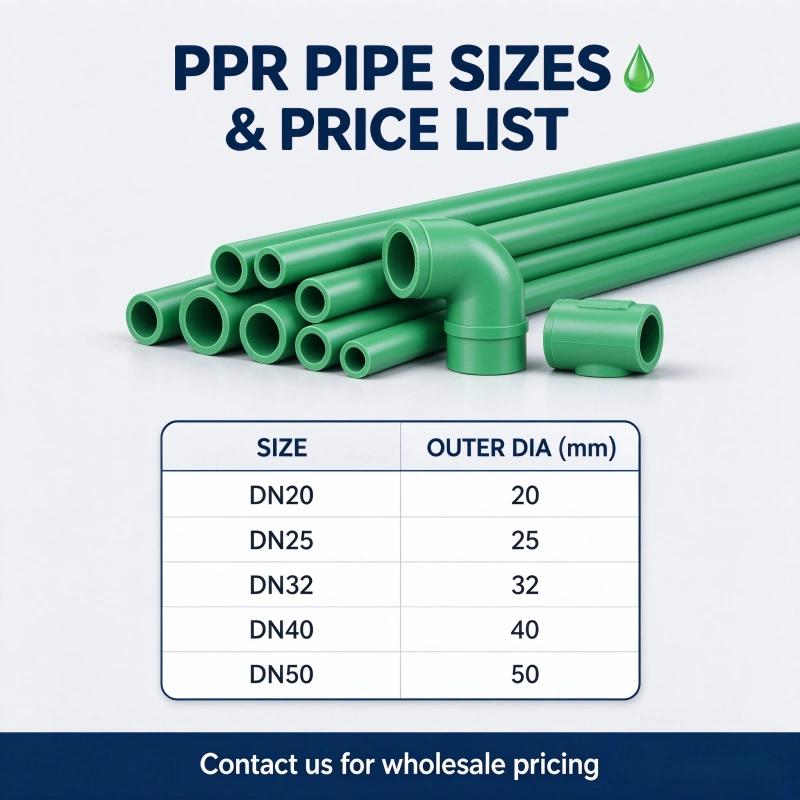
Choosing the right PPR pipe involves more than comparing prices. Buyers need to understand pipe diameter, wall thickness, pressure rating, material construction, and the relationship between size and cost. A 20 mm PPR pipe for residential plumbing, for example, has different material requirements and pricing from a 110 mm pipe designed for a larger building water-distribution system.
In this guide, we explain common PPR pipe sizes, provide a dimensional chart, present indicative wholesale price ranges in US dollars, and explain how to compare supplier quotations. Whether you are a plumbing contractor, distributor, importer, or project purchaser, this information will help you prepare a more accurate purchasing budget.
What Are the Standard PPR Pipe Sizes?
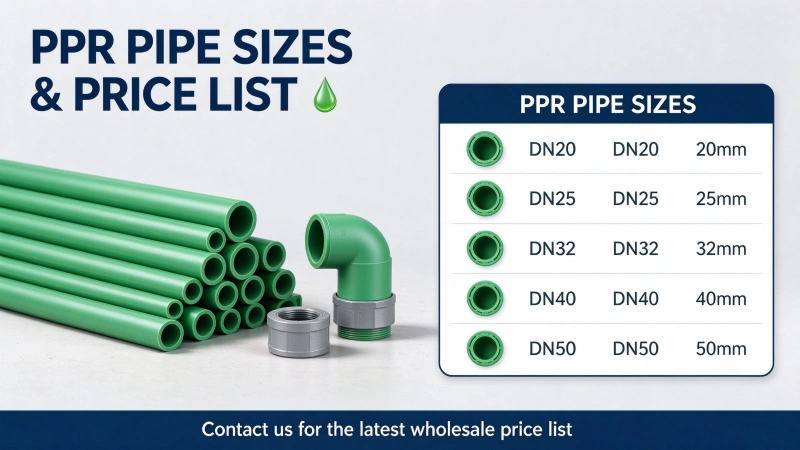
PPR pipes are generally identified by their nominal outside diameter in millimeters. Common sizes range from 20 mm to 110 mm for many building plumbing applications, while larger sizes, including 125 mm, 140 mm, and 160 mm, are available for selected commercial and industrial systems.
The most suitable size depends on water demand, flow rate, pipe length, operating pressure, and system design. For hot and cold water installations, ISO 15874 specifies requirements for polypropylene piping systems, including pipes, fittings, and service conditions. The applicable dimensional series and product specification must be checked before ordering.
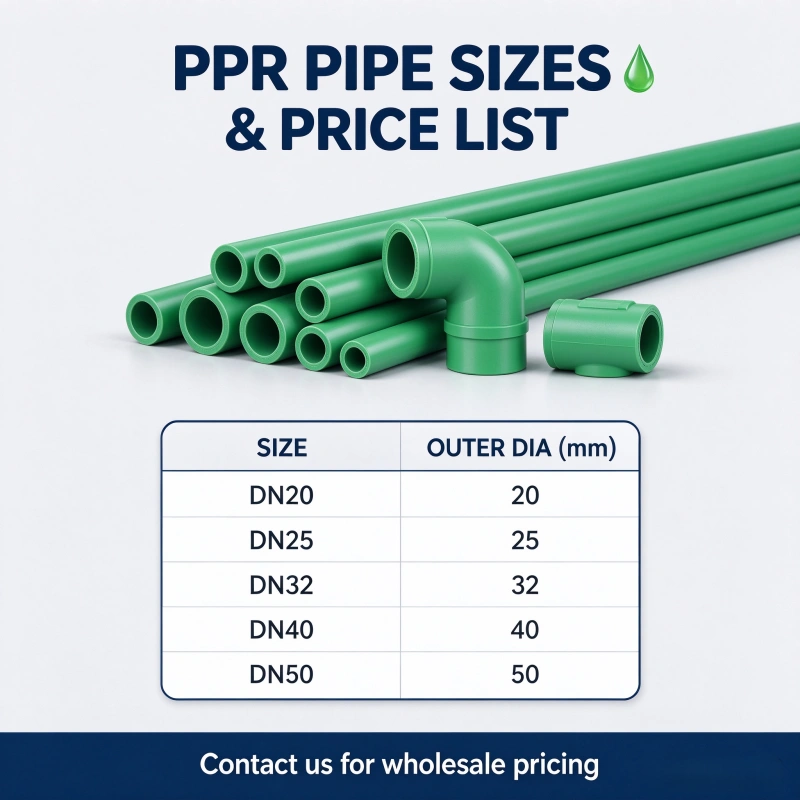
PPR Pipe Sizes Chart
The following chart lists commonly available PPR pipe diameters and their typical applications. Inch equivalents are approximate trade references rather than exact dimensional substitutions.
| PPR Pipe Size (OD) | Approximate Inch Equivalent | Typical Applications |
|---|---|---|
| 16 mm | About 3/8 inch | Small distribution lines in compatible systems |
| 20 mm | About 1/2 inch | Residential water supply and fixture branches |
| 25 mm | About 3/4 inch | Residential distribution lines |
| 32 mm | About 1 inch | Main branches and small commercial systems |
| 40 mm | About 1 1/4 inches | Building distribution and larger branches |
| 50 mm | About 1 1/2 inches | Commercial plumbing and water distribution |
| 63 mm | About 2 inches | Larger building supply lines |
| 75 mm | About 2 1/2 inches | Commercial and selected industrial systems |
| 90 mm | About 3 inches | Larger distribution pipelines |
| 110 mm | About 4 inches | Main distribution and selected large piping systems |
| 125 mm | Manufacturer-dependent | Large commercial and industrial piping |
| 140 mm | Manufacturer-dependent | Large-diameter water distribution |
| 160 mm | About 6 inches | Large commercial and industrial systems |
Note: Applications are illustrative, not engineering recommendations. Actual suitability depends on flow requirements, pressure, temperature, system design, local regulations, and the manufacturer's specifications.
For international buyers, it is particularly important to specify the outside diameter in millimeters. A nominal inch equivalent alone is insufficient to establish compatibility with another pipe system.
PPR Pipe Sizes and Wall Thickness
Pipe diameter is only one part of a PPR pipe specification. Wall thickness affects the internal diameter, material consumption, pressure capability, and final price.
The following table illustrates one commonly used PP-R dimensional series for PN20 pipe, based on an S2.5/SDR6 specification.
| Outside Diameter (mm) | Illustrative Wall Thickness (mm) | Approximate Internal Diameter (mm) |
|---|---|---|
| 20 | 3.4 | 13.2 |
| 25 | 4.2 | 16.6 |
| 32 | 5.4 | 21.2 |
| 40 | 6.7 | 26.6 |
| 50 | 8.3 | 33.4 |
| 63 | 10.5 | 42.0 |
| 75 | 12.5 | 50.0 |
| 90 | 15.0 | 60.0 |
| 110 | 18.3 | 73.4 |
The internal diameter figures are approximate values calculated by subtracting twice the wall thickness from the outside diameter.
These dimensions represent a particular dimensional series, not a universal specification for every PN20 pipe. Other series, materials, and manufacturers may use different wall thicknesses. Always confirm the applicable standard and technical datasheet before comparing products.
PPR Pipe Price List in USD
PPR pipe prices vary according to diameter, pressure class, wall thickness, raw material, construction, order quantity, and delivery terms. A universal price list cannot accurately represent every country or manufacturer.
For initial budgeting, the following table provides illustrative 2026 bulk-export price ranges for standard, single-layer PP-R pipe. The figures are broad planning estimates, informed by published 2026 sourcing guidance that reports China-origin FOB offers from approximately US$0.30 per meter for small plain PP-R pipes to US$1.50–2.00 per meter for selected 110–160 mm sizes at high-volume order quantities. These figures are not a verified item-by-item quotation from a single factory.
Indicative PPR Pipe Price List
| PPR Pipe Size | Indicative FOB Price (USD/meter) | Illustrative Cost per 4-Meter Length |
|---|---|---|
| 20–25 mm | $0.30–$0.50 | $1.20–$2.00 |
| 32–40 mm | $0.40–$0.80 | $1.60–$3.20 |
| 50–63 mm | $0.60–$1.20 | $2.40–$4.80 |
| 75–90 mm | $0.90–$1.50 | $3.60–$6.00 |
| 110–160 mm | $1.50–$2.00 | $6.00–$8.00 |
Important pricing conditions: These are indicative budget bands, not guaranteed current factory prices. The ranges group sizes together and do not represent individual SKU quotations. The cost-per-length column assumes a 4-meter pipe and is calculated from the displayed per-meter range. The reference concerns standard plain PP-R under bulk-export conditions; it does not establish the price of every pressure class, composite pipe, or large-diameter specification.
International buyers should request a current, size-by-size quotation before publishing or relying on these figures commercially. Freight, insurance, import duties, taxes, local delivery, and other destination charges are not included in an FOB factory price.
How Much Does PPR Pipe Cost per Meter?
The price per meter is a useful starting point when comparing suppliers because different manufacturers may sell pipes in different standard lengths.
For example, if a supplier quotes US$0.45 per meter for a selected 20 mm pipe, the basic material cost of 1,000 meters is:
1,000 m × US$0.45/m = US$450
This calculation excludes any separate tooling, packaging, freight, insurance, taxes, or other applicable charges.
For a project requiring several diameters, calculate the quantity and cost of each size separately before combining them into the total order value.
How Much Does a 4-Meter or 6-Meter PPR Pipe Cost?
Some manufacturers supply PPR pipes in 4-meter straight lengths, while other markets and product lines use different lengths.
The calculation is straightforward:
Price per piece = Price per meter × Pipe length in meters
For a pipe priced at US$0.50 per meter:
A 4-meter length costs US$2.00.
A 6-meter length costs US$3.00.
These are mathematical examples rather than quoted market prices. Confirm the standard length, actual unit price, and any cutting or packaging charges with the supplier.
What Factors Affect PPR Pipe Prices?
1. Pipe Diameter
Larger pipes generally use more raw material per meter. As the diameter increases, manufacturing, cooling, handling, and packaging requirements may also change.
This is why 110 mm PPR pipe normally costs more per meter than 20 mm pipe of a comparable construction and pressure specification.
2. Wall Thickness and Pressure Rating
The wall thickness required for a particular pressure class affects material consumption and pricing.
Common PP-R designations include PN10, PN16, PN20, and PN25, although actual availability and dimensional specifications vary by manufacturer and product series.
A higher nominal pressure class often requires a thicker wall for the same outside diameter. However, PN ratings should not be compared in isolation: the material grade, temperature, design life, dimensional series, and operating conditions also matter.
A PN20 marking does not mean the pipe can safely operate at 20 bar under every temperature and service condition.
3. Material Construction
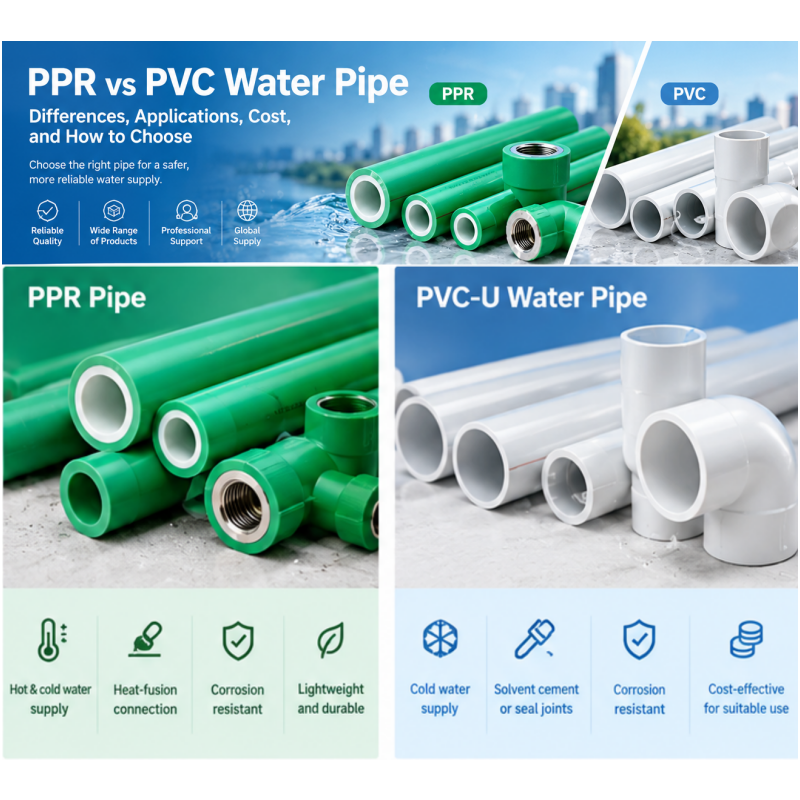
PPR pipes may be supplied as single-layer PP-R, fiber-reinforced composite pipe, or aluminum-composite pipe.
Single-layer PP-R is a common option for building hot and cold water distribution. Fiber-reinforced or aluminum-composite designs may be selected where reduced thermal expansion or other construction-specific performance is required.
Composite products may cost more than comparable single-layer pipes because of additional materials and manufacturing processes.
4. Raw Material Quality
The polymer grade, formulation, and consistency of production can influence cost and performance.
For potable-water applications, buyers should check the relevant product approval and documentation instead of assuming that every pipe labeled PP-R is automatically suitable for drinking water.
5. Order Quantity
Bulk orders may receive lower unit prices because manufacturers can plan production runs, packaging, and shipping more efficiently.
A distributor ordering tens of thousands of meters will generally need a different quotation from a contractor buying a few pipes for a repair.
Ask whether the quoted price is for a sample order, a regular wholesale order, a project order, or a full-container shipment.
6. Color, Length, and Packaging
Standard colors and standard lengths may be easier to manufacture in large quantities than customized options.
Special colors, private labeling, printed branding, customized bundles, or nonstandard lengths may affect the quotation and minimum order quantity.
7. Delivery Terms and Destination
An FOB quotation covers a different set of costs from a CIF or delivered quotation.
Before comparing prices, confirm the named port, applicable Incoterm, payment terms, loading quantity, and what each supplier includes in the price.
A low factory price is not necessarily the lowest final purchasing cost.
PPR Pipe Price by Pressure Class
The following table summarizes general price relationships between common PPR pipe classes. It is a relative guide, not a numerical price list.
| Pressure Class | General Price Relationship | Main Purchasing Consideration |
|---|---|---|
| PN10 | Often lower for a comparable size and product family | Confirm that it meets the intended operating conditions |
| PN16 | Often higher than a comparable lower-wall specification | Check dimensions and pressure-temperature requirements |
| PN20 | Depends on the specified dimensional series and construction | Frequently specified for building hot and cold water systems |
| PN25 | Often higher where a thicker wall is required | Confirm suitability for the actual design pressure and temperature |
The cost difference between pressure classes cannot be represented accurately by a single percentage across all diameters. Request quotations for the same outside diameter, material construction, length, and delivery terms to obtain a meaningful comparison.
Which PPR Pipe Size Should You Choose?
Correct pipe selection starts with the system requirement rather than the cheapest available size.
For Residential Plumbing
Sizes such as 20 mm and 25 mm are common in residential distribution systems. Larger branches or supply lines may require 32 mm or above, depending on fixture demand, flow rate, and pressure loss.
For Commercial Buildings
Hotels, offices, schools, and apartment buildings often use a combination of smaller branch pipes and larger distribution lines.
The size should be calculated using expected simultaneous demand, available pressure, pipe length, fitting losses, and system layout.
For Industrial and Larger Water Systems
PPR sizes of 50 mm, 63 mm, 75 mm, 90 mm, 110 mm, or larger may be considered in suitable systems. Actual selection depends on the transported medium, operating conditions, flow requirements, and applicable standards.
For high-demand systems, engineering calculations are more reliable than choosing a diameter based solely on the building type.
How to Compare PPR Pipe Manufacturers and Suppliers
A low price is valuable only when the product meets the project specification.
Before choosing a supplier, compare the following items:
Dimensions: Confirm outside diameter, wall thickness, tolerances, and standard pipe length.
Material: Verify the PP-R grade and whether the product is single-layer or composite.
Pressure and temperature: Check the complete operating specification.
Standards: Confirm the relevant standard, such as ISO 15874 where applicable, and any market-specific requirements.
Quality documentation: Request applicable test reports, batch information, and required product approvals.
Packaging: Check bundle quantity, labeling, and protection during transport.
Commercial terms: Compare MOQ, lead time, payment terms, FOB or CIF conditions, and shipping costs.
ISO 15874 covers polypropylene piping systems intended for hot and cold water installations and heating systems under specified operating conditions. Product conformity should be verified against the applicable parts of the standard and the actual project requirements. See the official ISO 15874-1 reference.
How to Request a PPR Pipe Price List from a Manufacturer
For distributors, contractors, and importers, an accurate quotation request should include the specifications needed to identify the correct product.
A useful request could read:
Please quote your PPR pipe range in 20 mm, 25 mm, 32 mm, 40 mm, 50 mm, and 63 mm, with the required pressure classes and wall thicknesses clearly stated. Please provide prices per meter and per standard length in USD, minimum order quantities, packing quantities, production lead times, applicable standards, and available test documentation. Please also provide FOB and CIF quotations for the specified destination port.
For a large order, include the estimated quantity of each diameter rather than only stating the total order volume.
The supplier should provide a price list that links each price to a specific product code, outside diameter, wall thickness, pressure class, and construction. This makes it easier to compare competing offers and reduce the risk of receiving a different specification from the one originally requested.
Frequently Asked Questions
What are the standard sizes of PPR pipes?
Common PPR sizes include 20, 25, 32, 40, 50, 63, 75, 90, and 110 mm. Some manufacturers also offer 16 mm and larger diameters such as 125, 140, and 160 mm. The available sizes depend on the product range and market.
What is the price of PPR pipe per meter?
The price depends on diameter, wall thickness, pressure class, construction, order quantity, and delivery terms. Indicative bulk-export estimates can help with early budgeting, but a current manufacturer quotation is necessary for an accurate purchase price.
Which PPR pipe size is used for residential plumbing?
20 mm and 25 mm pipes are common in residential plumbing, with 32 mm and larger pipes used where the system design requires higher flow capacity. The final sizes should be determined from hydraulic calculations and local requirements.
What is the difference between PN16 and PN20 PPR pipes?
They represent different nominal pressure classes, but the actual pressure capacity depends on temperature, material, dimensional series, and design conditions. Compare the complete technical specifications rather than relying on the PN label alone.
Are larger PPR pipes always more expensive?
Larger pipes generally use more raw material per meter, so they usually cost more than smaller pipes of comparable construction and pressure specification. Actual quotations can also be affected by production quantities, composite layers, and market conditions.
How do I calculate the cost of PPR pipes for a project?
Multiply the required length of each size by its quoted price per meter, then add fittings, valves, packaging, shipping, taxes, and other applicable expenses. Use the same pricing basis when comparing suppliers.
Is a factory price the same as a landed price?
No. A factory or FOB price does not necessarily include international freight, insurance, import duties, taxes, customs clearance, or delivery to the final destination. Calculate the complete landed cost before placing an international order.
Which standard applies to PPR pipes?
ISO 15874 is an important standard for polypropylene piping systems intended for hot and cold water installations and heating systems. Other standards or local regulations may also apply depending on the destination market and application.
Conclusion
Understanding PPR pipe sizes and price lists helps buyers make informed purchasing decisions, estimate project costs, and compare suppliers on a consistent basis.
The most important factors are outside diameter, wall thickness, pressure class, material construction, and the intended operating conditions. For international procurement, buyers should also consider order quantity, standard pipe length, packaging, delivery terms, and the total landed cost.
An indicative price table is useful for preliminary budgeting, but the final decision should be based on a current quotation linked to a complete technical specification. By requesting a detailed, size-by-size PPR pipe price list in USD, contractors, importers, and distributors can compare offers more accurately and select products that meet both project requirements and budget expectations.
916.webp)
204.webp)
659.webp)
185.webp)
312.webp)
849.webp)
587.webp)
767.webp)