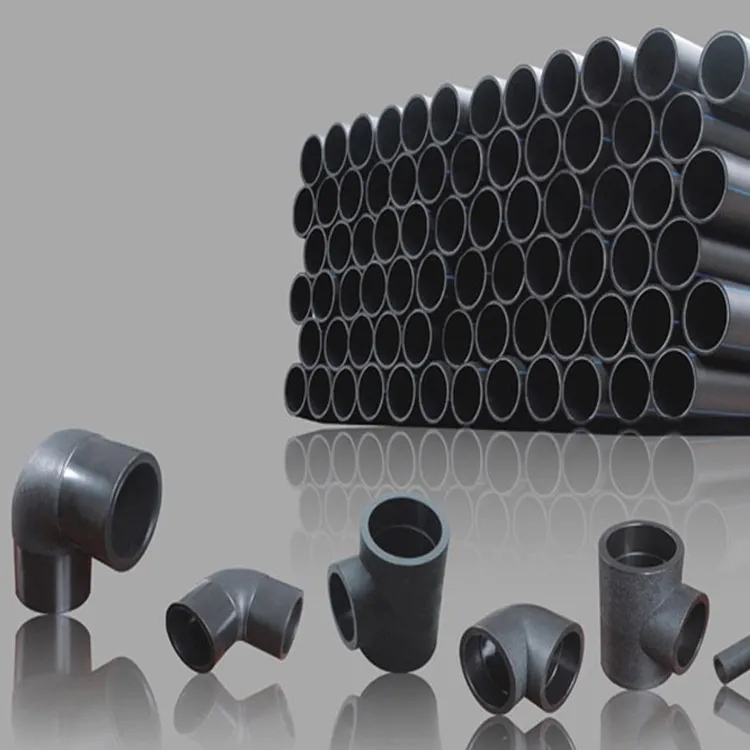
1. Raw Materials and Performance Requirements
HDPE Water Pipes
Require high-purity raw materials, usually PE80 or PE100 grade.
Must be non-toxic and odorless, complying with drinking water hygiene standards (e.g., GB/T 17219, NSF certification).
Focus on pressure resistance, resistance to water hammer, and long-term hydrostatic strength to ensure safety in pressurized water supply networks.
HDPE Drainage Pipes
Raw material requirements are more flexible, though PE80 or PE100 are still common.
Hygiene standards are less strict compared with water supply pipes.
Emphasis on abrasion resistance, impact resistance, and low-temperature toughness, ensuring long-term underground use.
In some non-pressure drainage systems, partial use of recycled material may be acceptable (depending on regulations).
2. Production Standards and Norms
Manufactured in compliance with ISO 4427, GB/T 13663, EN 12201.
Strict regulations on dimensions, pressure performance, and welding strength.
Quality testing includes hydrostatic pressure tests, elongation at break, and slow crack growth resistance (SCG).
HDPE Drainage Pipes
Common standards include GB/T 19472, EN 13476.
Focuses on ring stiffness (SN rating), impact resistance, and wear resistance.
Testing is simpler compared with water pipes, emphasizing physical and mechanical strength rather than hydrostatic pressure.
3. Pressure Rating and Structural Design
HDPE Water Pipes
Designed as pressure pipelines, with standard pressure ratings such as PN6.3, PN8, PN10, PN12.5, PN16.
Wall thickness defined by SDR (Standard Dimension Ratio). Larger diameters and higher pressures require thicker walls.
Typically solid-wall pipes to ensure uniform stress distribution.
HDPE Drainage Pipes
Generally non-pressure pipes, relying on gravity flow.
Structural stability is more important than pressure rating.
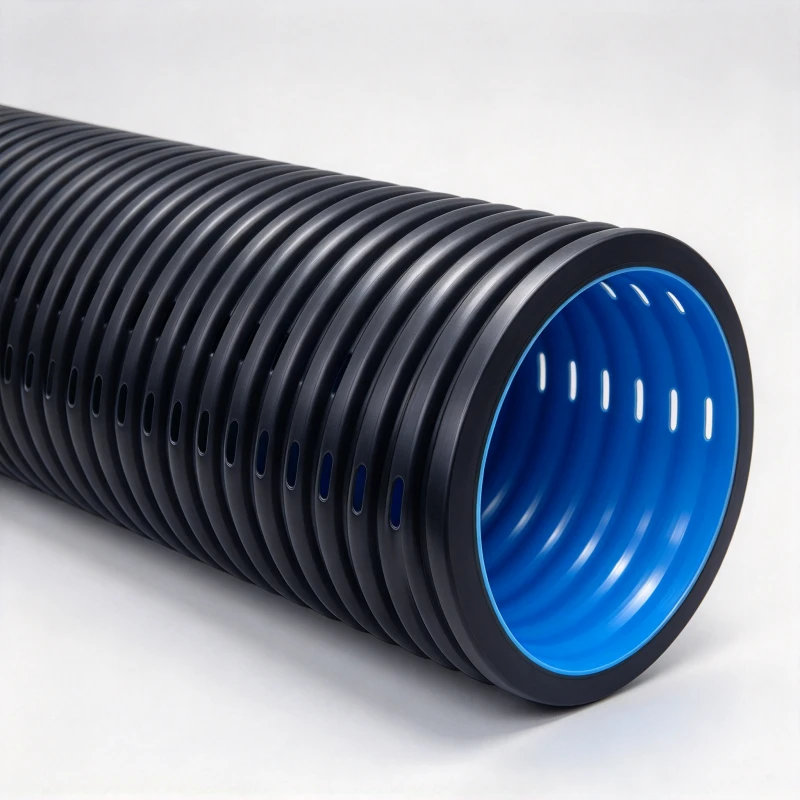
Common types: double-wall corrugated pipes, hollow-wall winding pipes, steel-reinforced PE pipes.
Available in very large diameters, from 200mm to over 3000mm.
4. Jointing Methods and Installation
HDPE Water Pipes
Connected by butt fusion welding or electrofusion welding, providing leak-free joints.
Flanges or threaded adaptors are used when connecting to metal valves or fittings.
Installation requires strict control of temperature, pressure, and cooling time to ensure weld quality.
HDPE Drainage Pipes
Primarily use bell-and-spigot joints with rubber gaskets, allowing flexibility against soil settlement.
For large-diameter pipes, external pressure connectors or electrofusion bands may be used.
Slight leakage is acceptable in some drainage systems as long as overall performance is not affected.
5. Application and Service Conditions
HDPE Water Pipes
Applications: municipal water networks, building water supply, industrial water systems, irrigation.
Must handle long-term pressure, ensure drinking water safety, and resist water hammer effects.
Suitable for both indoor and outdoor systems.
HDPE Drainage Pipes
Applications: urban stormwater, sewage systems, industrial wastewater, underground drainage.
Must withstand external soil loads, traffic loads, and corrosive environments.
No requirement for water purity.
6. Service Life and Maintenance
HDPE Water Pipes
Service life: over 50 years under proper conditions.
Requires monitoring of water pressure and joint integrity.
Repairs are complex and usually need fusion welding equipment.
HDPE Drainage Pipes
Also last up to 50 years, depending on soil conditions and external loads.
Maintenance mainly involves cleaning and preventing blockages.
Repairs are easier, often by replacing individual sections.
7. Cost and Economic Considerations
HDPE Water Pipes
Higher material and installation cost compared to drainage pipes.
Justified by the need for safety, durability, and compliance with strict drinking water standards.
Long-term economic benefits due to reduced leakage and extended lifespan.
HDPE Drainage Pipes
Generally lower cost due to lighter structure and simpler installation.
Particularly economical for large-diameter underground drainage projects, where HDPE corrugated pipes often replace heavier concrete or cast iron pipes.
Although both types of pipes are made of HDPE, they serve different functions and therefore follow different design principles:
HDPE water pipes: focus on pressure resistance and water safety.
HDPE drainage pipes: focus on structural stiffness, durability, and installation convenience.
In practice, the choice between the two depends on medium type, pressure requirements, environmental conditions, and cost factors. Selecting the right pipe ensures not only safe and reliable operation but also long-term economic efficiency in infrastructure projects.
916.webp)
204.webp)
659.webp)
185.webp)
312.webp)
849.webp)
587.webp)
767.webp)