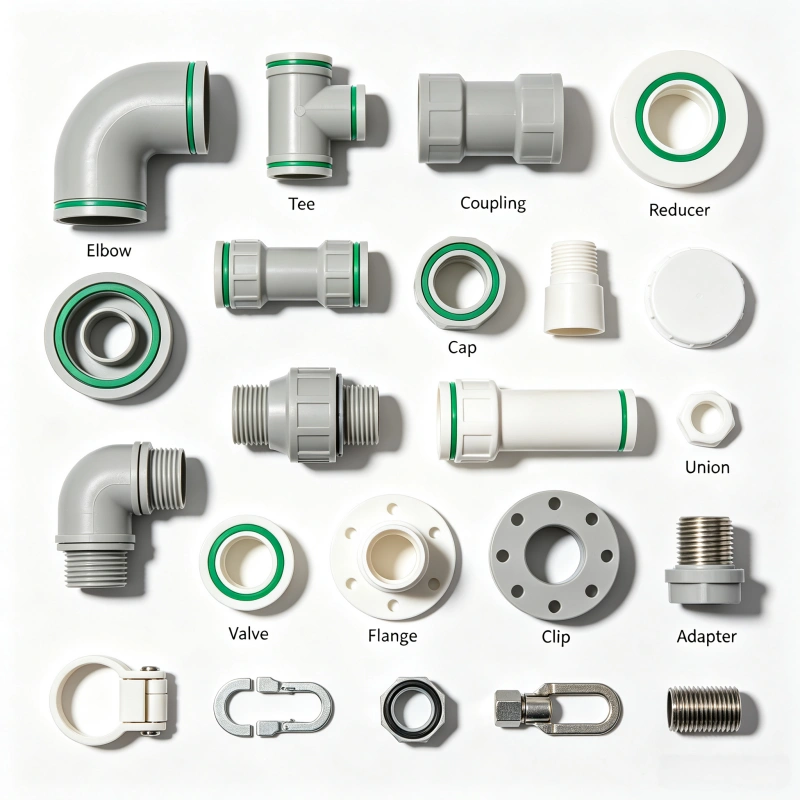
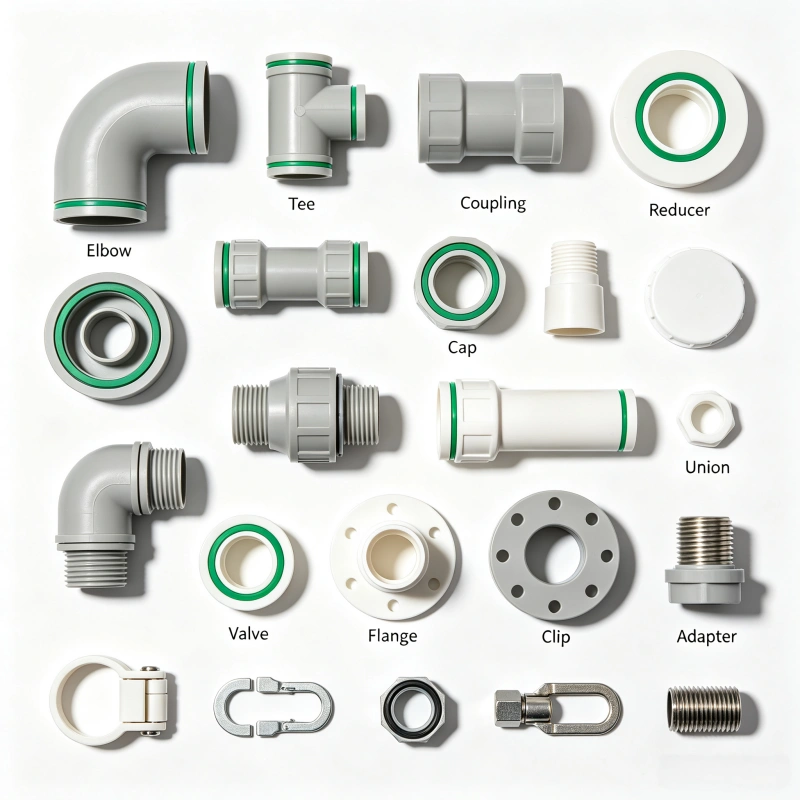
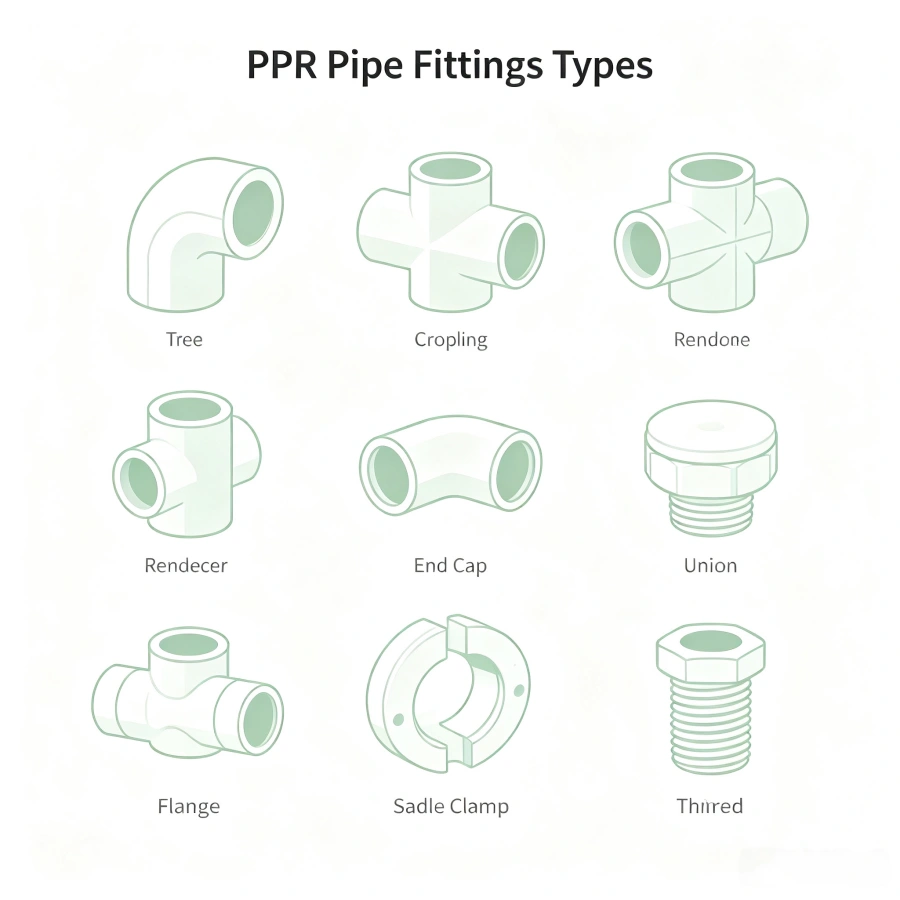
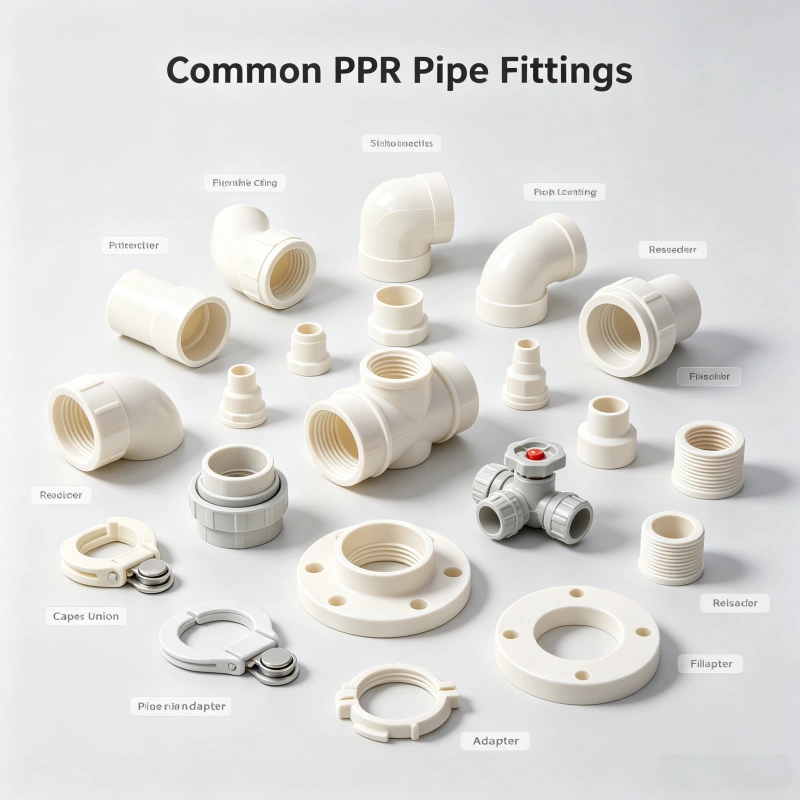
PPR pipe fittings are essential components used to connect, redirect, branch, reduce, terminate, or control PPR piping systems. If you are searching for PPR pipe fittings names, you will commonly encounter products such as PPR elbows, tees, couplings, reducers, unions, adapters, end caps, flanges, and valves.
Understanding the names of PPR fittings is more than a vocabulary exercise. For plumbers, contractors, engineers, distributors, and importers, knowing the function of each fitting makes it easier to select the correct component, prepare a piping design, and purchase compatible products.
This guide explains the most common PPR pipe fittings names, their functions, connection methods, sizes, applications, standards, and key factors to consider when purchasing PPR fittings from a manufacturer.
PPR Pipe Fittings Name.pdf
What Are PPR Pipe Fittings?
PPR pipe fittings are connection components manufactured primarily from polypropylene random copolymer (PP-R) and designed to work with PPR piping systems.
Unlike traditional threaded metal piping, many PPR systems use heat-fusion welding. During installation, the pipe and fitting socket are heated to the appropriate temperature and then joined. Once cooled, the connection forms a continuous polymer structure.
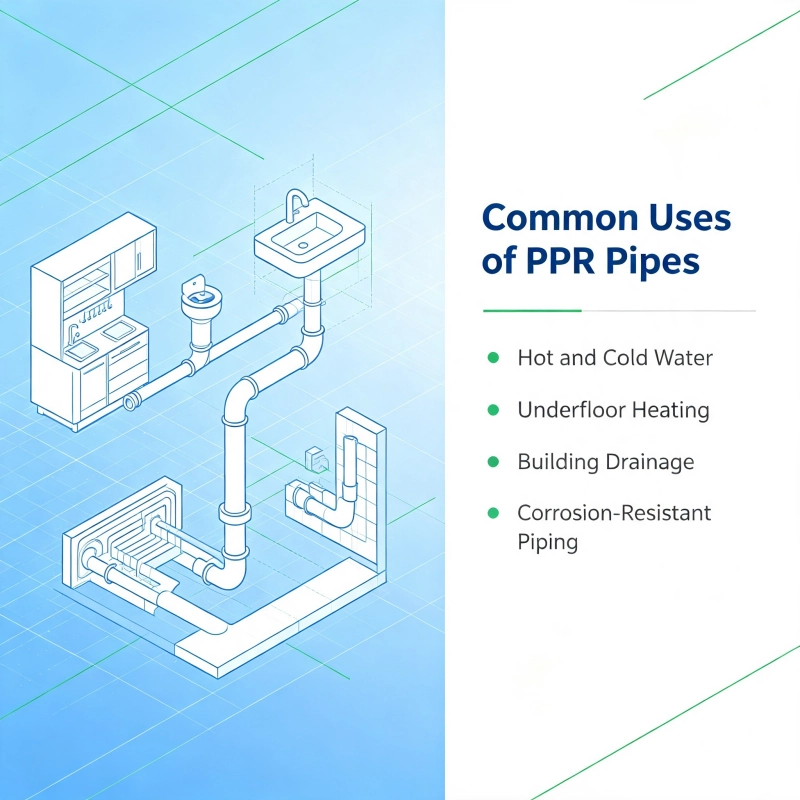
PPR fittings are widely used in hot and cold water distribution because of their corrosion resistance, relatively low weight, smooth internal surface, and suitability for fusion-welded piping systems.
Depending on the design, PPR fittings can also incorporate brass threaded inserts, allowing PPR pipes to connect with metal valves, faucets, pumps, water heaters, and other threaded equipment.
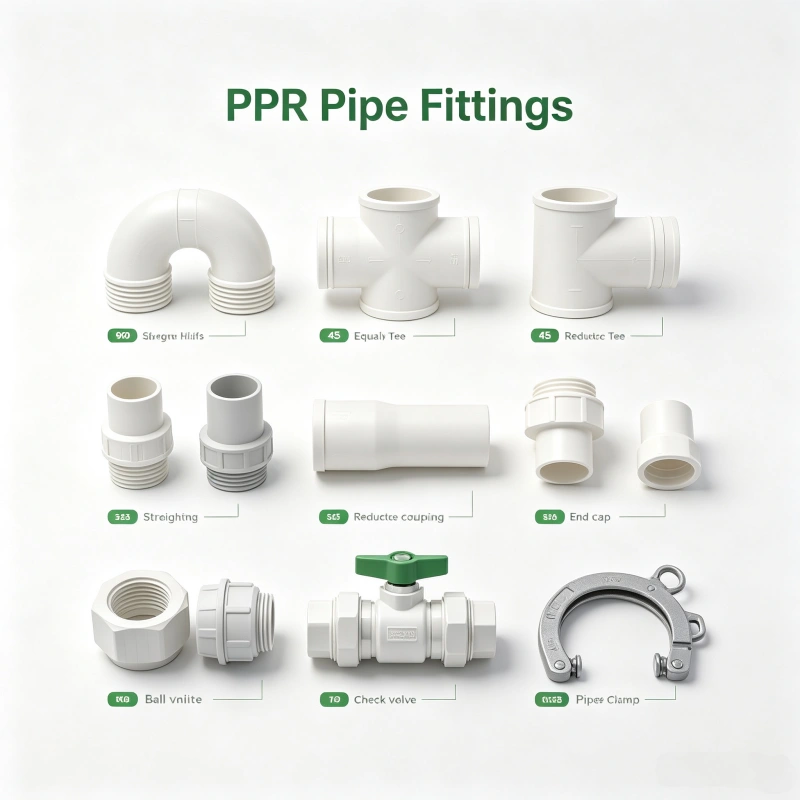
PPR Pipe Fittings Names List
The following are some of the most commonly used PPR pipe fitting names in residential, commercial, and industrial plumbing systems.
| PPR Fitting Name | Main Function |
|---|---|
| PPR Elbow | Changes the direction of a pipe |
| PPR Tee | Creates a branch connection |
| PPR Coupling | Connects two pipes of the same size |
| PPR Reducer | Connects pipes with different diameters |
| PPR Union | Allows a connection to be disconnected more easily |
| PPR End Cap | Closes the end of a pipe |
| PPR Male Adapter | Connects PPR pipe to a female-threaded component |
| PPR Female Adapter | Connects PPR pipe to a male-threaded component |
| PPR Flange Adapter | Provides a detachable flange connection |
| PPR Ball Valve | Controls water flow |
| PPR Check Valve | Helps prevent reverse flow |
| PPR Repair Coupling | Connects or repairs sections of piping |
PPR Elbow
A PPR elbow changes the direction of a pipeline. The most common configurations include 90-degree and 45-degree elbows.
Common PPR elbow names include:
PPR 90 Degree Elbow
PPR 45 Degree Elbow
PPR Reducing Elbow
PPR Male Thread Elbow
PPR Female Thread Elbow
A 90-degree elbow is commonly used when a pipe needs to make a sharp directional change, while a 45-degree elbow provides a more gradual change.
Threaded elbows can also be used when a PPR pipeline needs to connect to a threaded fixture or equipment component.
PPR Tee
A PPR tee fitting creates a branch from a main pipeline. It has three connection points and is commonly used to distribute water to different sections of a plumbing system.
The main types include:
PPR Equal Tee
PPR Reducing Tee
PPR Male Thread Tee
PPR Female Thread Tee
An equal tee connects three pipes of the same nominal size, while a reducing tee allows a smaller branch pipe to connect to a larger main pipe.
PPR Coupling
A PPR coupling, sometimes called a socket, is used to connect two PPR pipes in a straight line.
Common types include:
PPR Straight Coupling
PPR Reducing Coupling
PPR Repair Coupling
A standard coupling is useful when two pipes have the same diameter. A reducing coupling is designed for connections between different pipe sizes.
PPR Reducer
A PPR reducer connects pipes with different diameters.
For example, a piping system may transition from a larger main pipe to a smaller branch pipe. A reducer provides this size transition without requiring an improvised connection.
Depending on the manufacturer's product range, reducers may include straight reducing sockets and other reducing configurations.
PPR Union
A PPR union is designed to make a pipe connection easier to assemble and disassemble.
This can be particularly useful around equipment that may require future maintenance, such as pumps, valves, filters, and water-treatment components.
The key advantage of a union over a permanently fused coupling is serviceability.
PPR End Cap
A PPR end cap closes the end of a PPR pipe.
It can be used when:
A pipeline terminates at a particular point
A pipe section needs to be temporarily closed
A branch is reserved for future use
A pipeline needs to be isolated during construction
End caps are simple components, but they are important for completing a piping installation.
PPR Male Adapter
A PPR male adapter combines a PPR fusion socket with an external male thread.
It is commonly used to connect PPR pipe to components with internal female threads, including certain valves, fittings, faucets, and equipment connections.
Many versions use a brass threaded insert to provide a more durable threaded interface.
PPR Female Adapter
A PPR female adapter has a PPR fusion socket and an internal female thread.
It is generally used when the PPR pipeline needs to connect to a component with an external male thread.
Male and female adapters should not be selected based only on appearance. The thread type, size, connection standard, and mating component must all be compatible.
PPR Flange Adapter
A PPR flange adapter provides a detachable connection between the PPR pipeline and equipment or another piping section.
Flanged connections are particularly useful where regular inspection, maintenance, or equipment removal may be required.
They can be found in larger piping systems, water-treatment installations, pumps, tanks, and industrial applications.
PPR Valves
PPR valves are used to control or regulate fluid flow within a piping system.
Common product names include:
PPR Ball Valve
PPR Stop Valve
PPR Check Valve
PPR Brass Ball Valve
PPR Double Union Ball Valve
Valve selection should consider pressure, temperature, fluid characteristics, installation requirements, and the manufacturer's specifications.
PPR Pipe Fittings by Function
Another useful way to understand PPR fittings is to classify them according to what they do.
Direction-Changing Fittings
These fittings change the direction of a pipeline.
Typical examples include:
45-degree elbows
90-degree elbows
Branch Fittings
Branch fittings divide one pipeline into multiple directions.
Typical examples include:
Equal tees
Reducing tees
Cross fittings where available
Pipe-Connecting Fittings
These fittings join pipe sections together.
Typical examples include:
Couplings
Unions
Repair couplings
Size-Transition Fittings
These fittings connect pipes or branches of different diameters.
Examples include:
Reducing sockets
Reducers
Reducing tees
Reducing elbows
Threaded Fittings
Threaded PPR fittings allow a fusion-welded PPR system to connect with threaded components.
Examples include:
Male adapters
Female adapters
Threaded elbows
Threaded tees
Flow-Control Fittings
These components manage fluid movement.
Examples include:
Ball valves
Stop valves
Check valves
Pipe-End Fittings
End fittings close or terminate a pipeline.
The most common example is the PPR end cap.
PPR Fittings by Connection Type
PPR piping systems can incorporate several connection approaches depending on the fitting design and application.
Socket Fusion PPR Fittings
Socket fusion is one of the most common connection methods for PPR pipes and fittings.
The outside surface of the pipe and the inside surface of the fitting socket are heated with suitable fusion equipment. The heated components are then joined and allowed to cool.
This creates a continuous connection without traditional solvent cement.
Threaded PPR Fittings
Some PPR fittings contain threaded brass inserts.
These products are useful for connecting PPR pipe to:
Faucets
Valves
Pumps
Water heaters
Metal fittings
Other threaded equipment
Threaded fittings require correct thread specifications and careful installation to prevent damage to the insert or mating component.
Flanged PPR Fittings
Flanged connections are useful where a pipeline needs to be disconnected for maintenance.
They are commonly considered for larger pipe systems and equipment connections where serviceability is important.
PPR Pipe Fittings Sizes
PPR fittings are manufactured in different sizes to match corresponding PPR pipes. Common sizes in many markets include:
20 mm
25 mm
32 mm
40 mm
50 mm
63 mm
75 mm
90 mm
110 mm
160 mm
However, the exact size range varies by manufacturer, regional market, piping standard, and product series.
When selecting a fitting, the pipe outside diameter, fitting size, wall thickness, pressure class, and applicable standard should be checked together.
For example, choosing a 25 mm fitting simply because the pipe is described as a “25 mm pipe” is not enough. The actual product dimensions and manufacturer's compatibility specifications should be confirmed before installation.
PPR Pipe Fittings for Different Applications
Residential Plumbing
PPR fittings are widely used in residential water-distribution systems.
Typical applications include:
Cold-water supply
Hot-water supply
Kitchen plumbing
Bathroom plumbing
Water heater connections
Building water distribution
Elbows, tees, couplings, adapters, valves, and end caps form the basic fitting package for many residential projects.
Commercial Buildings
Commercial projects often require more extensive piping networks.
PPR fittings can be used in suitable applications within:
Hotels
Offices
Schools
Hospitals
Shopping centers
Apartment buildings
Large projects generally require closer attention to pressure, temperature, hydraulic design, fire regulations, and local building codes.
Industrial Applications
PPR and related polypropylene piping systems may be used in selected industrial water and process applications.
Potential applications depend on the material grade and product specifications and may include:
Process water
Industrial water distribution
Cooling-water systems
Certain chemical-service applications
For industrial projects, the fluid, concentration, temperature, pressure, and operating conditions should always be checked against the manufacturer's technical data.
HVAC and Mechanical Systems
PPR fittings may also be used in appropriate hot-water and chilled-water applications.
Typical components include:
Elbows
Tees
Couplings
Reducers
Valves
Flange connections
The exact suitability depends on the system's operating temperature, pressure, water chemistry, and applicable engineering requirements.
PPR Fittings vs PVC, CPVC and HDPE Fittings
PPR is not the only material used for modern piping systems.
| Feature | PPR | PVC | CPVC | HDPE |
| Typical Connection | Heat fusion | Solvent cement/mechanical | Solvent cement/mechanical | Fusion |
| Hot Water Applications | Commonly used | Product/application dependent | Commonly used | Application dependent |
| Corrosion Resistance | High | High | High | High |
| Weight | Relatively light | Light | Light | Relatively light |
| Typical Applications | Hot/cold water | Drainage/cold water and other applications | Hot/cold water | Water, industrial and other applications |
| Flexibility | Moderate | Relatively rigid | Relatively rigid | High |
The best material depends on the project rather than on one material being universally superior.
For example, PPR can be attractive for hot and cold water distribution, while HDPE may be preferred where greater flexibility is important. CPVC may be selected for particular hot-water applications, while PVC is commonly used in drainage and other suitable systems.
How to Choose the Right PPR Pipe Fittings
Selecting the right PPR fitting requires more than matching the fitting name.
1. Check Pipe Size
The fitting must be compatible with the pipe's actual dimensions and the manufacturer's product system.
2. Check Pressure Requirements
Select a fitting designed for the system's operating pressure and applicable pressure class.
3. Consider Temperature
Hot-water systems require fittings with suitable temperature performance.
4. Select the Correct Connection
Determine whether the project requires:
Fusion connection
Threaded connection
Flanged connection
A combination of these methods
5. Check Material and Inserts
For threaded fittings, check the type and quality of the metal insert. Depending on the application, brass inserts may be used to provide the threaded connection.
6. Consider the Application
Residential, commercial, HVAC, water-treatment, and industrial systems may have different requirements.
7. Verify Standards and Certifications
The required standards and certifications depend on the destination market and application. For potable-water projects, additional requirements may apply.
PPR Pipe Fittings Standards
PPR fittings for international markets may be manufactured according to relevant piping standards, with ISO 15874 being an important international standard family for polypropylene piping systems intended for hot and cold water installations.
Other standards and certifications may be relevant depending on the target market, product, and application.
For example, buyers may need to evaluate:
ISO requirements
EN or DIN requirements
Local plumbing regulations
Drinking-water requirements
Third-party product certifications
Project-specific specifications
Importantly, a manufacturer should distinguish between manufacturing according to a standard and holding a specific third-party certification. Buyers should request technical documents and certificates when certification is a project requirement.
How to Buy PPR Pipe Fittings from a Manufacturer
For distributors, contractors, plumbing companies, and importers, purchasing PPR fittings directly from a manufacturer can provide more control over product specifications and supply.
Before placing an order, consider asking the supplier about:
Available fitting types
Product dimensions
Pressure ratings
Temperature ratings
Material grade
Brass insert specifications
Available sizes
Applicable standards
Testing procedures
Packaging options
OEM and private-label services
Minimum order quantity
Production capacity
Sample availability
Delivery time
Export experience
A reliable PPR pipe fittings manufacturer should be able to provide clear technical specifications rather than simply offering a long product catalog.
For large projects, it is also useful to request samples before bulk purchasing. Samples allow buyers to evaluate dimensions, fusion compatibility, surface quality, thread accuracy, marking, packaging, and other practical details.
Frequently Asked Questions About PPR Pipe Fittings Names
What are the most common PPR pipe fittings?
The most common PPR fittings include elbows, tees, couplings, reducers, unions, end caps, male adapters, female adapters, flange adapters, and valves.
What is a PPR elbow used for?
A PPR elbow changes the direction of a pipeline. 90-degree and 45-degree elbows are among the most common configurations.
What is a PPR tee fitting?
A PPR tee creates a branch connection from a main pipeline. Equal tees connect pipes of the same size, while reducing tees connect a smaller branch to a larger pipe.
What is a PPR coupling?
A PPR coupling connects two PPR pipe sections, normally in a straight line. A reducing coupling can connect pipes with different diameters.
What is the difference between a PPR coupling and a PPR union?
Both can connect piping sections, but a union is designed to make future disconnection and maintenance easier. A standard fusion coupling generally creates a more permanent connection.
What is a PPR male adapter?
A PPR male adapter combines a PPR fusion connection with an external thread, allowing PPR pipe to connect to a component with a compatible internal thread.
What is a PPR female adapter?
A PPR female adapter has a PPR fusion socket and an internal thread. It is used to connect PPR pipe with a compatible male-threaded component.
What sizes are PPR fittings available in?
Common sizes include 20, 25, 32, 40, 50, 63, 75, 90, 110, and 160 mm, although the available range varies between manufacturers and markets.
Can PPR fittings be used for hot water?
Many PPR systems are designed for hot and cold water applications. However, the specific pipe and fitting series must be suitable for the required temperature, pressure, and service conditions.
How are PPR fittings connected?
Most standard PPR fittings are connected using socket-fusion welding. Threaded and flanged fittings can be used where PPR pipe needs to connect to valves, equipment, or other piping systems.
Conclusion
Knowing the correct PPR pipe fittings names makes it easier to understand piping drawings, prepare material lists, communicate with suppliers, and select the right components for a project.
The most important PPR fittings include elbows for changing direction, tees for branching, couplings for joining pipes, reducers for changing pipe size, unions for serviceable connections, adapters for threaded interfaces, end caps for pipe termination, flanges for detachable connections, and valves for flow control.
For buyers, however, the name of a fitting is only the starting point. Pipe size, pressure, temperature, material, connection method, applicable standards, and intended application should all be considered before purchasing.
For distributors, contractors, and project buyers, working directly with an experienced PPR pipe fittings manufacturer can also make it easier to obtain consistent specifications, customized packaging, technical documentation, and stable bulk supply.

916.webp)
204.webp)
659.webp)
185.webp)
312.webp)
849.webp)
587.webp)
767.webp)