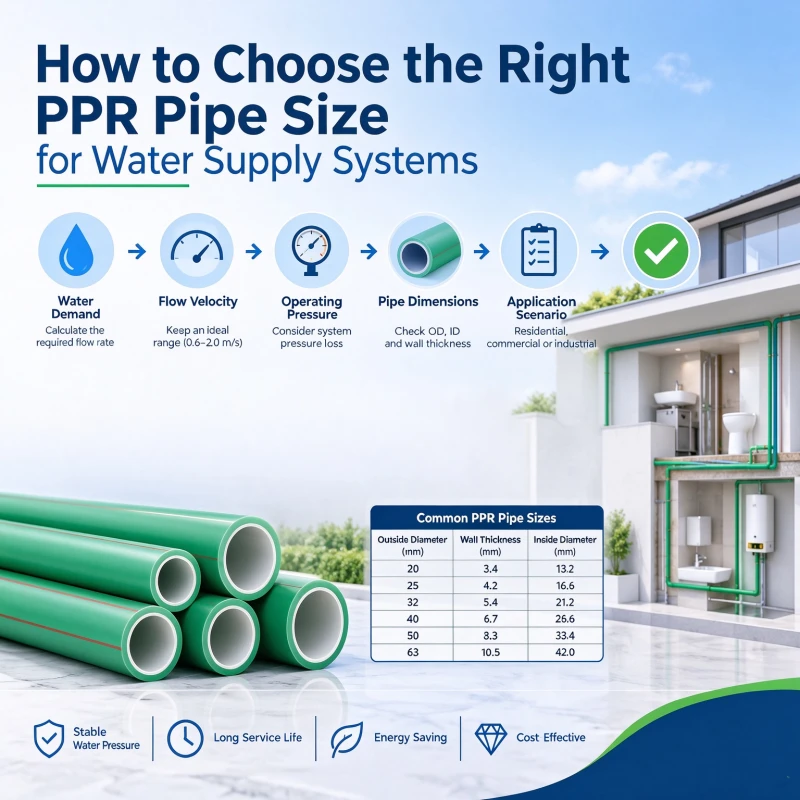
Choosing the right PPR pipe size is essential for ensuring stable water pressure, sufficient flow capacity, and long-term reliability in residential, commercial, and industrial water supply systems. An undersized pipe may cause excessive pressure loss, insufficient water flow, and noise, while an oversized pipe can increase material costs and installation expenses.
However, selecting a suitable PPR pipe diameter involves more than simply checking a standard pipe size chart. Engineers and plumbing contractors need to consider several factors, including water demand, flow velocity, actual internal diameter, pipe wall thickness, operating pressure, pipeline length, and the number of connected fixtures.
Whether you are designing a residential plumbing network, specifying pipes for a commercial building, or purchasing PPR piping materials for a construction project, understanding these factors will help you make a more informed decision.
In this guide, Haili Pipe explains how to choose the right PPR pipe size, understand pipe dimensions, calculate the required diameter, and avoid common sizing mistakes in water supply installations.
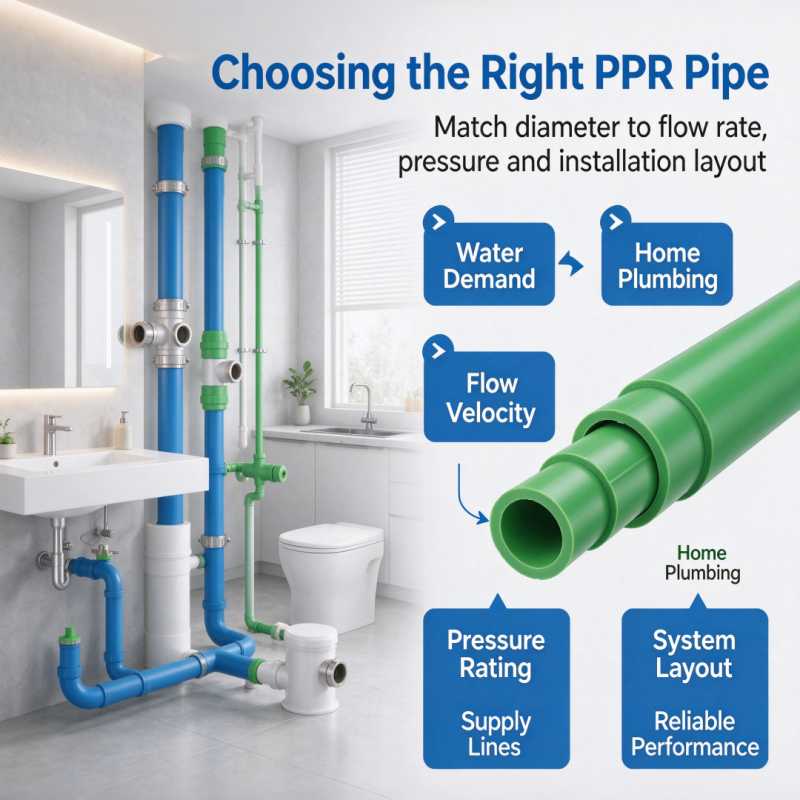
1. Understand PPR Pipe Sizes Before Making a Selection
Before selecting a pipe diameter, it is important to understand how PPR pipes are measured and identified.
Unlike some metal piping systems that use nominal pipe sizes, PPR pipes are generally specified by their nominal outside diameter (OD), expressed in millimeters.
Common PPR pipe sizes include:
20 mm
25 mm
32 mm
40 mm
50 mm
63 mm
75 mm
90 mm
110 mm
Smaller diameters are commonly used for individual water distribution branches, while larger diameters are generally considered for building supply lines and higher-demand applications.
However, the outside diameter alone does not determine how much water a pipe can carry. Its internal diameter and wall thickness are equally important.
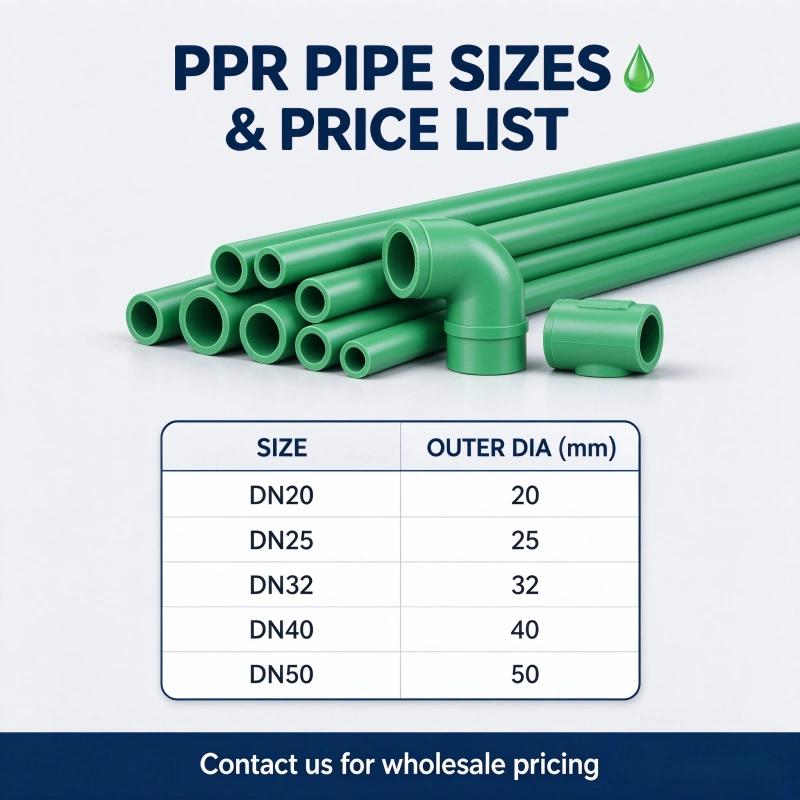
For a broader overview of available specifications, refer to Haili's PPR Pipe Sizes and Price List.
1.1 Outside Diameter vs. Inside Diameter: What Is the Difference?
The outside diameter is the measurement across the exterior of the pipe, while the inside diameter represents the actual opening through which water flows.
The relationship is:
Inside Diameter = Outside Diameter − (2 × Wall Thickness)
For example, consider a PPR pipe with the following specifications:
Outside diameter: 32 mm
Wall thickness: 5.4 mm
Inside diameter: 21.2 mm
Although this pipe is marketed as a 32 mm PPR pipe, its actual water passage is approximately 21.2 mm.
This distinction is particularly important when calculating flow velocity and pressure loss.
Two PPR pipes with the same outside diameter may have different internal diameters because they use different wall thicknesses or dimensional series.
Therefore, engineers should always check the manufacturer's dimensional specifications rather than selecting pipes based on outside diameter alone.
1.2 PPR Pipe Size Chart: Outside Diameter, Wall Thickness and Inside Diameter
The following table provides an illustrative dimensional reference for commonly used PPR pipes manufactured to an S2.5 / SDR6 dimensional series.
| Outside Diameter (mm) | Wall Thickness (mm) | Approx. Inside Diameter (mm) |
|---|---|---|
| 20 | 3.4 | 13.2 |
| 25 | 4.2 | 16.6 |
| 32 | 5.4 | 21.2 |
| 40 | 6.7 | 26.6 |
| 50 | 8.3 | 33.4 |
| 63 | 10.5 | 42.0 |
| 75 | 12.5 | 50.0 |
| 90 | 15.0 | 60.0 |
| 110 | 18.3 | 73.4 |
Important: These values are representative dimensions for one particular pipe series, not universal dimensions for every PPR pipe. Always verify the applicable standard, product construction, and manufacturer's technical datasheet before making a final selection.
For international buyers, it is also important to specify the outside diameter in millimeters instead of relying exclusively on approximate inch equivalents.
2. What Factors Determine the Right PPR Pipe Size?
A suitable PPR pipe diameter should be selected according to the hydraulic requirements of the complete water supply system.
The following six factors should be evaluated before confirming a pipe specification.
2.1 Water Flow Rate and Demand
Flow rate is one of the most important considerations in pipe sizing.
It refers to the volume of water passing through a pipe within a specific period, commonly measured in:
Liters per second (L/s)
Liters per minute (L/min)
Cubic meters per hour (m³/h)
A pipeline supplying a single bathroom requires less water than a main distribution line supplying multiple apartments or an entire commercial building.
For this reason, the pipe diameter should be selected according to the expected peak water demand rather than the average daily consumption alone.
For residential and commercial projects, engineers should consider the number of connected fixtures, their individual flow requirements, and the probability of simultaneous water usage.
For example, a residential building may have several bathrooms, kitchen sinks, washing machines, and water heaters connected to the same distribution network.
The main supply pipe must accommodate the expected combined demand, while individual branch pipes can be sized according to their respective fixture requirements.
2.2 Water Flow Velocity
Flow velocity describes how quickly water moves through a pipeline.
It is commonly expressed in meters per second (m/s).
If the pipe diameter is too small, water velocity may become excessive, increasing friction losses, noise, and the potential for water hammer.
Conversely, an unnecessarily large pipe may increase installation costs and create inefficient system design.
A preliminary design velocity range of approximately 0.6–2.0 m/s can be used as an illustrative starting point for many building water distribution applications. However, this is not a universal design requirement. The actual allowable velocity depends on local plumbing regulations, water temperature, system pressure, noise considerations, and project specifications.
The basic relationship between flow rate, pipe area, and velocity is:
Q = A × v
Where:
Q = Water flow rate (m³/s)
A = Internal cross-sectional area (m²)
v = Water velocity (m/s)
This relationship helps engineers estimate the minimum internal diameter required for a given flow rate and target velocity.
2.3 Operating Pressure and Pressure Loss
Water supply pressure is another important factor when choosing PPR pipe sizes.
Pressure losses occur as water travels through pipes, fittings, valves, meters, and other components.
These losses become more significant when:
The pipeline is excessively long.
The pipe diameter is too small.
Water velocity is too high.
The system contains numerous bends and fittings.
The building has significant elevation differences.
For example, a water supply system serving a high-rise building must account for the pressure required at the highest fixture, not simply the pressure available at the building entrance.
A pipe that provides sufficient flow in a short residential branch may not perform equally well in a longer distribution network.
Engineers should therefore calculate the total available pressure after accounting for elevation changes and friction losses.
2.4 Pipe Wall Thickness and SDR
PPR pipe wall thickness affects the actual internal diameter and therefore the flow capacity of the pipe.
SDR (Standard Dimension Ratio) is calculated using the following relationship:
SDR = Outside Diameter / Wall Thickness
For a given outside diameter, a thicker pipe wall results in a smaller internal diameter.
For example, a 32 mm PPR pipe with a thicker wall will have a smaller water passage than another 32 mm pipe with a thinner wall.
This is why two products with the same nominal outside diameter may have different hydraulic performance.
When comparing PPR pipes, always check:
Outside diameter
Nominal wall thickness
SDR or pipe series
Material type
Applicable pressure-temperature rating
Do not assume that a larger PN number automatically means a larger internal diameter or greater flow capacity.
The relationship between pressure capability, temperature, material properties, and wall thickness must be evaluated according to the applicable product standard.
2.5 Pipeline Length and Layout
Pipeline length has a direct influence on pressure loss.
Longer pipelines create greater friction resistance, even when the same pipe diameter and flow rate are maintained.
The layout also matters.
A relatively short pipeline with multiple elbows, tees, reducers, and valves may experience greater pressure losses than a straight pipeline of similar length.
Therefore, pipe sizing should consider both straight-pipe friction and the additional resistance caused by fittings and valves.
For more complex projects, engineers should use hydraulic calculation methods or manufacturer-provided pressure-loss data rather than relying on nominal diameter recommendations.
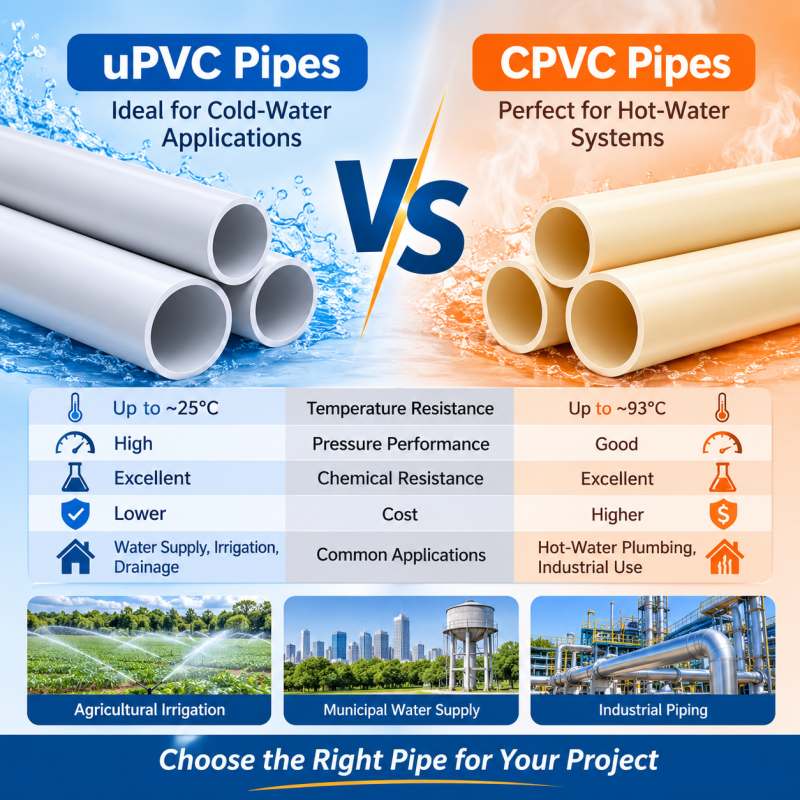
2.6 Hot Water vs. Cold Water Applications
Hot and cold water systems may require different design considerations.
Water temperature affects material performance, pressure ratings, and system operating conditions.
PPR pipes intended for hot water applications must be selected according to their applicable temperature-pressure classification and expected service life.
For example, a pipe specification suitable for a cold-water distribution system should not automatically be assumed suitable for continuous hot-water operation under the same pressure.
For more information about application requirements, explore Haili's PP-R Water Pipes for Hot and Cold Water.
3. How to Calculate the Required PPR Pipe Diameter
Understanding the relationship between flow rate and pipe diameter makes pipe selection more accurate.
For preliminary sizing, the required internal diameter can be estimated using the following formula:
D = √(4Q / πv)
Where:
D = Required internal diameter (m)
Q = Design flow rate (m³/s)
v = Target water velocity (m/s)
π = Mathematical constant, approximately 3.1416
This equation calculates the minimum theoretical internal diameter required to achieve a selected flow rate at a given velocity.
3.1 Practical PPR Pipe Sizing Example
Assume an engineer needs to size a PPR distribution pipe with the following design conditions:
| Parameter | Design Value |
|---|---|
| Required flow rate | 0.6 L/s |
| Target flow velocity | 1.5 m/s |
| Water supply application | Building distribution |
| Pipe material | PP-R |
First, convert the flow rate:
0.6 L/s = 0.0006 m³/s
Then substitute the values into the formula:
D = √(4 × 0.0006 / (3.1416 × 1.5))
The calculated internal diameter is approximately:
D = 0.0226 m = 22.6 mm
This means the selected pipe should have an actual internal diameter of at least approximately 22.6 mm to achieve the specified flow rate at the assumed velocity.
Now compare two illustrative PPR pipe options:
| Pipe Specification | Internal Diameter | Calculated Velocity |
|---|---|---|
| 32 mm SDR6 | 21.2 mm | 1.70 m/s |
| 40 mm SDR6 | 26.6 mm | 1.08 m/s |
Under these simplified conditions, the 40 mm pipe provides a lower flow velocity and a larger internal passage.
However, this calculation is only a preliminary hydraulic sizing exercise. The final selection must also account for pressure loss, pipe length, fittings, available supply pressure, temperature, and applicable design standards.
A pipe that meets the velocity requirement may still fail the pressure-loss requirement.
This is why professional pipe sizing should consider the complete hydraulic system rather than one calculation alone.
4. How to Select PPR Pipe Sizes for Different Applications
Different water supply applications have different flow requirements and distribution layouts.
The following table provides general application references rather than fixed engineering recommendations.
| Application | Commonly Considered PPR Sizes | Main Selection Consideration |
|---|---|---|
| Individual fixture branches | 20–25 mm | Fixture flow demand |
| Residential distribution branches | 25–32 mm | Simultaneous water usage |
| Residential main supply | 32–40 mm or larger | Total building demand |
| Small commercial buildings | 32–63 mm | Occupancy and distribution layout |
| Hotels and apartment buildings | 40–90 mm or larger | Peak demand and elevation |
| Large commercial projects | 63–110 mm or larger | Hydraulic calculations |
The final diameter should always be determined by project-specific calculations and local plumbing requirements.
4.1 PPR Pipe Sizes for Residential Water Supply
Residential water supply systems typically use a combination of different pipe diameters.
Smaller pipes are generally installed for individual fixture connections, while larger pipes distribute water to multiple branches.
For example:
20 mm pipes may be considered for individual fixture branches.
25 mm pipes may be used for smaller distribution branches.
32 mm pipes may be considered for larger residential branches.
40 mm pipes may be used for certain main distribution sections.
However, these examples should not be treated as universal sizing rules.
A large villa with multiple bathrooms may require a different configuration from a small apartment, even if both buildings use PPR piping.
The number of fixtures, expected simultaneous demand, pipeline length, and available water pressure should determine the final pipe sizes.
4.2 PPR Pipe Sizes for Commercial Buildings
Commercial buildings generally have more complex water distribution requirements.
Hotels, hospitals, shopping centers, schools, and office buildings may require multiple distribution branches serving different floors and functional areas.
In these projects, selecting one pipe diameter for the entire building is rarely appropriate.
A more practical approach is to divide the network into sections:
Main water supply line.
Vertical risers.
Floor distribution branches.
Individual equipment connections.
Fixture supply connections.
Each section should be sized according to its calculated peak flow rate and allowable pressure loss.
For high-rise buildings, engineers must also consider elevation differences and pressure zoning to ensure that sufficient water pressure reaches upper floors.
4.3 PPR Pipe Sizes for Industrial Water Supply
Industrial applications may involve larger flow rates and more demanding operating conditions.
PPR piping can be considered for suitable clean-water distribution, heating, and compatible process-fluid applications.
However, pipe selection should be based on the transported medium, chemical compatibility, temperature, pressure, and required service life.
For industrial systems, engineers should pay particular attention to the manufacturer's technical documentation and applicable design standards.
Larger pipe diameters should not be selected simply because an installation is classified as industrial.
The actual hydraulic requirements must determine the specification.
5. How PPR Pipe Fittings Affect Water Flow and Pipe Sizing
Selecting the correct pipe diameter is only one part of designing an efficient water supply system.
Pipe fittings and valves also influence hydraulic performance.
Common PPR components include:
Elbows
Tees
Couplings
Reducers
Female threaded adapters
Male threaded adapters
Ball valves
End caps
Each component introduces additional resistance to water flow.
For example, a pipeline with multiple elbows and tees may experience greater pressure loss than a straight pipeline with the same diameter and length.
Reducers also require special attention because sudden changes in diameter may affect flow distribution and local pressure losses.
When designing a PPR water supply system, engineers should evaluate the pipe and fitting combination as a complete assembly.
It is equally important to ensure that the selected fittings are compatible with the pipe diameter, material, dimensional series, and connection method.
Haili provides a range of PPR Fittings and Valves for building complete hot and cold water piping systems.
For projects requiring additional dimensional stability and reduced thermal expansion, engineers can also evaluate PPR Fiber and Aluminum Composite Pipes.
6. Common Mistakes to Avoid When Choosing PPR Pipe Sizes
Even when standard pipe dimensions are available, incorrect selection can affect the performance and cost of an entire plumbing system.
Here are six common mistakes to avoid.
Mistake 1: Selecting Pipes Based Only on Outside Diameter
A 32 mm PPR pipe does not necessarily provide the same internal flow capacity across different wall thicknesses.
Always compare the actual internal diameter.
Mistake 2: Ignoring Peak Water Demand
Sizing pipes according to average water consumption can result in insufficient flow when multiple fixtures operate simultaneously.
Use an appropriate design demand calculation.
Mistake 3: Choosing Pipes Based Only on PN Ratings
Pressure class alone does not determine whether a pipe is suitable for a particular project.
Consider temperature, service conditions, material properties, and dimensional series.
Mistake 4: Ignoring Pressure Loss in Long Pipelines
Long distribution networks and high-rise buildings require careful pressure-loss calculations.
A pipe that works well in a short branch may not be suitable for a much longer main line.
Mistake 5: Overlooking Fittings and Valves
Elbows, tees, reducers, and valves create additional resistance.
Ignoring these components may lead to an inaccurate hydraulic calculation.
Mistake 6: Choosing Pipes Based Only on Purchase Price
The lowest-priced pipe may not be the most economical option over the entire project lifecycle.
Engineers and purchasing teams should compare material specifications, pressure-temperature performance, product quality, installation requirements, and expected service life.
A properly selected PPR system can help reduce unnecessary material expenses while maintaining reliable water distribution performance.
7. What Standards Should Be Considered When Selecting PPR Pipes?
For professional plumbing projects, pipe selection should comply with the applicable national and international standards.
One important reference is ISO 15874, which covers polypropylene piping systems for hot and cold water installations.
The standard addresses different parts of the piping system, including:
ISO 15874-1: General requirements.
ISO 15874-2: Pipes.
ISO 15874-3: Fittings.
ISO 15874-5: Fitness for purpose of the system.
Engineers and buyers should also check the relevant product documentation, dimensional tolerances, pressure-temperature classifications, and testing requirements.
Depending on the project and market, other applicable national standards may also need to be considered.
When comparing products from different manufacturers, make sure that the specifications refer to equivalent materials, dimensional series, and service conditions.
This is particularly important for international procurement, where different markets may use different technical designations.
8. How to Choose a Reliable PPR Pipe Manufacturer for Your Project
Correct pipe sizing is only one part of a successful water supply project.
Choosing a reliable manufacturer is equally important, particularly for distributors, contractors, importers, and large-scale construction projects.
Before placing an order, consider the following factors.
1. Product Range and Available Specifications
A reliable manufacturer should offer suitable pipe diameters, wall thicknesses, pressure classifications, and compatible fittings for different applications.
2. Raw Material Quality
The quality and consistency of polypropylene raw materials influence the physical and mechanical performance of finished pipes.
3. Manufacturing Capacity
Stable production capacity is important for projects requiring multiple pipe sizes, large order quantities, and consistent delivery schedules.
4. Quality Control and Testing
Ask for relevant technical datasheets, product inspection records, and test reports to verify that the supplied products meet the required specifications.
5. Technical Support
Manufacturers with engineering and R&D capabilities can provide more effective assistance when evaluating product specifications and project requirements.
Why Choose Haili Pipe?
Established in 2013, Shandong Haili Pipeline Technology Co., Ltd. operates a 10,000-square-meter manufacturing facility with a total investment of USD 65 million.
With more than 24 plastic pipe production lines, Haili provides a wide range of pipeline products, including PE water pipes, PE gas pipes, PE mine pipes, irrigation pipes, MPP electrical conduit pipes, PVC-U water supply pipes, PPR pipes, PEX pipes, pipe fittings, and related infrastructure products.
Haili integrates research and development, manufacturing, sales, and technical services to support customers in different international markets.
The company's technical R&D team includes international experts, senior engineers, and qualified technical professionals. Its R&D center has been named a national-level CNAS laboratory, and the company holds more than 32 patents.
Haili focuses on product innovation, quality control, and the development of energy-efficient and environmentally responsible pipeline solutions.
Whether you are sourcing PPR pipes for residential plumbing, commercial water distribution, or large-scale engineering projects, Haili aims to provide reliable products and responsive technical support.
Learn more about Haili's manufacturing capabilities and company background.
9. Frequently Asked Questions About PPR Pipe Sizes
Q1: What is the most common PPR pipe size for residential water supply?
Common residential PPR pipe sizes include 20 mm, 25 mm, 32 mm, and 40 mm.
Smaller diameters are often used for individual fixture branches, while larger diameters may be used for distribution and main supply sections. The actual selection depends on water demand, flow rate, pressure loss, and system layout.
Q2: How do I calculate the correct PPR pipe diameter?
The required internal diameter can be estimated using:
D = √(4Q / πv)
Where Q represents the design flow rate and v represents the target water velocity.
After calculating the required internal diameter, select a commercially available PPR pipe with a sufficient actual internal diameter and verify that the system meets its pressure-loss requirements.
Q3: Is a 25 mm PPR pipe suitable for a main water supply line?
A 25 mm PPR pipe may be suitable for certain small residential distribution systems, but it is not automatically appropriate for every main supply line.
The decision should depend on the number of connected fixtures, total water demand, pipeline length, available pressure, and allowable pressure loss.
Q4: Does a larger PPR pipe always provide better water flow?
A larger internal diameter generally reduces water velocity and friction loss at the same flow rate.
However, selecting an unnecessarily large pipe increases material and installation costs.
The objective is to achieve an appropriate balance between flow capacity, pressure performance, and overall project cost.
Q5: What is the difference between 20 mm and 25 mm PPR pipes?
The main difference is their outside diameter and, depending on the dimensional series, their internal diameter and wall thickness.
A 25 mm pipe generally provides a larger internal flow passage than a 20 mm pipe of the same series.
However, the actual difference in hydraulic performance should be calculated using the specified wall thickness and internal diameter.
Q6: Does PPR pipe wall thickness affect water flow?
Yes. For the same outside diameter, a thicker wall results in a smaller internal diameter.
A smaller internal diameter increases water velocity and can increase friction loss at a given flow rate.
Therefore, wall thickness should be considered together with outside diameter when selecting PPR pipes.
Q7: Which PPR pipe is suitable for hot water supply?
The appropriate pipe should meet the required temperature-pressure classification and design service life.
Engineers should check the manufacturer's technical specifications and applicable requirements under ISO 15874 before selecting a product for hot water applications.
Q8: Can I use the same PPR pipe diameter for hot and cold water?
Not necessarily.
The required diameter depends primarily on flow demand, internal diameter, pressure loss, and system layout. However, hot water service conditions may influence the allowable operating pressure and product specification.
Separate hydraulic and material suitability checks should be performed for both systems.
Q9: What information should I provide when requesting a PPR pipe quotation?
To receive an accurate quotation, provide:
Required outside diameters.
Wall thicknesses or dimensional series.
Pressure and temperature requirements.
Material and pipe construction.
Required quantities for each size.
Fitting and valve requirements.
Applicable standards.
Destination country and preferred shipping terms.
Providing complete specifications helps manufacturers recommend suitable products and prepare more accurate quotations.
Conclusion: Choose PPR Pipe Sizes Based on System Requirements, Not Just Pipe Dimensions
Choosing the right PPR pipe size requires a comprehensive understanding of water demand, flow velocity, internal diameter, wall thickness, operating pressure, pipeline length, and fitting resistance.
A standard pipe size chart is a useful starting point, but it cannot replace proper hydraulic calculations for residential, commercial, or industrial water supply systems.
By evaluating these factors together, engineers and contractors can select PPR pipes that provide sufficient water flow, acceptable pressure loss, and cost-effective long-term performance.
If you are sourcing PPR pipes and fittings for an upcoming project, Haili Pipe can help you evaluate available product specifications and identify suitable piping solutions.
Contact Haili Pipe today to discuss your PPR pipe requirements, request product specifications, or obtain a quotation for your project.
Visit our PPR Pipe Systems product range or contact our team for further information.
About Haili Pipe
Shandong Haili Pipeline Technology Co., Ltd. is a Chinese plastic pipe manufacturer integrating R&D, manufacturing, sales, and service. With more than 24 production lines, a national-level CNAS laboratory, and over 32 patents, Haili provides pipeline products and technical solutions for water supply, drainage, gas transportation, irrigation, and infrastructure applications.
916.webp)
204.webp)
659.webp)
185.webp)
312.webp)
849.webp)
587.webp)
767.webp)