Choosing the right piping material is essential for ensuring the safety, durability, and efficiency of any water supply or industrial piping system. Among the many plastic piping materials available today, uPVC and CPVC pipes are two widely used options. Although they share a similar chemical foundation, their performance characteristics, temperature resistance, applications, and installation requirements are quite different.
So, when comparing uPVC vs CPVC pipes, which one is better?
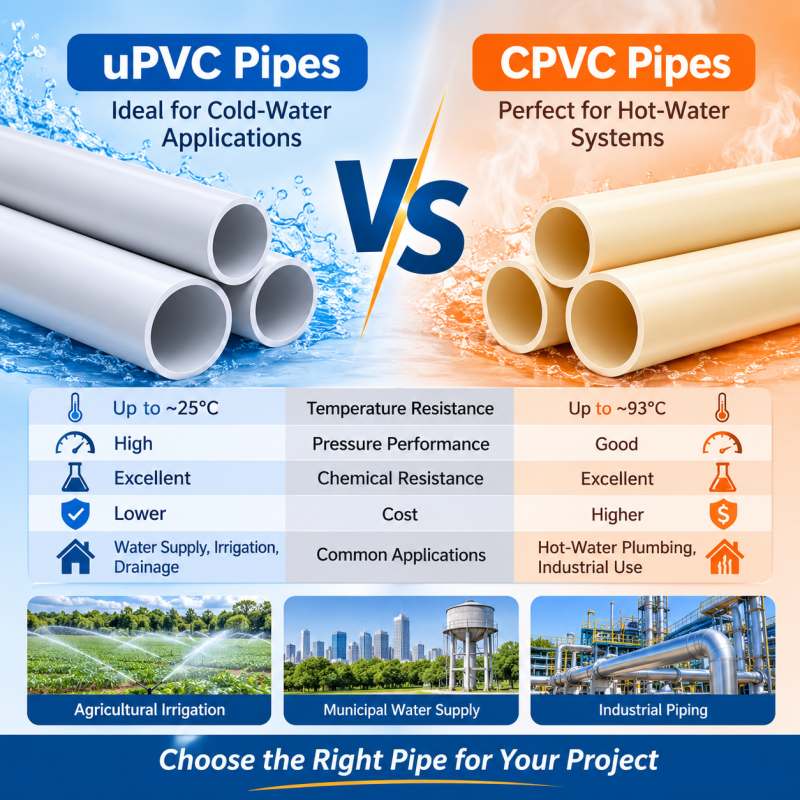
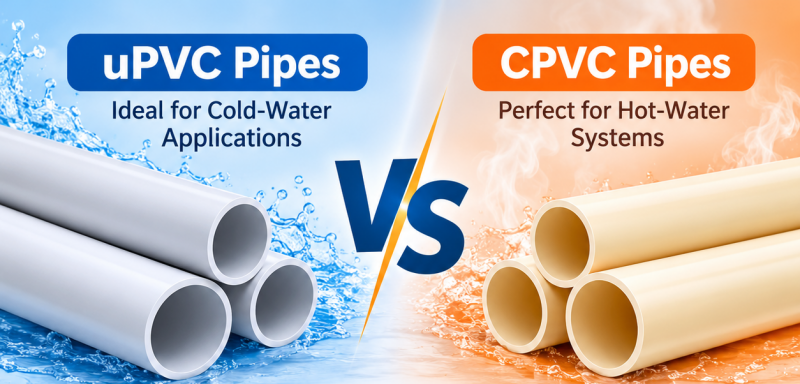
The answer depends on the operating environment, fluid temperature, working pressure, chemical compatibility, and overall project requirements. uPVC pipes are commonly selected for cold-water supply, agricultural irrigation, drainage, and underground infrastructure, while CPVC pipes are particularly suitable for hot-water distribution and certain industrial applications involving elevated temperatures.
In this guide, we will explore the differences between uPVC and CPVC pipes from both technical and practical perspectives, helping engineers, contractors, distributors, and project buyers make informed decisions.
1. Quick Answer: What Is the Difference Between uPVC and CPVC Pipes?
The main difference between uPVC and CPVC pipes is their chemical composition and ability to withstand elevated temperatures.
uPVC (Unplasticized Polyvinyl Chloride) is a rigid thermoplastic material manufactured without plasticizers. It offers good mechanical strength, corrosion resistance, dimensional stability, and cost efficiency. It is widely used in cold-water supply, irrigation, drainage, and underground piping networks.
CPVC (Chlorinated Polyvinyl Chloride) is produced through an additional chlorination process applied to PVC resin. This modification improves its heat resistance, making it suitable for hot-water plumbing and certain industrial fluid transportation systems.
Here is a quick comparison:
| Comparison Factor | uPVC Pipes | CPVC Pipes |
|---|---|---|
| Full Name | Unplasticized Polyvinyl Chloride | Chlorinated Polyvinyl Chloride |
| Material Structure | Rigid PVC without plasticizers | Chlorinated PVC |
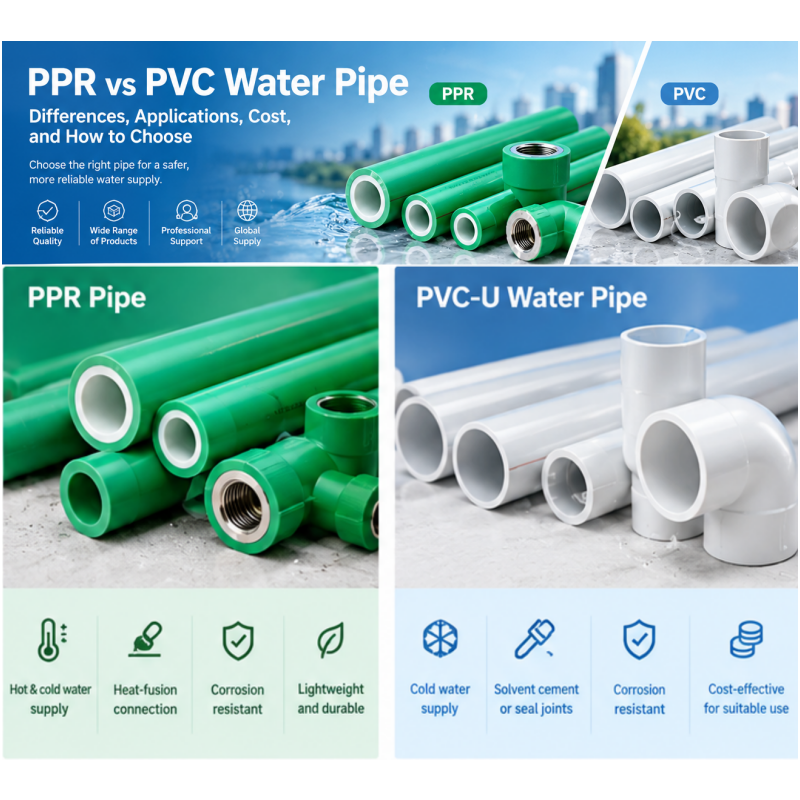
| Temperature Resistance | Primarily designed for cold-water applications | Suitable for hot- and cold-water applications |
| Mechanical Properties | High rigidity and dimensional stability | Good mechanical strength and heat resistance |
| Chemical Resistance | Resistant to many acids, alkalis, and salts | Resistant to many chemicals, depending on concentration and temperature |
| Corrosion Resistance | Excellent | Excellent |
| Common Applications | Water supply, irrigation, drainage | Hot-water plumbing, industrial piping |
| Installation | Solvent cement or elastomeric ring joints, depending on the system | CPVC-specific solvent cement |
| Relative Cost | Generally lower | Generally higher |
| Best Application | Cold-water and infrastructure systems | Hot-water and higher-temperature systems |
Quick recommendation:
Choose uPVC for cold-water distribution, agricultural irrigation, drainage, and underground water supply.
Choose CPVC for hot-water plumbing and applications requiring higher operating temperatures.
For industrial projects, always evaluate the actual fluid, temperature, pressure, chemical concentration, and applicable pipe standards before selecting either material.
UPVC Pipes VS CPVC Pipes
2. What Are uPVC and CPVC Pipes?
Understanding their material properties is the first step toward choosing the correct piping system.
What Is a uPVC Pipe?
uPVC stands for Unplasticized Polyvinyl Chloride. It is a rigid form of PVC manufactured without the addition of plasticizers.
The absence of plasticizers gives uPVC its characteristic rigidity, dimensional stability, and mechanical strength.
Unlike traditional metal piping, uPVC does not rust or suffer from electrochemical corrosion. Its smooth internal surface also helps reduce flow resistance and the accumulation of deposits.
These properties make uPVC an economical and reliable choice for many water transportation and infrastructure applications.
Common applications include:
Municipal water supply systems
Agricultural irrigation networks
Residential cold-water distribution
Underground water pipelines
Industrial drainage systems
Stormwater and wastewater transportation
For example, HAILI provides PVC-U water supply pipes in sizes ranging from 20 mm to 800 mm, with various pressure ratings designed for different water supply requirements.
Learn more about HAILI PVC-U Water Supply Pipes.
What Is a CPVC Pipe?
CPVC stands for Chlorinated Polyvinyl Chloride.
It is manufactured by introducing additional chlorine into the PVC polymer structure. This process increases the material's heat resistance and allows it to maintain useful mechanical properties at higher operating temperatures.
CPVC is commonly used in residential, commercial, and industrial piping systems where hot water or elevated fluid temperatures are involved.
Its major applications include:
Hot- and cold-water plumbing
Residential water heater connections
Commercial building plumbing
Industrial process piping
Selected chemical transportation systems
Certain approved fire sprinkler applications
One important advantage of CPVC is its ability to maintain performance under elevated temperatures when correctly specified.
However, its actual operating limits depend on the product design, pressure rating, relevant standards, and manufacturer's technical documentation.
3. uPVC vs CPVC Pipes: 7 Major Differences Explained
Although both materials belong to the PVC family, they are not interchangeable. Let's examine the seven most important differences.
3.1 Material Composition and Manufacturing Process
The fundamental difference begins with the manufacturing process.
uPVC is produced using PVC resin with suitable processing additives but without plasticizers. This creates a rigid structure suitable for pressure piping, drainage, and water transportation.
CPVC undergoes an additional chlorination process. The increased chlorine content changes the polymer's thermal characteristics, allowing it to withstand higher temperatures.
In practical terms:
uPVC prioritizes rigidity, strength, and cost-effective performance in suitable cold-water applications.
CPVC prioritizes heat resistance while maintaining the mechanical properties needed for hot-water distribution.
This difference explains why CPVC generally costs more than uPVC.
3.2 Temperature Resistance
Temperature resistance is one of the most important factors when comparing uPVC vs CPVC pipes.
uPVC is primarily designed for cold-water applications. Although some product specifications permit limited exposure to warmer fluids, its pressure-bearing capacity decreases significantly as operating temperature rises.
CPVC offers substantially better thermal performance and is commonly specified for hot-water systems.
Typical reference values are shown below:
| Parameter | uPVC | CPVC |
|---|---|---|
| Typical application | Cold-water systems | Hot- and cold-water systems |
| Common reference temperature | Around 20–25°C | Up to approximately 82–93°C for suitable products |
| High-temperature suitability | Limited | Significantly higher |
| Pressure at elevated temperatures | Requires substantial derating | Also requires derating |
These figures are general reference points, not universal product ratings. Always follow the manufacturer's approved operating temperature and pressure tables.
Why does temperature matter?
When thermoplastic materials become hotter, their stiffness and pressure-bearing capacity generally decrease.
For example, a pipe that is rated for a particular working pressure at room temperature may not safely withstand the same pressure at 60°C or 80°C.
This is why engineers should never select pipes based only on their nominal pressure rating.
The correct approach is to evaluate operating temperature and pressure together.
3.3 Pressure Resistance and Mechanical Strength
Both uPVC and CPVC pipes offer good mechanical performance, but their pressure capabilities depend on different operating conditions.
uPVC is known for its rigidity and strength at ordinary temperatures. It is commonly used in water supply networks where stable dimensions and pressure performance are important.
CPVC also provides good mechanical strength, particularly in hot-water applications. However, its allowable working pressure decreases as temperature increases.
When evaluating pressure resistance, consider:
Nominal pipe diameter
Wall thickness
Pressure class or schedule
Operating temperature
Fluid characteristics
Installation conditions
Water hammer and surge pressure
For example, a PN-rated uPVC pipe and an SDR-rated CPVC pipe cannot be compared directly without checking their dimensional standards and design conditions.
The pipe material alone does not determine the maximum working pressure.
3.4 Chemical Resistance and Corrosion Resistance
One reason plastic piping systems are widely used in modern infrastructure is their resistance to corrosion.
Unlike conventional steel pipes, neither uPVC nor CPVC is susceptible to ordinary rusting.
Both materials can provide excellent resistance to many acids, alkalis, salts, and other chemical substances.
However, their chemical compatibility is not identical.
The performance of a piping system depends on:
Chemical concentration
Operating temperature
Fluid pressure
Exposure duration
Pipe formulation
Jointing materials and seals
For example, certain chemicals may be compatible with uPVC at room temperature but become unsuitable at elevated temperatures.
Similarly, CPVC may perform well in a particular chemical environment but still require verification of the concentration and temperature limits.
For industrial projects, engineers should always consult a manufacturer-specific chemical resistance chart before specifying a piping material.
3.5 Installation and Connection Methods
Installation requirements are another important difference.
uPVC pipes can commonly be connected using solvent cement or elastomeric sealing rings, depending on the pipe system and its intended application.
CPVC pipes generally use dedicated CPVC solvent cement for solvent-welded connections.
These joining materials are not automatically interchangeable.
Important installation considerations include:
For uPVC systems:
Select compatible pipes and fittings.
Clean and prepare pipe surfaces before joining.
Follow the specified solvent cement or gasket installation procedure.
Allow sufficient curing time before pressure testing.
Provide appropriate support and expansion allowances.
For CPVC systems:
Use compatible CPVC pipes, fittings, and approved joining materials.
Follow the manufacturer's surface preparation instructions.
Observe the recommended curing time.
Account for thermal expansion in hot-water installations.
Perform pressure testing according to the applicable installation standard.
Using an incompatible solvent cement or fitting can compromise joint integrity and cause leakage.
3.6 Service Life and Maintenance
Both materials can offer long service life when properly designed and installed.
uPVC is resistant to corrosion, scaling, and many common environmental factors. Its smooth internal surface helps maintain hydraulic performance and reduces the likelihood of deposits accumulating.
CPVC also offers good corrosion resistance and can provide reliable service in hot-water environments.
However, neither material has a guaranteed service life independent of operating conditions.
Actual durability depends on:
Material quality
Operating temperature
Working pressure
Chemical exposure
UV exposure
Installation quality
Mechanical loading
Maintenance practices
For underground systems, proper bedding, backfilling, joint sealing, and protection against external loads are particularly important.
The best material is therefore not necessarily the one with the highest theoretical temperature resistance, but the one correctly matched to the actual application.
3.7 Cost and Overall Project Investment
uPVC is generally more economical than CPVC.
The additional chlorination process and higher-temperature performance requirements contribute to CPVC's higher material cost.
However, comparing the initial pipe price alone can lead to incorrect purchasing decisions.
A more complete project cost analysis should include:
Pipe and fitting purchase prices.
Transportation and storage.
Installation labor.
Joining materials and tools.
Thermal insulation, where required.
Inspection and pressure testing.
Maintenance and replacement costs.
For cold-water infrastructure, irrigation, and drainage systems, uPVC can offer a strong balance between performance and investment.
For hot-water applications, CPVC may justify its higher initial cost by providing the necessary thermal performance.
The key is to select the right material for the operating conditions rather than purchasing the most expensive option by default.
4. Applications: Where Should You Use uPVC and CPVC Pipes?
Understanding real-world applications makes the selection process much easier.
4.1 Applications of uPVC Pipes
uPVC pipes are widely used in water transportation and infrastructure projects because of their rigidity, corrosion resistance, and relatively low installation cost.
Agricultural Irrigation
Agricultural irrigation requires efficient water distribution across large areas.
uPVC pipes can be used in irrigation networks to transport water from pumping stations or storage facilities to distribution points.
Their smooth internal surfaces help reduce flow resistance, while their lightweight construction simplifies transportation and installation.
Explore HAILI uPVC Agricultural Irrigation Pipes for applications involving farmland irrigation and outdoor water distribution.
Municipal Water Supply
Municipal water supply projects require piping materials that can maintain stable performance under specified pressure conditions.
uPVC pressure pipes are commonly used in water distribution networks, underground pipelines, and infrastructure development.
Their corrosion resistance and relatively low maintenance requirements make them an attractive alternative to traditional metal pipes in suitable applications.
Drainage and Wastewater Systems
uPVC is also widely used for drainage and wastewater transportation.
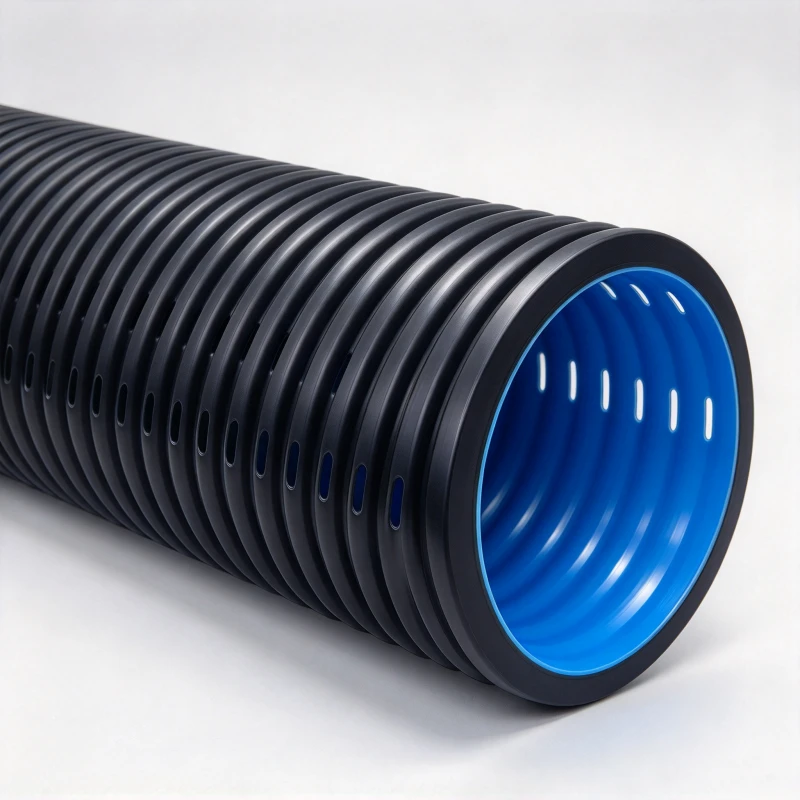
For underground drainage projects, double-wall corrugated pipes offer a different structural design from conventional solid-wall pressure pipes.
The corrugated exterior provides structural stiffness, while the smooth inner wall helps maintain efficient flow.
Learn more about HAILI PVC-U Double-Wall Corrugated Drainage Pipes.
Industrial Cold-Water Transportation
In selected industrial environments, uPVC pipes can transport compatible fluids where operating temperatures and pressures remain within the manufacturer's specifications.
Chemical compatibility should always be checked before installation.
4.2 Applications of CPVC Pipes
CPVC is particularly useful in systems where ordinary uPVC cannot meet the required temperature conditions.
Typical applications include:
Hot-water distribution in residential buildings
Commercial kitchens and bathrooms
Water heater connections
Hot-water circulation systems
Selected industrial chemical processing lines
Certain approved fire protection installations
For example, a residential building with separate cold-water and hot-water distribution systems may use uPVC for suitable cold-water lines and CPVC for hot-water lines.
This approach allows each material to perform according to its intended design conditions.
Important: Fire sprinkler systems and industrial process piping require specific approved products and applicable system certifications. General-purpose CPVC pipe should not automatically be assumed suitable for these applications.

Applications of PVC Pipes
5. uPVC vs CPVC: Which Pipe Is Better for Your Project?
There is no universal winner. The correct choice depends on the application.
Use the following selection guide:
| Project Requirement | Recommended Material | Reason |
|---|---|---|
| Cold-water distribution | uPVC | Economical and corrosion-resistant |
| Agricultural irrigation | uPVC | Suitable for properly designed cold-water irrigation networks |
| Underground water supply | uPVC | Good rigidity and pressure performance within its rating |
| Building drainage | uPVC | Cost-effective drainage solution |
| Residential hot-water plumbing | CPVC | Designed for higher operating temperatures |
| Commercial hot-water systems | CPVC | Better thermal performance |
| Industrial cold-fluid transportation | uPVC or CPVC | Depends on chemical compatibility and operating conditions |
| Industrial hot-fluid transportation | CPVC or another engineered material | Requires temperature and pressure verification |
Before making the final decision, ask five questions:
1. What is the operating temperature?
If the system transports hot water continuously, CPVC or another approved hot-water material should be considered.
2. What is the maximum working pressure?
Check the actual pressure rating at the expected operating temperature.
3. What fluid will flow through the pipeline?
Water, wastewater, fertilizers, acids, and industrial chemicals have different compatibility requirements.
4. Where will the pipe be installed?
Underground, exposed outdoor, indoor, and industrial installations have different mechanical and environmental requirements.
5. What standards must the project meet?
Check the applicable local regulations and product standards, such as ISO 1452 for PVC-U pressure piping, ASTM D1785 for applicable PVC pressure pipe systems, ASTM F441 for CPVC schedule pipe, and ASTM D2846 for applicable CPVC hot- and cold-water distribution systems.
The correct standard depends on the market, pipe dimensions, product type, and intended service.
6. What About uPVC vs CPVC vs HDPE Pipes?
Although uPVC and CPVC are common choices, HDPE is another important material worth considering, especially for infrastructure and underground piping projects.
HDPE stands for High-Density Polyethylene. It has different mechanical and joining characteristics compared with PVC-based piping materials.
| Feature | uPVC | CPVC | HDPE |
|---|---|---|---|
| Material | Rigid PVC | Chlorinated PVC | High-density polyethylene |
| Flexibility | Rigid | Rigid | Flexible |
| Hot-Water Suitability | Generally unsuitable | Suitable for specified hot-water systems | Depends on grade and temperature rating |
| Corrosion Resistance | Excellent | Excellent | Excellent |
| Common Joining Method | Solvent cement or gasket | CPVC solvent cement | Butt fusion or electrofusion |
| Common Applications | Water supply, irrigation, drainage | Hot-water plumbing | Water supply, gas distribution, underground networks |
| Relative Cost | Generally economical | Generally higher | Depends on grade, size, and project requirements |
When should you consider HDPE?
HDPE is particularly suitable for long-distance underground water supply, municipal infrastructure, agricultural irrigation, and projects requiring fused joints.
Its flexibility and fusion connections make it useful for installations where ground movement and joint integrity are important considerations.
For projects requiring alternative plastic piping solutions, explore HAILI HDPE Water Supply Pipes.
The final material selection should always be based on the project's operating conditions, applicable standards, and total installation cost.
7. How to Choose a Reliable uPVC Pipe Manufacturer?
Selecting the correct material is only one part of a successful piping project. Choosing a qualified manufacturer is equally important.
For distributors, contractors, importers, and engineering companies, the following factors should be evaluated.
7.1 Product Specifications and Quality Control
A professional manufacturer should provide clear technical information, including:
Pipe material and product classification
Nominal diameter and wall thickness
Pressure rating
Applicable manufacturing standards
Dimensional tolerances
Product inspection and testing information
These specifications help buyers determine whether the product meets their project requirements.
7.2 Manufacturing Capacity
Production capacity is particularly important for large infrastructure and wholesale orders.
A reliable supplier should have sufficient production equipment, technical personnel, and quality control procedures to maintain consistent product specifications.
7.3 Customization and Product Range
Different projects may require different diameters, pressure ratings, colors, and pipe configurations.
Working with a manufacturer that provides multiple product categories and customized production options can simplify procurement and supplier management.
7.4 Technical Support and Export Experience
International buyers should also consider packaging, shipping arrangements, documentation, communication, and after-sales support.
A manufacturer with experience serving overseas markets can help reduce procurement difficulties and improve project coordination.
8. Why Consider HAILI for Your uPVC and Plastic Piping Projects?
When sourcing plastic piping products for infrastructure, water supply, drainage, or agricultural irrigation projects, working with an experienced manufacturer can make a significant difference.
HAILI Pipe, operated by Shandong Haili Pipeline Technology Co., Ltd., is a Chinese manufacturer specializing in plastic pipes and related fittings.
The company was established in 2013 and operates a 10,000-square-meter manufacturing facility with more than 24 plastic pipe production lines.
Its product portfolio includes:
PVC-U water supply pipes
Agricultural irrigation pipes
PVC drainage pipes
PVC-U double-wall corrugated pipes
HDPE water supply pipes
HDPE gas pipes
HDPE drainage systems
Plastic pipe fittings
Inspection chambers and septic tanks
For PVC-U water supply applications, HAILI offers pipe sizes from 20 mm to 800 mm, with pressure ratings ranging from 0.5 MPa to 2.5 MPa in its published product specifications.
This range supports different water transportation and infrastructure requirements, subject to project-specific design verification.
HAILI also provides product customization and supports customers with piping solutions for different markets and applications.
For buyers looking for a plastic pipe manufacturer in China, HAILI can be considered for uPVC water supply, irrigation, drainage, and HDPE piping requirements.
Need a piping solution for your next project?
Visit the HAILI product catalog to explore available PVC pipe products, or contact the HAILI team to discuss your required pipe dimensions, pressure ratings, applications, and purchasing requirements.
9. Frequently Asked Questions About uPVC vs CPVC Pipes
Q1: What is the main difference between uPVC and CPVC pipes?
The main difference is their chemical composition and temperature resistance. uPVC is unplasticized PVC and is commonly used for cold-water supply, irrigation, and drainage. CPVC is chlorinated PVC, which offers higher heat resistance and is suitable for hot-water applications.
Q2: Which is better, uPVC or CPVC?
Neither material is universally better. uPVC is generally more economical for cold-water and infrastructure applications, while CPVC is better suited to hot-water systems. The right choice depends on operating temperature, pressure, fluid compatibility, and project requirements.
Q3: Can uPVC pipes be used for hot water?
Standard uPVC pressure pipes are generally designed for cold-water applications. Their pressure-bearing capacity decreases as temperature rises. They should not be used for hot-water systems unless the specific product is explicitly rated and approved for the intended conditions.
Q4: Can CPVC pipes be used for cold water?
Yes. CPVC pipes are suitable for both hot- and cold-water applications when they meet the relevant product and installation requirements. However, they may be more expensive than uPVC for applications that do not require heat resistance.
Q5: Are uPVC and CPVC pipes corrosion-resistant?
Yes. Both materials offer excellent resistance to corrosion and rust. However, their compatibility with specific chemicals depends on the chemical concentration, temperature, pressure, and pipe formulation.
Q6: Which pipe is more expensive, uPVC or CPVC?
CPVC generally costs more because of its additional chlorination process and higher-temperature performance. However, actual prices depend on pipe diameter, wall thickness, pressure rating, manufacturer, and market conditions.
Q7: Can uPVC and CPVC fittings be used together?
They should not be assumed interchangeable. The materials may use different dimensional systems, fitting designs, and solvent cements. Any transition must use a specifically approved connection method and compatible components.
Q8: Which pipe is better for agricultural irrigation?
uPVC is a widely used choice for agricultural irrigation because it offers rigidity, corrosion resistance, and cost-effective water transportation. HDPE is another option where flexibility and fusion-jointed connections are preferred.
Q9: How long do uPVC and CPVC pipes last?
Both materials can provide long service life when properly manufactured, installed, and operated within their design limits. Actual service life depends on pressure, temperature, chemical exposure, installation conditions, and maintenance.
Q10: How do I choose the right pipe manufacturer?
Compare product specifications, manufacturing standards, quality control procedures, available sizes, pressure ratings, customization capabilities, export experience, and technical support. Always request relevant product documentation before placing a bulk order.
Conclusion: Choose the Right Pipe for the Right Application
When comparing uPVC vs CPVC pipes, the most important consideration is not simply which material is stronger or cheaper. It is whether the pipe can safely and efficiently perform under the actual operating conditions.
uPVC is an excellent option for cold-water distribution, agricultural irrigation, drainage, and underground infrastructure. CPVC is more suitable for hot-water plumbing and selected industrial applications requiring higher temperature resistance.
For engineers, contractors, distributors, and project buyers, evaluating temperature, pressure, chemical compatibility, installation requirements, and total project cost is essential before making a final decision.
If your project involves uPVC water supply pipes, agricultural irrigation systems, PVC drainage products, or HDPE piping solutions, explore the product range available from HAILI and contact the team to discuss your requirements.
The right piping material is an investment in long-term system reliability, operational efficiency, and project value.
916.webp)
204.webp)
659.webp)
185.webp)
312.webp)
849.webp)
587.webp)
767.webp)