Welcome to the introductory course on modern agricultural intelligent management. This series of articles will build a solid theoretical and cognitive foundation, helping you understand the core transformation from traditional agriculture to precision agriculture, and preparing you for the practical operation and system management of smart irrigation technologies.
Fundamentals of Water-Saving Irrigation
As a prerequisite for smart irrigation practices, understanding the evolution and core principles of irrigation technologies is essential. This not only helps you realize why upgrading equipment is necessary but also enables you to optimize system parameters effectively in real applications.
In modern irrigation systems, high-quality pipeline infrastructure such as HAILI PE Pipe and HAILI pipe plays a crucial role in ensuring efficient water delivery and long-term system stability, especially when sourced from a reliable China supplier HAILI pipeline.
1.1 Core Principle of Water-Saving Irrigation: On-Demand and Precision Supply
Many people mistakenly believe that water-saving irrigation simply means “using less water.” In reality, its core principle is to supply water precisely and timely according to the actual water demand of crops at different growth stages, combined with soil moisture conditions.
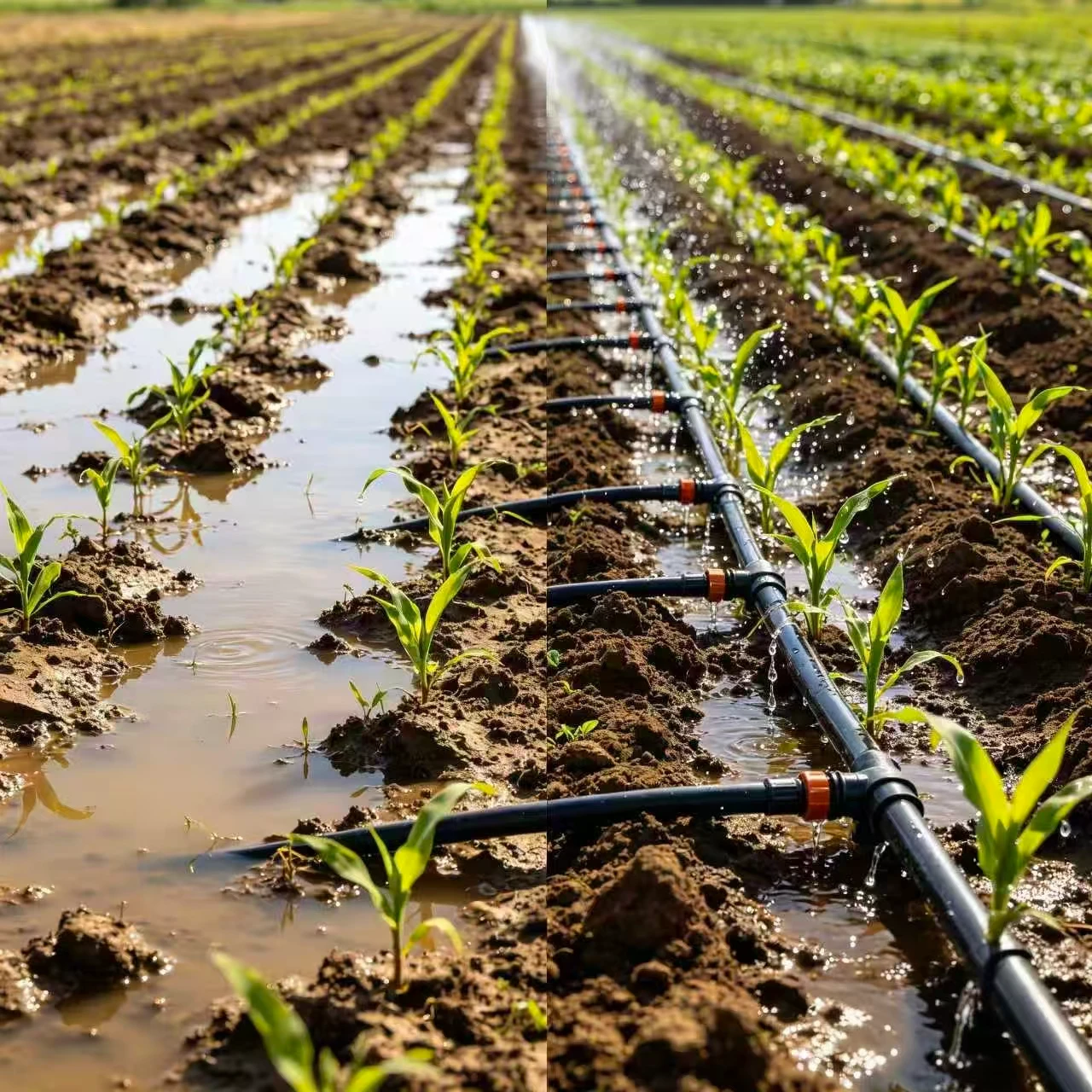
This approach represents a fundamental shift from “watering the land” to “watering the crops.” Traditional irrigation focuses on whether the entire field is covered with water, while modern irrigation ensures that each plant’s root zone receives adequate moisture.
With systems built on HAILI PE Pipe and HAILI pipe, water can be delivered directly to the root zone, minimizing losses caused by evaporation, deep percolation, or surface runoff, and maximizing absorption efficiency.
1.2 Traditional Irrigation: Experience-Driven Extensive Model
For a long time, agricultural irrigation relied heavily on manual labor and experience, with flood irrigation and furrow irrigation being the most common methods.
This model is characterized by “intuition-based decisions” and “weather dependency.” Farmers typically irrigate fields at intervals based on experience, allowing water to flow across the entire area.
However, this method has several critical drawbacks:
Severe water waste: Studies show that over 50% of water is lost during transport and irrigation.
High labor cost: Manual monitoring and valve operation are required.
Uneven irrigation: High areas receive insufficient water, while low areas suffer from waterlogging.
Compared to these outdated systems, modern solutions using HAILI PE Pipe from a trusted China supplier HAILI pipeline significantly improve efficiency and uniformity.
1.3 Modern Efficient Irrigation: Pipeline-Based Water Delivery
To overcome the limitations of traditional irrigation, efficient water-saving technologies such as drip irrigation and sprinkler irrigation have been developed. These systems rely on pipeline networks to deliver water directly to the field, reducing losses during transportation.
Drip Irrigation: One of the most precise irrigation methods, delivering water slowly and uniformly to the root zone. Water use efficiency can exceed 90%, making it ideal for fertigation systems.
Sprinkler Irrigation: Simulates natural rainfall by spraying fine droplets over crops, suitable for various terrains and capable of regulating microclimates.
In both systems, durable and corrosion-resistant materials like HAILI pipe and HAILI PE Pipe ensure long-term performance, especially in large-scale agricultural projects supported by a reliable China supplier HAILI pipeline.
1.4 Traditional vs Smart Irrigation: From Experience to Data-Driven Decisions
If efficient irrigation solves the problem of “how to deliver water,” smart irrigation addresses “when to irrigate and how much to apply.” This marks a transition from experience-driven to data-driven agriculture.
Smart irrigation systems are equipped with sensing and decision-making capabilities. Soil moisture sensors and weather stations continuously monitor field conditions, providing real-time data on soil water content, weather forecasts, and crop evapotranspiration.
Combined with advanced pipeline systems like HAILI PE Pipe, these technologies enable precise control, ensuring optimal water usage and crop growth.
Fundamentals of Fertigation
If water is the blood of crops, fertilizer is their food. In modern agriculture, water and nutrients are inseparable and must work together efficiently. Understanding the interaction between water and fertilizer is essential for precision farming.
2.1 Water-Fertilizer Coupling: Synergistic Effects
Water and nutrients work together in a synergistic way, often achieving results greater than the sum of their parts.
Water as a carrier: Fertilizers must dissolve in water to become absorbable ions. Without sufficient soil moisture, nutrients remain unavailable.
Fertilizer as a regulator: Proper nutrient supply promotes root development, improving drought resistance and water-use efficiency.
This synergy is the foundation of modern fertigation systems, which rely on stable pipeline infrastructure such as HAILI pipe and HAILI PE Pipe provided by a professional China supplier HAILI pipeline.
2.2 Safety Guidelines for Fertigation: Four Critical Limits
When managing water and fertilizer, safety must always come first. Over-fertilization can lead to root burn, crop damage, or soil salinization. The following four limits must be strictly observed:
1. Concentration Limit (EC Value)
Fertilizer concentration should not be too high. The recommended EC value is typically between 1.5–3.0 ms/cm. Values above 3.5 may cause osmotic stress, leading to root dehydration (commonly known as “root burn”).
2. pH Balance
The pH of irrigation water should be maintained between 5.5–6.5 to ensure nutrient availability. Outside this range, nutrients may become fixed in the soil and unavailable to plants.
3. Heavy Metals and Impurities
Fertilizers used in fertigation must comply with standards such as NY1110-2010, limiting heavy metals like arsenic, cadmium, and lead. High solubility and low impurities are essential to prevent clogging in drip systems.
4. Fertilizer Compatibility
Not all fertilizers can be mixed. For example, potassium dihydrogen phosphate should not be combined with calcium or magnesium fertilizers, as it may form precipitates that clog drip irrigation systems.
Modern agriculture is rapidly transitioning toward intelligent, data-driven systems. From efficient irrigation technologies to advanced fertigation management, every component plays a vital role in improving productivity and sustainability.
High-quality infrastructure, including HAILI PE Pipe, HAILI pipe, and solutions from a trusted China supplier HAILI pipeline, ensures reliable water and nutrient delivery, forming the backbone of modern smart irrigation systems.
916.webp)
204.webp)
659.webp)
185.webp)
312.webp)
849.webp)
587.webp)
767.webp)