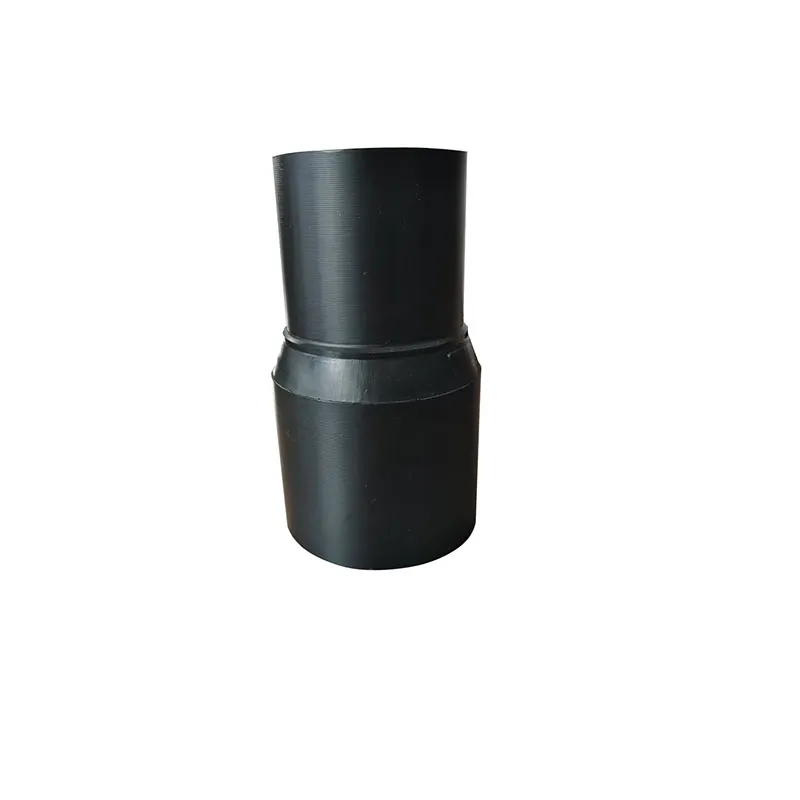
What is a PE reducer?
PE reducer is a pipe fitting used to connect PE pipes of different diameters. It is usually used for diameter transition in pipeline systems to ensure smooth transition of medium flow and reduce hydraulic loss. According to the use environment and fluid characteristics, the appropriate type of PE reducer can be selected to meet specific engineering needs.
Classification and common specifications of PE reducers
PE reducers are pipe fittings used to connect PE pipes of different diameters. They are widely used in water supply, gas, drainage, agricultural irrigation and industrial fluid transportation systems. According to different classification methods, PE reducers can be divided into the following categories:
1. Classification of PE reducers
(1) Classification by shape
Concentric reducer
Axis symmetry, uniform transition, suitable for liquid or gas delivery systems.
Mainly used in vertical pipelines to ensure uniform flow of the medium and reduce turbulence.
Eccentric reducer
One side is straight and the other side gradually changes diameter, suitable for horizontal pipeline systems.
Commonly used to prevent gas accumulation, suitable for drainage systems or pump suction inlets.
(2) Classification by connection method
①Butt fusion reducer
Adopts hot fusion butt welding, suitable for large diameter and high pressure pipelines.
Applicable to high-requirement pipelines such as municipal water supply and gas transmission.
②Electrofusion reducer
Embedded with electric heating wire inside, connected by electrofusion welding, the connection is firm and reliable.
Mainly used for high safety standard pipelines such as gas and water supply.
③ Flange Reducer
Connected by flange, it is easy to connect with metal pipes or valves.
Applicable to pipeline systems that require detachable maintenance, such as industrial pipelines.
④ Socket Fusion Reducer
Using socket welding, it is suitable for connecting small-diameter pipes.
Commonly used in agricultural irrigation and low-pressure water supply systems.
Common specifications of PE reducers
The specifications of PE reducers are usually manufactured according to PE pipe standards. Different pressure levels (such as SDR11, SDR17, etc.) will affect the wall thickness. The following are some common specifications:
(1) Common specifications of PE reducers (metric)
| Large diameter(mm) | Small pipe diameter (mm) | Applicable pressure level (SDR11/SDR17) |
| 160 | 110 | SDR11 / SDR17 |
| 200 | 160 | SDR11 / SDR17 |
| 250 | 200 | SDR11 / SDR17 |
| 315 | 250 | SDR11 / SDR17 |
| 400 | 315 | SDR11 / SDR17 |
| 500 | 400 | SDR11 / SDR17 |
| 630 | 500 | SDR11 / SDR17 |
(2) Common specifications of PE reducers (imperial)
| Large pipe diameter (inches) | Small pipe diameter (inches) | Applicable pressure level |
| 6" | 4" | SDR11 / SDR17 |
| 8" | 6" | SDR11 / SDR17 |
| 10" | 8" | SDR11 / SDR17 |
| 12" | 10" | SDR11 / SDR17 |
| 16" | 12" | SDR11 / SDR17 |
Application and installation methods of PE reducers
PE reducers (PE Reducer) are pipe fittings used to connect PE pipes of different diameters. They are widely used in municipal water supply, gas transmission, agricultural irrigation, industrial fluid transmission and other fields. This article will introduce the main application scenarios and installation methods of PE reducers to help users better understand their use.
1. Main applications of PE reducers
1. Municipal water supply and drainage systems
PE reducers are used to connect PE water supply pipes of different diameters to ensure smooth transition of water flow and reduce pressure loss.
Suitable for urban water supply, sewage treatment, rainwater discharge and other projects.
Made of PE100 high-density polyethylene, it is corrosion-resistant, pressure-resistant and has a long service life.
2. Gas transmission pipelines
PE gas pipelines must use PE80 or PE100 grade pipes, and reducers are used to connect gas pipes of different specifications.
Use electric fusion or hot fusion connection to ensure sealing and safety and prevent gas leakage.
Suitable for natural gas and liquefied petroleum gas (LPG) pipelines.
3. Agricultural irrigation and landscaping
PE reducers are used to connect irrigation pipes of different diameters and are suitable for water-saving irrigation systems such as drip irrigation and sprinkler irrigation.
Suitable for farmland, orchards, landscaping, greenhouses and other scenes.
4. Industrial fluid transportation
Applicable to the transportation of chemical solutions, wastewater, slurry, mud and other media, widely used in chemical plants, pharmaceutical plants, mines and other industries.
PE pipes are resistant to acid and alkali, high pressure, and suitable for corrosive fluid transportation.
5. Communication and power cable protection
Applicable to the protection pipe network of power cables and optical fiber cables, connecting PE protection pipes of different diameters.
Good insulation, moisture-proof and corrosion-resistant, ensuring the safe operation of communication lines and power systems.
2. Installation method of PE reducer
The installation methods of PE reducer mainly include hot-melt connection, electric fusion connection, and flange connection. The specific methods are as follows:
1. Hot-melt connection (Butt Fusion)
Scope of application
Applicable to the connection of large-diameter PE pipes (generally above DN75).
Mainly used in municipal water supply, gas pipeline network, industrial fluid transportation and other projects.
Installation steps
1. Preparation: Clean the end faces of PE pipes and PE reducers to ensure that there are no impurities and moisture.
2. Heating the pipe end: Use a hot melt welder to heat the pipe end until the material melts.
3. Butt fusion: Align the two ends of the pipe and pressurize them to fuse the melted end faces.
4. Cooling and solidification: Keep the pressure still and release the clamp after the fused part is completely cooled.
5. Check the quality: Confirm that the welded joint is free of defects and ensure that the connection is firm.
✅ Advantages: Firm connection, good sealing, suitable for high-pressure pipelines.
❌ Disadvantages: A hot melt welder is required, and the construction is difficult.
2. Electrofusion
Scope of application
Applicable to PE pipes (DN20-DN630) with small diameter or that need to be installed quickly.
Mainly used for gas pipelines, water supply pipelines, underground pipelines, etc.
Installation steps
1. Preparation: Clean the pipe end and use a scraper to remove the surface oxide layer.
2. Insert the electric fusion pipe fitting: insert the PE reducer into the electric fusion sleeve to ensure a tight connection.
3. Power on and heat: use the electric fusion welder to energize the pipe fitting to weld the pipe and the pipe fitting.
4. Cooling and solidification: let it stand after power off, and use it after the joint cools down.
5. Quality inspection: confirm that the welding part is complete and there is no risk of leakage.
✅ Advantages: easy installation, automatic control of welding quality, suitable for gas pipelines.
❌ Disadvantages: electric fusion welder is required, which is more expensive.
3. Flange Connection
Scope of application
Applicable to the connection between PE pipe and metal pipe or valve.
Mainly used in industrial pipelines, sewage treatment, pumping stations and other scenarios.
Installation steps
1. Install the flange: install the flange at both ends of the PE pipe and fix it.
2. Align the flange: align the PE pipe with the PE reducer so that the flange holes are aligned.
3. Install the sealing gasket: Place the sealing gasket between the flanges to improve the sealing performance.
4. Tighten the bolts: Use a torque wrench to tighten the bolts evenly to prevent leakage.
5. Sealing test: Pressurize the test to ensure that there is no leakage before putting it into use.
✅ Advantages: Easy installation and disassembly, suitable for large-diameter pipes or pipe networks that require frequent maintenance.
❌ Disadvantages: The sealing performance is affected by the tightness of the bolts and needs to be checked regularly.
III. Precautions for the installation of PE reducers
1. Choose a suitable welding method: Choose hot melt, electric fusion or flange connection according to the pipe diameter and construction conditions.
2. Clean the pipe port: Before welding, impurities must be cleaned from the pipe end to ensure the quality of the welding.
3. Avoid moisture affecting welding: When constructing in rainy days or humid environments, avoid getting the pipe port wet.
4. Strictly control welding parameters: Heating time, temperature, and pressure must comply with PE pipe standards (ISO 4427, GB/T 13663).
5. The cooling time must be sufficient: After welding, the pressure test must be performed after complete cooling to prevent joint damage.
6. Flange connections must be tightened evenly: Avoid leakage caused by uneven tightening of bolts.
916.webp)
204.webp)
659.webp)
185.webp)
312.webp)
849.webp)
587.webp)
767.webp)