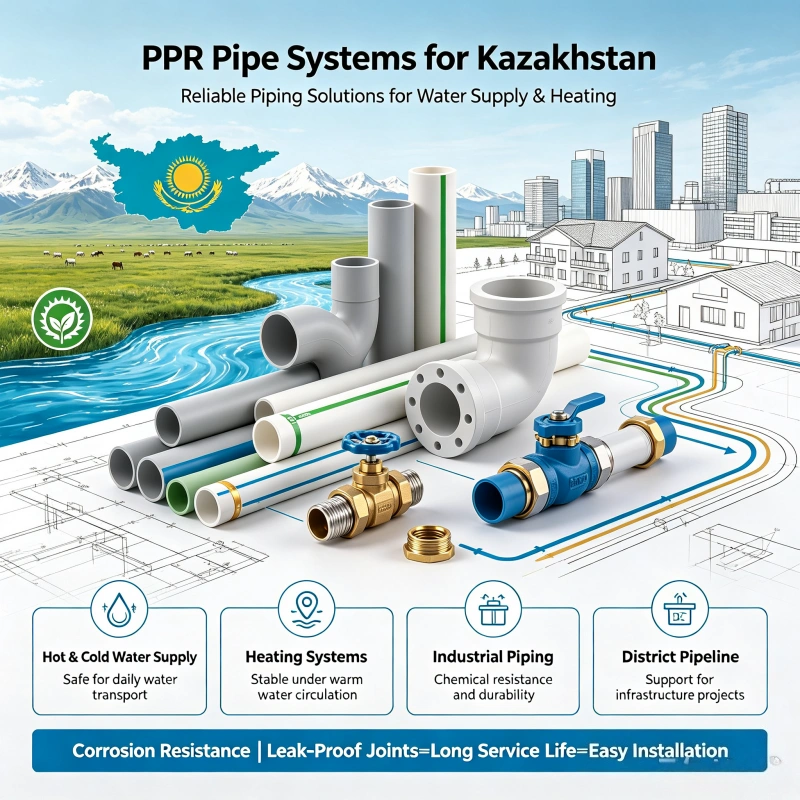
Kazakhstan's plumbing and heating projects require piping systems that can handle reliable hot and cold water distribution, seasonal temperature changes, and demanding installation conditions. From residential apartments in Almaty and Astana to commercial buildings, hotels, industrial facilities, and new construction projects, PPR pipe systems are widely considered for their corrosion resistance, heat resistance, lightweight structure, and fusion-welded connections.
However, selecting a PPR pipe system for Kazakhstan involves more than choosing a pipe diameter or pressure rating. Buyers must consider operating temperature, design pressure, pipe reinforcement, local technical requirements, fitting compatibility, installation quality, and long-term maintenance.
For importers, distributors, contractors, and plumbing wholesalers, working with an experienced manufacturer is equally important. A complete supply package should include compatible PPR pipes, fittings, threaded adapters, valves, and technical documentation.
This guide explains how to select PPR pipe systems for Kazakhstan, compare common pipe types, understand relevant standards, and evaluate an overseas supplier. It also introduces the PPR pipe and fitting solutions available from HAILI.
1. Why Are PPR Pipe Systems Suitable for Kazakhstan?
Kazakhstan has a continental climate, with significant seasonal temperature differences between winter and summer. In cities such as Astana, Karaganda, and Almaty, plumbing and heating systems must be designed around local building conditions and the actual operating temperatures of the water inside the pipes.
PPR, or polypropylene random copolymer, is commonly used in indoor hot and cold water distribution because it offers several practical advantages.
Corrosion Resistance
Unlike conventional metal pipes, PPR pipes do not rust. Their resistance to corrosion helps reduce the risk of rust-related contamination and deterioration inside water distribution systems.
This is particularly useful in residential buildings, hotels, commercial facilities, and other projects where long-term water quality and maintenance costs matter.
Suitable for Hot and Cold Water
PPR piping systems are available in different pressure and application classes. When correctly selected, they can be used in domestic hot water, cold water, and certain heating applications.
The operating temperature and pressure must always be checked against the manufacturer's technical data and the applicable design conditions.
Lightweight and Easy to Transport
PPR pipes are considerably lighter than many traditional metal piping alternatives. This makes transportation, warehouse handling, and installation more convenient.
For distributors importing container quantities into Kazakhstan, lower handling complexity can also improve warehouse efficiency.
Heat-Fusion Connections
PPR pipes and compatible fittings are normally connected using socket fusion welding. The pipe and fitting are heated with a suitable welding tool and joined to form a permanent connection.
Unlike systems relying on numerous mechanical joints, properly installed fusion connections can create a continuous piping network with fewer potential leakage points.
Long-Term Service Potential
PPR systems are often marketed with a service life of up to 50 years under specified operating conditions.
However, this should not be interpreted as a guaranteed lifespan under every condition. Actual service life depends on water temperature, pressure, operating cycles, material quality, installation workmanship, and compliance with the manufacturer's design limits.
For Kazakhstan projects, the correct approach is to select a complete system based on the actual application rather than choosing pipes only because they carry a high PN marking.
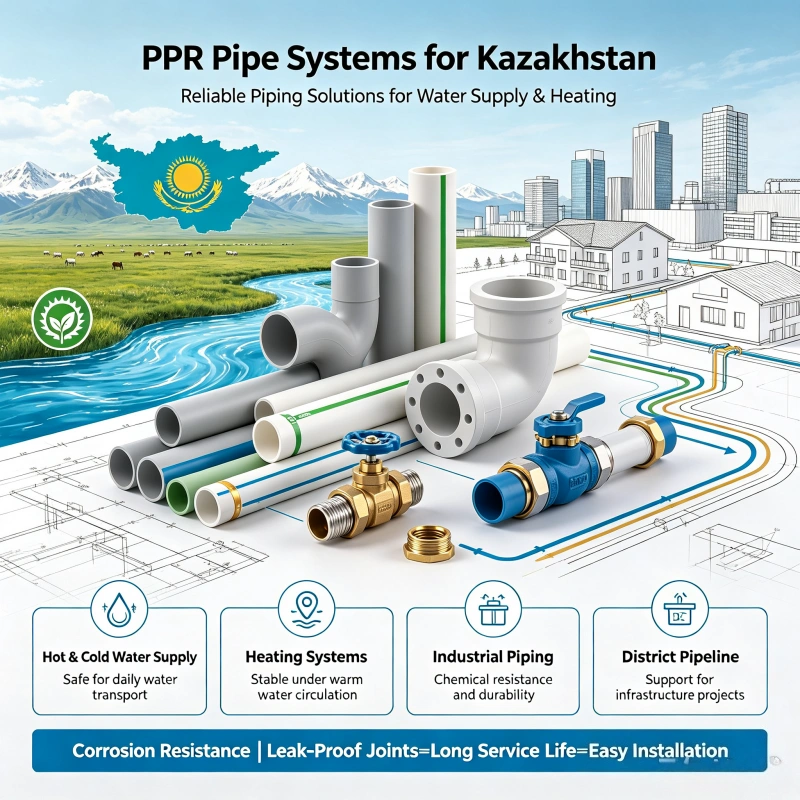
2. Main Applications of PPR Pipe Systems in Kazakhstan
PPR pipes are used in several building and infrastructure-related applications. The appropriate pipe construction and pressure class depend on the operating conditions of each project.
| Application | Common pipe selection considerations | Main requirements |
|---|---|---|
| Residential cold water | Standard PPR pressure pipe | Pressure resistance and water quality |
| Residential hot water | PPR pipe with suitable pressure-temperature rating | Temperature resistance and expansion control |
| Apartment heating | Reinforced PPR or another approved heating pipe system | Temperature stability and system design |
| Commercial buildings | PPR pipes and matching fittings | Flow capacity and connection reliability |
| Hotels and hospitals | Hot and cold water piping systems | Hygiene, documentation, and maintenance |
| Industrial water distribution | Application-specific PP piping | Chemical compatibility and operating pressure |
| Agricultural facilities | PPR or other suitable plastic piping | Water quality, pressure, and installation conditions |
Residential Plumbing
Apartments and private houses generally require separate cold-water and hot-water distribution lines.
Smaller pipe diameters, such as 20 mm and 25 mm, are commonly used for individual fixtures and branch connections. Larger diameters may be required for main distribution lines, depending on the number of users and calculated water demand.
Heating Systems
Heating applications require more careful engineering than ordinary cold-water plumbing.
The designer must consider continuous operating temperature, maximum temperature, pressure, circulation conditions, thermal expansion, and the applicable heating-system requirements.
Glass-fiber-reinforced or aluminum-reinforced PPR pipes may be considered where reduced thermal expansion is desirable. Nevertheless, reinforcement alone does not determine whether a pipe is suitable for a particular heating circuit.
Commercial and Industrial Projects
Hotels, office buildings, shopping centers, and industrial facilities may require larger quantities of pipes and fittings in several diameters.
For these projects, purchasing a coordinated system from one supplier can simplify product matching, inventory management, and technical communication.
Explore HAILI's PPR pipes and fittings for pipe connection components and system supply options.
3. PPR Pipe Types: Which System Should Buyers Choose?
Not all PPR pipes have the same construction or performance characteristics. Understanding the differences helps contractors and importers prepare a more accurate purchasing specification.
Standard PPR Pipes
Standard PPR pipes are manufactured from polypropylene random copolymer.
They are commonly used for:
Cold-water distribution.
Domestic hot-water pipelines within rated conditions.
Residential plumbing.
Commercial water distribution.
Their advantages include corrosion resistance, relatively low weight, and straightforward heat-fusion installation.
Glass-Fiber-Reinforced PPR Pipes
Glass-fiber-reinforced PPR pipes typically contain a multilayer structure with a glass-fiber-reinforced middle layer.
The reinforcement can reduce longitudinal thermal expansion compared with an equivalent unreinforced pipe, depending on the product construction.
Potential applications include:
Hot-water distribution.
Heating circuits where the pipe is approved for the design conditions.
Long straight pipeline sections.
Installations where thermal movement needs to be controlled.
Buyers should confirm the pipe's layer construction, temperature-pressure rating, and technical documentation instead of assuming every glass-fiber product has identical performance.
Aluminum-Reinforced PPR Pipes
Aluminum-reinforced PPR pipes incorporate an aluminum layer into the pipe structure.
Depending on the construction, aluminum reinforcement can reduce thermal expansion and may provide an oxygen barrier.
Before purchasing, confirm whether the pipe is solid-wall, perforated-aluminum, or another multilayer construction. These products may have different preparation and welding requirements.
PPR Pipe Selection Comparison
| Pipe type | Main characteristic | Typical consideration |
|---|---|---|
| Standard PPR | Simple polypropylene construction | General hot and cold water distribution |
| PPR-GF | Glass-fiber reinforcement | Reduced thermal expansion |
| PPR with aluminum | Aluminum reinforcement | Expansion control and potential oxygen barrier |
| PP-RCT | Modified polypropylene material | Product-specific pressure and temperature performance |
For Kazakhstan projects, the best pipe type depends on the system's operating conditions, not simply on whether a product is labeled as reinforced.
4. PPR Pipe Sizes Commonly Used in Kazakhstan
PPR pipe sizes are normally identified by their nominal outside diameter in millimeters.
The commonly encountered size range for building plumbing includes 20 mm, 25 mm, 32 mm, 40 mm, 50 mm, and 63 mm. Larger diameters may be required for main distribution lines and commercial installations.
The following table provides a practical overview of common sizes and applications.
| Nominal outside diameter | Common applications |
|---|---|
| 20 mm | Individual water outlets and fixture branches |
| 25 mm | Residential distribution branches |
| 32 mm | Main apartment distribution lines |
| 40 mm | Larger building branches |
| 50 mm | Commercial water distribution |
| 63 mm | Larger supply and distribution lines |
| 75–110 mm | Larger building or project-specific distribution |
These are general application examples, not a substitute for hydraulic calculations.
How to Select the Correct Diameter
Pipe diameter selection should consider:
Required flow rate.
Available water pressure.
Pipeline length.
Number of connected fixtures.
Allowable pressure loss.
Water velocity.
Pipe wall thickness and actual internal diameter.
For example, a 20 mm PPR pipe may be suitable for a small branch supplying one or a limited number of fixtures. It should not automatically be used as the main supply pipe for a large apartment building.
A common procurement mistake is comparing pipes only by outside diameter. Two pipes with the same outside diameter but different SDR values or wall thicknesses can have different internal diameters and hydraulic performance.
5. PN16, PN20 and PN25: Understanding PPR Pressure Ratings
PN is a nominal pressure classification commonly used in PPR product descriptions.
However, PN20 does not mean that a pipe can continuously operate at 20 bar under every temperature condition.
Pressure capacity changes with operating temperature, material characteristics, design life, and the relevant application class.
| Pressure designation | General purchasing consideration | Important verification |
|---|---|---|
| PN16 | Lower nominal pressure class | Confirm suitability for the actual cold-water or heating conditions |
| PN20 | Commonly specified for building plumbing | Check temperature-pressure performance |
| PN25 | Higher nominal pressure designation | Confirm the construction and rated operating conditions |
PN20 vs. PN25 for Kazakhstan Projects
For many residential plumbing projects, PN20 and PN25 are among the product designations buyers may encounter.
The selection should be based on the engineering specification rather than a simple assumption that PN25 is always better.
For example:
A cold-water branch may not require the same pipe construction as a high-temperature heating circuit.
A reinforced pipe may offer lower thermal expansion than an unreinforced pipe.
A higher nominal pressure designation does not eliminate the need to calculate operating pressure at elevated temperatures.
Practical recommendation: Request the manufacturer's pressure-temperature relationship, SDR information, wall thickness, and application-class documentation before confirming the purchase order.
6. Kazakhstan Standards and Documentation for PPR Pipe Systems
Standards and product documentation are important considerations when importing PPR pipes into Kazakhstan.
Two references that buyers may encounter are GOST 32415-2013 and ISO 15874.
GOST 32415-2013
GOST 32415-2013 covers pressure pipes made from thermoplastics and their fittings for water supply and heating systems.
It addresses materials including PP-R and PP-RCT, as well as other polymer piping materials. The standard also considers the requirements for pipes, fittings, and joints as a complete piping system.
Buyers should confirm whether the relevant product specification, certification, and project documentation meet the requirements applicable to their destination and application.
ISO 15874
ISO 15874 is an international standard series for polypropylene piping systems used in hot and cold water installations.
Its main parts cover different aspects:
ISO 15874-1: General requirements.
ISO 15874-2: Requirements for pipes.
ISO 15874-3: Requirements for fittings.
ISO 15874-5: Fitness for purpose of the system.
ISO 15874 considers application classes, design temperatures, pressures, and pipe dimensions. It is therefore more useful as a system-level reference than simply checking whether a pipe carries a particular PN label.
Documents Buyers Should Request
Before importing PPR pipes into Kazakhstan, request the following documents where applicable:
| Document | Why it matters |
|---|---|
| Product technical datasheet | Confirms diameter, wall thickness, SDR, material, and ratings |
| Material information | Helps verify the polymer grade and product construction |
| Test reports | Provides evidence of relevant product performance |
| Quality certificates | Supports quality and project documentation requirements |
| ISO 15874 or relevant standard declaration | Helps assess technical compliance |
| GOST-related documentation | Relevant where specified by local regulations or project documents |
| Packing list | Supports customs clearance and warehouse receiving |
| Commercial invoice | Required for commercial and customs procedures |
Not every document is automatically mandatory for every shipment. Importers should verify current Kazakhstan customs, conformity assessment, and project-specific requirements before shipment.
7. How Kazakhstan's Winter Climate Affects PPR Pipe Installation
One of the most important differences between selecting PPR pipes for Kazakhstan and selecting them for a milder climate is the need to plan for seasonal temperature changes.
However, an important technical distinction must be made: PPR pipes are normally selected according to the temperature of the fluid inside the pipe, while the surrounding air temperature affects storage, installation, thermal movement, and freeze protection.
Protect Water Pipelines from Freezing
PPR is not a guarantee against freeze damage.
When water freezes inside a closed pipeline, expansion can generate stress that may damage pipes, fittings, valves, or connected equipment.
For pipelines installed in unheated spaces or exposed locations, project designers should consider:
Suitable thermal insulation.
Heated or protected pipe routes where necessary.
Installation below the locally determined frost depth for buried services, where applicable.
Drainage provisions for lines that may be shut down.
Freeze-protection measures for vulnerable sections.
Proper sealing of building penetrations.
Do not assume that wrapping a pipe with ordinary insulation will prevent freezing indefinitely. Insulation slows heat loss; it does not generate heat.
Control Thermal Expansion
PPR pipes expand when their temperature increases.
For long hot-water pipelines, designers should account for expansion through appropriate routing, supports, fixed points, sliding supports, and expansion loops or compensators where required.
Glass-fiber or aluminum reinforcement can help reduce expansion, but it does not remove the need for proper installation design.
Follow the Welding Temperature Requirements
Cold weather can make PPR installation more challenging.
The installer should follow the pipe and fitting manufacturer's welding instructions, including:
Recommended welding-tool temperature.
Heating time for each pipe diameter.
Insertion depth.
Joining time.
Cooling time.
Environmental temperature limitations.
Avoid welding wet or contaminated components. Do not forcefully rotate the pipe and fitting during the fusion process unless the manufacturer's instructions specifically allow it.
For low-temperature installation, the contractor should confirm whether additional environmental precautions or different working procedures are required.
8. PPR Pipe Fittings: Building a Complete System
A PPR pipe system is only as reliable as its pipes, fittings, connections, and installation quality.
For Kazakhstan distributors and contractors, purchasing compatible fittings together with the pipes helps reduce the risk of missing components during installation.
Common PPR fittings include:
| Fitting | Function |
|---|---|
| PPR elbow | Changes pipeline direction |
| PPR tee | Creates a branch connection |
| PPR coupler | Connects two pipes of the same diameter |
| PPR reducer | Connects different pipe diameters |
| PPR female adapter | Connects PPR pipes to male-threaded components |
| PPR male adapter | Connects PPR pipes to female-threaded components |
| PPR end cap | Closes a pipeline end |
| PPR union | Allows a removable connection in suitable designs |
| PPR valve | Controls water flow |
Metal-threaded fittings require particular attention. Buyers should confirm the thread type, insert material, connection dimensions, and compatibility with the intended valves or equipment.
HAILI supplies a range of PPR connection components, including female adapters, male adapters, couplers, and end caps.
Explore the HAILI PPR pipes and fittings range and the broader pipe fittings product category.
For a more detailed explanation of individual components, see PPR Pipe Fittings Name: Complete Guide.
9. How to Choose a Reliable PPR Pipe Supplier for Kazakhstan
Importing PPR pipe systems is not simply a matter of comparing the lowest price per meter.
A reliable supplier should be able to provide consistent specifications, compatible fittings, clear technical documentation, and practical export support.
Here are seven factors to evaluate.
1. Product Range
Check whether the manufacturer can supply the pipe diameters and constructions required by your project.
A coordinated product range can simplify purchasing and reduce the number of suppliers involved.
2. Material Quality
Ask about the PP-R raw material grade, material traceability, production controls, and testing procedures.
Avoid choosing products based solely on appearance or color. Similar-looking pipes can have different material formulations and performance characteristics.
3. Technical Specifications
Request complete product datasheets covering:
Outside diameter.
Wall thickness.
SDR or pipe series.
Pressure designation.
Temperature limits.
Pipe construction.
Applicable standards.
These details should match the approved project specification.
4. Fitting Compatibility
Pipes and fittings must be dimensionally compatible and suitable for the same fusion-welding procedure.
Mixing components from different manufacturers without confirming compatibility can increase the risk of poor fusion joints.
5. Quality Control
Ask how the factory controls raw materials, extrusion dimensions, wall thickness, product appearance, and batch consistency.
Where appropriate, request production inspection records and test reports.
6. Export Experience
For Kazakhstan buyers, evaluate whether the supplier can prepare export documents, product labels, packing lists, and shipment arrangements.
Confirm the shipping terms, destination, delivery schedule, and responsibilities for customs-related procedures.
7. After-Sales Communication
A supplier should be able to answer technical questions after delivery.
This is particularly important for distributors and contractors who may need assistance with product specifications, welding instructions, or replacement components.
10. HAILI PPR Pipe Systems for Kazakhstan Buyers
HAILI is a Chinese pipe manufacturer and supplier with more than 20 years of experience in the pipe industry and a team of over 200 experienced professionals.
The company supplies multiple plastic piping product categories, including PPR pipe systems, HDPE pipes, PEX and PE-RT systems, PVC pipes, pipe fittings, and related products.
For buyers serving Kazakhstan, HAILI can support sourcing discussions for PPR pipes and compatible fittings for residential, commercial, and industrial water distribution projects.
PPR Product Range
HAILI's published PPR pipe and fitting product information includes:
| Item | Published product information |
|---|---|
| Material | PP-R and PP |
| Listed fitting size range | 20–63 mm |
| Listed colors | White and green |
| Published pressure information | Product page lists pressure rating 25 |
| Applications | Hot and cold water, heating, and industrial fluid transportation |
| Connection methods | Fusion-welded and threaded connections, depending on fitting type |
The published product page also describes female adapters, male adapters, couplers, and end caps.
For a specific order, buyers should request confirmation of the exact pipe series, PN classification, wall thickness, available diameter, color, and standard documentation. Product-page descriptions may cover multiple specifications, so the final purchase order should be based on an approved technical datasheet.
Why Work with HAILI?
More than 20 years of industry experience
HAILI has developed experience in plastic pipe manufacturing and supply, supporting different project and distribution requirements.
A broad piping product portfolio
The company offers several pipe-system categories. Buyers sourcing more than one type of plastic piping product can discuss coordinated purchasing requirements.
Compatible fitting options
HAILI's PPR product range includes essential connection components, helping buyers prepare a more complete bill of materials.
Export-oriented supply support
HAILI provides international buyers with product information and export communication support for purchasing discussions.
Learn more about HAILI as a pipe manufacturer or explore its PPR and PP-RCT piping information.
11. PPR Pipe Purchasing Checklist for Kazakhstan Importers
Before sending an inquiry to a manufacturer, prepare a clear product specification.
This makes it easier to compare quotations and reduces the risk of ordering incompatible products.
| Purchasing information | Details to confirm |
|---|---|
| Product type | Standard PPR, glass-fiber reinforced, or aluminum reinforced |
| Diameter | 20, 25, 32, 40, 50, 63 mm, or other sizes |
| Pressure class | PN16, PN20, PN25, or project-specific requirements |
| Wall thickness | Confirm by diameter and pipe series |
| Color | White, green, gray, or custom options |
| Pipe length | Standard or project-specific length |
| Fittings | Elbows, tees, couplers, reducers, adapters, valves |
| Quantity | Meters, pieces, cartons, or complete project quantities |
| Documentation | Datasheets, test reports, certificates, and declarations |
| Destination | Almaty, Astana, Karaganda, or another city |
| Shipping terms | EXW, FOB, CIF, or another agreed Incoterm |
| Packaging | Bundling, protective caps, labels, and pallet requirements |
Example: Preparing a Residential Plumbing Order
A distributor purchasing for residential plumbing projects might prepare a request with:
20 mm PPR pipes for fixture branches.
25 mm pipes for smaller distribution lines.
32 mm pipes for selected main branches.
Matching elbows, tees, couplers, and reducers.
Female and male threaded adapters.
End caps and other required accessories.
This is only an example purchasing structure. Actual quantities and pipe classes must be determined by the building design.
A useful practice is to prepare a bill of materials before requesting a quotation. This allows the manufacturer to quote pipes and fittings together rather than pricing individual items without understanding the complete order.
12. What Affects PPR Pipe Prices in Kazakhstan?
The final price of an imported PPR piping system depends on several factors.
Pipe Diameter and Wall Thickness
Larger diameters and thicker pipe walls generally require more raw material per meter, increasing production costs.
Pressure Class and Reinforcement
PN classification, pipe series, material grade, and reinforcement construction all influence manufacturing costs.
Fitting Quantity
A complete piping project requires many fittings. The cost of elbows, tees, reducers, adapters, valves, and threaded inserts should be included in the total procurement budget.
Order Volume
Bulk orders may offer better unit economics because production planning, packaging, and shipping can be organized more efficiently.
Shipping and Import Costs
The delivered cost in Kazakhstan may include:
Factory price.
Export packaging.
Inland transportation in China.
International freight.
Cargo insurance, where applicable.
Customs duties and taxes.
Local transportation and warehouse handling.
For this reason, buyers should compare the total landed cost rather than only the factory price per meter.
Currency and Delivery Conditions
Quotations may be issued in USD or another agreed currency. Exchange rates, freight availability, shipment timing, and destination arrangements can affect the final cost.
For accurate pricing, send the manufacturer a detailed list of pipe diameters, pressure classes, quantities, fittings, and destination city.
13. Common Mistakes When Purchasing PPR Pipe Systems
Even experienced buyers can encounter problems when product specifications are incomplete.
The following mistakes are worth avoiding.
Mistake 1: Selecting pipes only by PN rating
PN alone does not establish suitability for high-temperature service. Always check pressure-temperature performance.
Mistake 2: Ignoring thermal expansion
Long hot-water pipelines need suitable support and expansion provisions.
Mistake 3: Mixing incompatible fittings
Different manufacturers may use different dimensions or welding recommendations. Confirm compatibility before combining products.
Mistake 4: Focusing only on the lowest purchase price
Low initial cost may be offset by inconsistent dimensions, poor fittings, inadequate documentation, or installation problems.
Mistake 5: Forgetting winter installation conditions
Storage, transportation, handling, and welding procedures should account for low ambient temperatures.
Mistake 6: Treating insulation as complete freeze protection
Insulation slows heat loss but cannot prevent freezing indefinitely without an appropriate thermal design.
Mistake 7: Ordering pipes without a complete fitting list
Missing adapters, tees, or valves can delay project installation and increase additional procurement costs.
14. Frequently Asked Questions About PPR Pipe Systems in Kazakhstan
Are PPR pipes suitable for Kazakhstan's climate?
PPR pipes can be suitable for indoor hot- and cold-water systems in Kazakhstan when selected according to the design temperature, pressure, and applicable technical requirements.
However, exposed or unheated pipelines need appropriate freeze protection. PPR should not be treated as automatically freeze-proof.
Which PPR pipe is better for heating: PN20 or PN25?
The answer depends on the product construction and actual operating conditions.
Buyers should compare the manufacturer's pressure-temperature ratings, application class, reinforcement type, and design life. A higher PN designation does not automatically mean that a pipe is suitable for every heating application.
What PPR pipe sizes are commonly used in Kazakhstan?
Common building plumbing sizes include 20 mm, 25 mm, 32 mm, 40 mm, 50 mm, and 63 mm. Larger sizes may be needed for commercial or project-specific applications.
Are glass-fiber-reinforced PPR pipes suitable for heating?
They may be suitable for certain heating systems when the product is designed and approved for the required operating temperature and pressure.
Glass-fiber reinforcement can reduce thermal expansion, but the system still requires proper support and installation design.
What standards should buyers check when importing PPR pipes into Kazakhstan?
GOST 32415-2013 and the ISO 15874 series are relevant technical references for polymer piping systems used in water supply and heating.
Importers should also confirm current Kazakhstan conformity assessment and project-specific documentation requirements before ordering.
Can PPR pipes be used for drinking water?
PPR pipes can be manufactured for potable-water applications. However, buyers should request the relevant material declarations, hygiene approvals, and conformity documents required in the destination market.
Do not assume that every PPR product is automatically approved for drinking-water use.
What fittings are required for a complete PPR system?
Typical components include elbows, tees, couplers, reducers, female adapters, male adapters, end caps, and valves.
The final list depends on the piping layout and the equipment being connected.
Can HAILI supply PPR pipes and fittings for Kazakhstan distributors?
HAILI provides PPR pipes and fitting products for international buyers. Distributors and contractors can contact the company with their required diameters, pressure classes, product types, fitting quantities, and destination details to confirm availability and obtain a quotation.
15. Get a PPR Pipe System Quotation for Kazakhstan
Choosing the right PPR pipe system is an important decision for distributors, plumbing contractors, construction companies, and project developers in Kazakhstan.
The best purchasing decision considers more than the price per meter. Pipe construction, pressure-temperature performance, compatible fittings, technical documentation, installation conditions, and delivery arrangements all affect the long-term value of the system.
HAILI supports international buyers with PPR piping products, pipe fittings, and a broader range of plastic piping solutions.
If you are sourcing PPR pipes for residential plumbing, commercial buildings, heating projects, or wholesale distribution in Kazakhstan, send us your product specifications and estimated quantities.
Contact HAILI to discuss your PPR pipe requirements and request a project-based quotation.
Website: https://www.hailigd.com/
Email: salehaili03@hailigd.com
Phone / WhatsApp: +86-18678788117
446.webp)



916.webp)
204.webp)
659.webp)