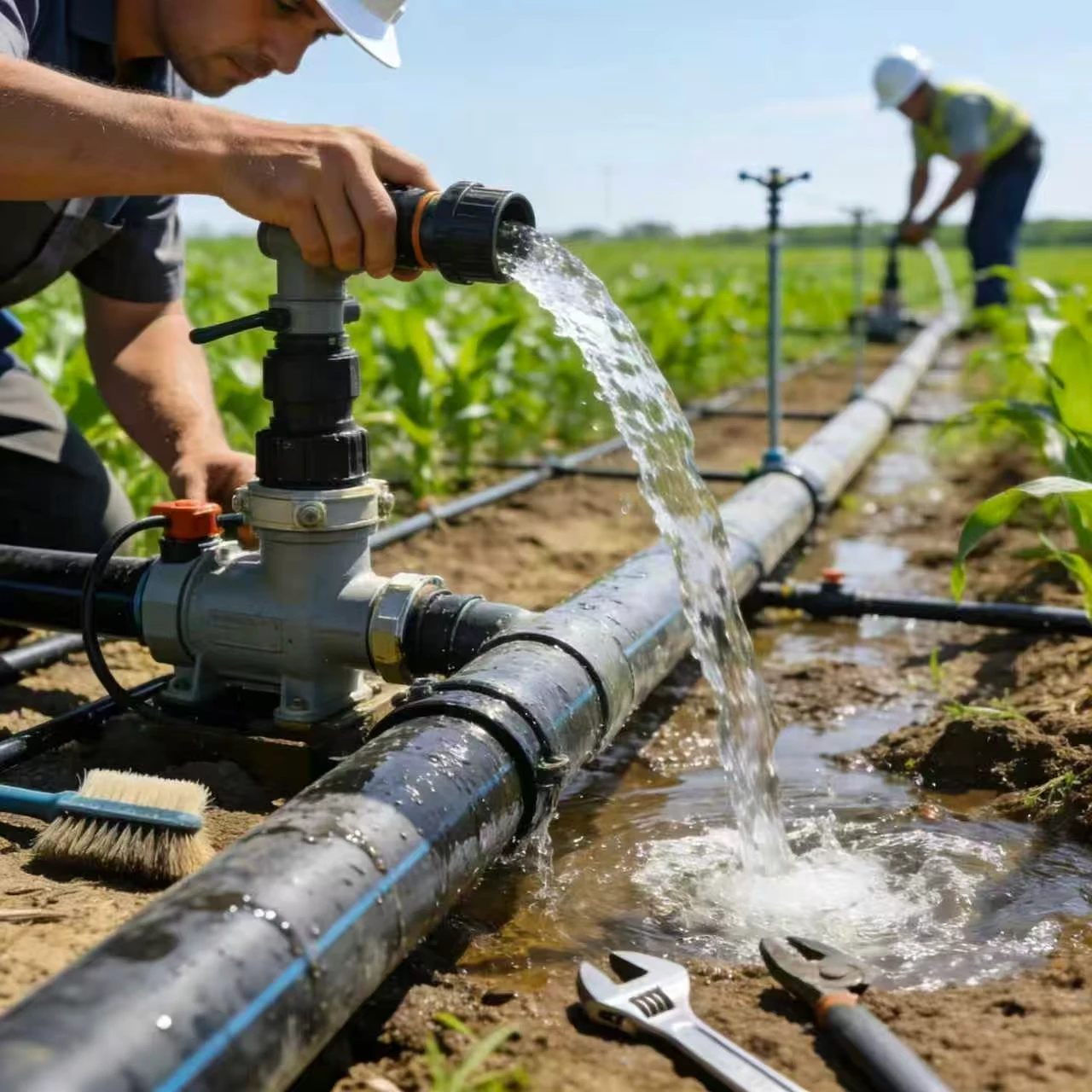
Pipeline flushing, as a core operation throughout the entire lifecycle of installation, operation, maintenance, and wintering, is not a single construction step but a systematic work with phased stages and specific objectives. This article, based on practical experience in irrigation engineering construction and operation and maintenance, clarifies the classification, operation methods, technical requirements, and installation and acceptance specifications for pipeline flushing, providing technical support for the standardized management of irrigation pipelines.
I. Core Classifications and Applicable Scenarios of Pipeline Flushing
Based on different stages of irrigation system construction and operation, pipeline flushing can be divided into three basic types: initial flushing after installation, preparatory flushing before system operation, and maintenance flushing after the irrigation season. Additionally, a special winter anti-freezing flushing is added for areas with frozen soil. The four types of flushing have different purposes, timings, and operational focuses, and none can be omitted.
(I) Initial Flushing After Installation
Installation flushing is the first mandatory flushing after the drip irrigation system is completed. It is performed when pipe laying, fitting connections, and valve installation are all completed, but the sprinklers have not yet been installed or have been temporarily sealed. The core purpose of flushing at this stage is to thoroughly remove residual soil, sand, gravel, plastic debris, cement residue, sealant residue, and other debris from the pipeline construction process, preventing impurities from entering the capillary tubes and clogging the drippers and micro-sprinklers. It also checks the sealing of pipe joints and eliminates potential construction hazards, which is a fundamental step to ensure the subsequent normal operation of the system.
(II) Preparatory Flushing Before System Operation
Preparatory flushing before drip irrigation system operation is for the system commissioning stage before the start of the irrigation season and is applicable to irrigation systems that have been idle for a long time (such as across seasons). After being idle during winter or the non-irrigation season, small amounts of silt, insect eggs, and dust can easily accumulate on the inner walls of the pipes. In some humid environments, trace amounts of algae may also grow. If the system is started directly, these impurities will enter the irrigation system with the water flow, causing blockages. This flushing stage aims to pre-treat and remove silt, ensuring the system is put into irrigation operation in a clean state.
(III) Post-Irrigation Season Maintenance
Flushing Maintenance flushing is required after the irrigation season ends and crops are harvested. This is a routine maintenance task for the system. During irrigation operation, fertilizer solutions, silt, impurities, and microorganisms gradually adhere to the inner walls of the pipes, forming crystals or biofilms. Long-term residue can corrode the pipes, reduce the water flow cross-section, and decrease water delivery efficiency. Maintenance flushing can thoroughly remove pollutants accumulated during operation, keep the inner walls of the pipes clean, extend the service life of the pipes and fittings, and prepare for the next irrigation season.
(IV) Winter Anti-Freezing Flushing in Frozen Soil Areas
This flushing is a special operation for specific areas and is only applicable to cold northern regions with frozen soil. The timing is before winter arrives and the temperature drops to 0℃. Its core purpose is not to remove impurities, but to completely drain accumulated water from the pipes, preventing the water from freezing and expanding in low-temperature environments, which could lead to freezing and cracking of main pipes, branch pipes, and capillary pipes. This is a crucial measure for winter protection of irrigation systems in permafrost regions.
II. Basic Configuration Requirements for Pipeline Flushing
(I) Installation Specifications for Flushing Valves and Plugs
To ensure smooth flushing, sewage discharge, and drainage of accumulated water in each section of the pipeline, each main pipe, branch pipe, and capillary pipe must be equipped with a flushing valve or a removable plug according to specifications. This is an essential hardware requirement for pipeline flushing.
1. For main pipes with large diameters and long water transport distances, flushing valves must be installed at the pipe ends, low-lying areas, and branch nodes. Valve selection should match the pipe pressure rating to ensure unobstructed drainage.
2. Branch pipes, serving as connections between main and capillary pipes, must have removable plugs or small flushing valves installed at their ends for easy segmented flushing.
3. Capillary pipes have small diameters and are prone to clogging; simple plugs can be used at their ends, which can be removed for flushing to allow drainage.
4. All flushing valves and plugs must be securely installed and well-sealed to ensure normal drainage during flushing and a tight seal during irrigation to prevent leakage.
(II) Flushing Water Source and Power Requirements
:The effectiveness of pipe flushing directly depends on the water pressure and flow rate. A centralized pressure water source with dedicated flushing valves is required; the use of low-pressure, dispersed water sources is strictly prohibited.
1. The flushing pump must meet the maximum water flow requirements of the pipeline to ensure sufficient flow velocity within the pipes, quickly discharging silt and impurities.
2. Centralized pressurized water ensures sufficient water flow impact, preventing impurities from accumulating at the bottom of the pipes due to insufficient pressure, thus ensuring thorough flushing.
3. The flushing water source must be clean, free of large amounts of silt and debris to prevent secondary contamination of the pipelines. If the water source quality is poor, a primary filter must be installed beforehand.
III. General Sequence for Pipeline Flushing
Regardless of the type of pipeline flushing, the fixed sequence of "main pipe first, then branch pipes, and finally capillary pipes" must be followed. Flushing must be done segment by segment, and simultaneous flushing of the entire pipeline is strictly prohibited. The specific reasons and requirements are as follows:
1. Main pipes have the largest diameter and longest length, and contain the most construction residue and accumulated impurities. Prioritizing flushing main pipes prevents impurities from entering branch pipes and capillary pipes with the water flow, causing secondary blockages.
2. After flushing the main pipes, flush each branch pipe in sequence, and finally flush the capillary pipes. Step-by-step flushing ensures thorough flushing of each section of pipeline.
3. When flushing in segments, the valves of the unflushed sections must be closed. After completing one segment and sealing the end flushing valve/plug, the next segment can be flushed to prevent short-circuiting of the water flow and backflow of impurities.
IV. Specific Operating Procedures for Flushing Various Types of Pipelines
(I) Initial Flushing Procedures After Installation
1. Preparation before flushing: Temporarily remove all capillary irrigation devices (drip tape, drip tubing, micro-sprinklers, etc.), or close the valves at the end of the capillary tubes to ensure that impurities do not enter the irrigation devices; open all end flushing valves on the main and branch pipes, remove the end plugs of the capillary tubes to form a smooth drainage channel; check whether the water pump and water source connections are normal, and whether the pipe joints are loose.
2. Segmented flushing operation: Turn on the flushing water pump and supply water for flushing at maximum flow rate and rated pressure. During the flushing process, arrange personnel to observe the water quality at the end of the pipe, focusing on checking for mud, debris, and turbidity; each section of the pipe should be flushed for no less than 5-10 minutes until the water at the end of the pipe is completely clear, free of impurities, turbidity, and floating matter. 3. Post-flushing cleanup: After flushing the main pipes, branch pipes, and capillary tubes, close all end-flushing valves and reinstall the capillary tube emitters. Before installation, check again whether the emitter flow channels are unobstructed to avoid introducing new impurities during installation. Thoroughly inspect pipe joints, flanges, and valve connections to ensure there are no leaks or seepage.
(II) Pre-operation flushing steps:
1. Preliminary inspection: Check that all flushing valves and plugs are intact, filters are clean, and pipes are free of obvious damage.
2. Step-by-step flushing: Following the order of main pipes, then branch pipes, and finally capillary tubes, turn on the corresponding end-flushing devices and start the water supply to flush until the effluent is clear.
3. System commissioning: After flushing, turn off the flushing devices and turn on some emitters for trial operation. Check the irrigation uniformity and, after confirming there are no blockages or leaks, put the system into formal operation. (III) Post-Irrigation Season Maintenance and Flushing Procedures
1. Pre-treatment: Stop fertilization and pesticide application. Allow clean water to circulate in the pipes for 10-15 minutes to dilute any residual fertilizer solution.
2. Thorough Drainage: Operate the flushing devices in stages, following the sequential flushing sequence. Focus on flushing away any biofilm and fertilizer crystals adhering to the inner walls of the pipes until the effluent is odorless and free of viscous substances.
3. Final Maintenance: After flushing, close all valves. Disassemble and clean the filter, allow it to dry, and then reinstall it. This completes the seasonal maintenance of the system. (IV) Winter Anti-freezing Flushing Procedures in Frozen Soil Areas
1. Routine Drainage Flushing: First, start the water source and flush the pipes according to the normal flushing procedure to remove most of the accumulated water and residual impurities, preparing for subsequent drainage;
2. High-Pressure Air Purging: Due to the large diameter of the main pipe and the difficulty in completely draining accumulated water, it is necessary to use high-pressure air to blow water into the pipe to remove the accumulated water. During operation, a dedicated high-pressure blower must be connected, and the air pressure must be controlled within the pipe's pressure-bearing range. Purge from the beginning to the end of the main pipe until no water is discharged from the end;
3. Branch Pipe and Capillary Pipe Drainage: Branch pipes and capillary pipes can be thoroughly drained of residual water using inclined drainage combined with water flow impact, ensuring no water remains in the pipes;
4. Winter Sealing: After the accumulated water has been drained, close all flushing valves, remove exposed valves, and ensure proper insulation to complete winter protection.
V. Precautions for Pipeline Flushing
1. Never force open valves under pressure during flushing to avoid water jet injury;
2. When using high-pressure air to purge the main pipe, control the air pressure to prevent damage from excessive pressure;
3. In permafrost areas, antifreeze flushing must be completed before the temperature drops to 0℃. Operation is strictly prohibited after freezing;
4. If the effluent remains turbid during flushing, check for pipe damage or water ingress and address any potential hazards promptly.
VI. Inspection and Acceptance Methods After Installation
After the drip irrigation system is installed and flushed, a comprehensive inspection and acceptance process is required. The system can only be put into use after confirming its qualification. The acceptance items are as follows:
1. Pipe Appearance Inspection: Main pipes, branch pipes, and capillary pipes are laid straight, without damage, deformation, or cracks. Joint connections are firm and tightly sealed, with no leakage or seepage.
2. Flushing Effect Inspection: Randomly open the flushing valve at the end of the pipe and observe the water quality. Ensure the water is clear and free of impurities, and that the irrigation emitter flow path is unobstructed.
3. Accessory Installation Inspection: All flushing valves, plugs, valves, filters, and other accessories are installed in place, operate flexibly, and function normally.
4. Pressure Test Inspection: Start the water pump for a short-term trial run and monitor the pipeline working pressure. The pressure should be stable without abnormal fluctuations, and there should be no leakage.
5. System Function Acceptance: Start the irrigation emitter for a trial run. The irrigation water flow should be uniform, without interruption or dripping, and the system should operate smoothly.
6. Document Acceptance: Compile the pipeline installation records, flushing records, and pressure test records to form complete acceptance documentation, which will be archived. Through phased and standardized pipe flushing, potential hazards such as blockages, freezing, and cracks in irrigation pipes can be completely eliminated, ensuring long-term stable operation of the system, extending equipment lifespan, and reducing maintenance costs. It is an indispensable core technology in the construction and operation of water-saving irrigation projects.
916.webp)
204.webp)
659.webp)
185.webp)
312.webp)
849.webp)
587.webp)
767.webp)