404.webp)
When it comes to choosing the right material for water supply systems, the decision between PE (polyethylene) and PPR (random copolymer polypropylene) plastic water pipes is an important one. Both materials are widely used in plumbing applications, but they differ significantly in terms of properties, performance, and suitability for specific environments. Understanding these differences can help homeowners, builders, and engineers make informed choices that ensure the longevity, efficiency, and safety of water distribution systems. In this article, we’ll explore the key distinctions between PE and PPR water pipes, including their material characteristics, temperature resistance, thermal conductivity, and installation considerations.
PE is the abbreviation of "polyethylene", and PE water supply pipes mainly use HDPE (high-density polyethylene) as raw materials.
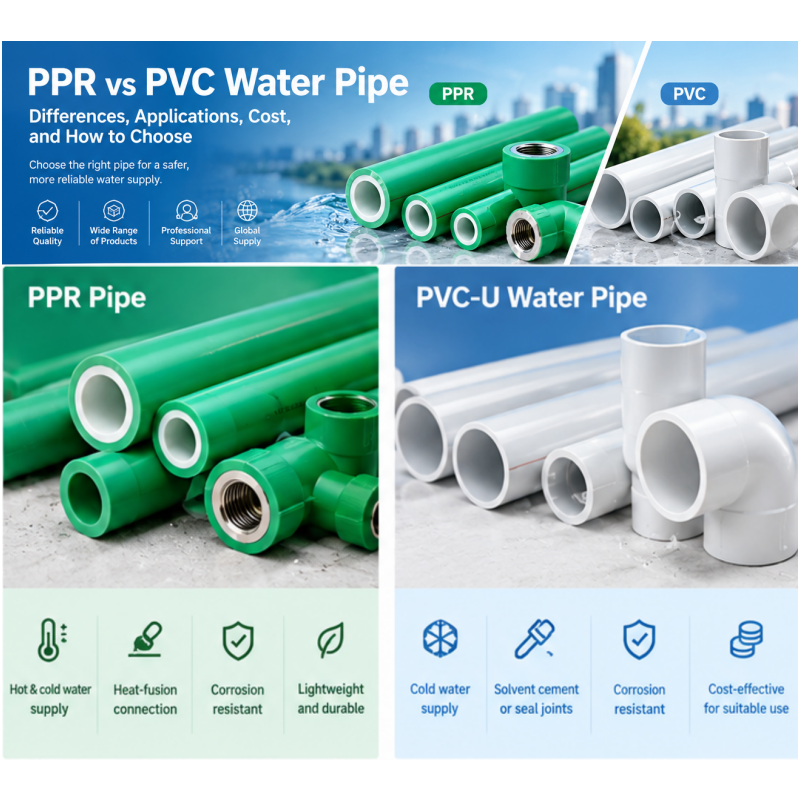
PPR (random copolymer polypropylene) is another form of polypropylene, which is suitable for use as water supply pipes due to its excellent heat resistance and frost resistance.
What are the differences between these two plastic materials used for water pipes?
1. Material and mechanical properties
PPR water pipes are made of polypropylene, and its "elastic modulus" is as high as 850 MPa, with good stiffness and poor toughness; in contrast, PE water pipes are made of medium-density polyethylene, with an "elastic modulus" of about 550 MPa, good toughness and slightly inferior stiffness.
PPR water pipes are more suitable for use in the field of building water supply to ensure that the pipes are flat and beautiful in appearance.
Because PE has excellent toughness, it is widely used in the field of municipal water supply and can adapt to more complex laying environments.
2. Temperature resistance
Polyethylene material is superior to low temperature environment adaptability, but its high temperature resistance is not as good as PPR. Since municipal pipelines mainly serve the transportation of domestic water for residents, they do not need to withstand the influence of excessively high water temperatures, and they do not need to be outdoors for a long time, so it is more appropriate to use PE pipes as pipeline materials.
For household users, the demand for hot water supply is more common. According to measurements, the maximum water temperature that ordinary PE pipes can withstand is only 60°C; while the conventional water temperature in household water supply is usually around 50°C. Under such temperature conditions for a long time, PE pipes are prone to accelerated aging, so PPR water pipes are generally preferred.
3. Thermal conductivity
The "thermal conductivity" of PPR is 0.24, while that of PE is 0.42, which is nearly twice the difference.
The lower the thermal conductivity, the better the insulation effect of the water pipe, but it may lead to better performance. In floor heating applications, the insulation effect of PE pipes on hot water is inferior to that of PPR, and its advantages can be exerted through PE-RT pipes.
For example, PE-RT pipe is a modified heat-resistant polyethylene material suitable for floor heating, which can transport hot water and has good heat dissipation performance.
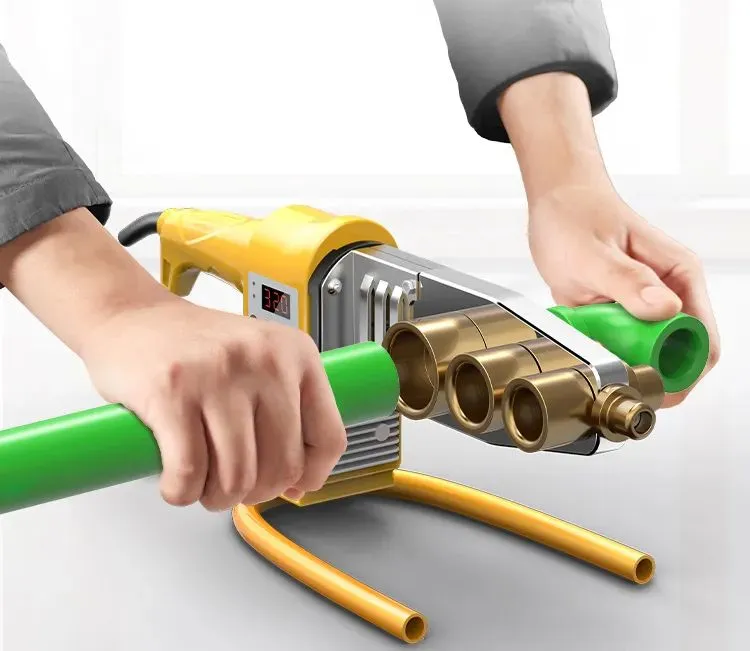
4. Welding difficulty
In terms of hot-melt performance, there is a difference in the "welding temperature" of PE and PPR, among which PPR water pipe is in the range of 260-270℃, while PE water pipe is 220-230℃. After hot melting, the flange of PPR water pipe is smooth, while the flange of PE water pipe is irregular and easy to clog.
In addition, PE material is easy to oxidize, and special tools must be used to remove the surface oxide scale before welding, otherwise it is impossible to form a truly integrated pipeline, and the pipeline may leak. This is an important reason why PPR water pipes are used instead of PE pipes for home decoration.
Therefore, although both PPR water pipes and PE water pipes can be hot-melt connected, they are not at the same level in terms of standardized operation difficulty. PPR water pipes are easier to operate and more convenient to construct.

916.webp)
204.webp)
659.webp)
185.webp)
312.webp)
849.webp)
587.webp)
767.webp)