Features
Excellent material
Made of PVC resin, it has corrosion resistance, chemical resistance and excellent physical properties.
Lightweight and high strength, easy to carry and install.
Structural characteristics
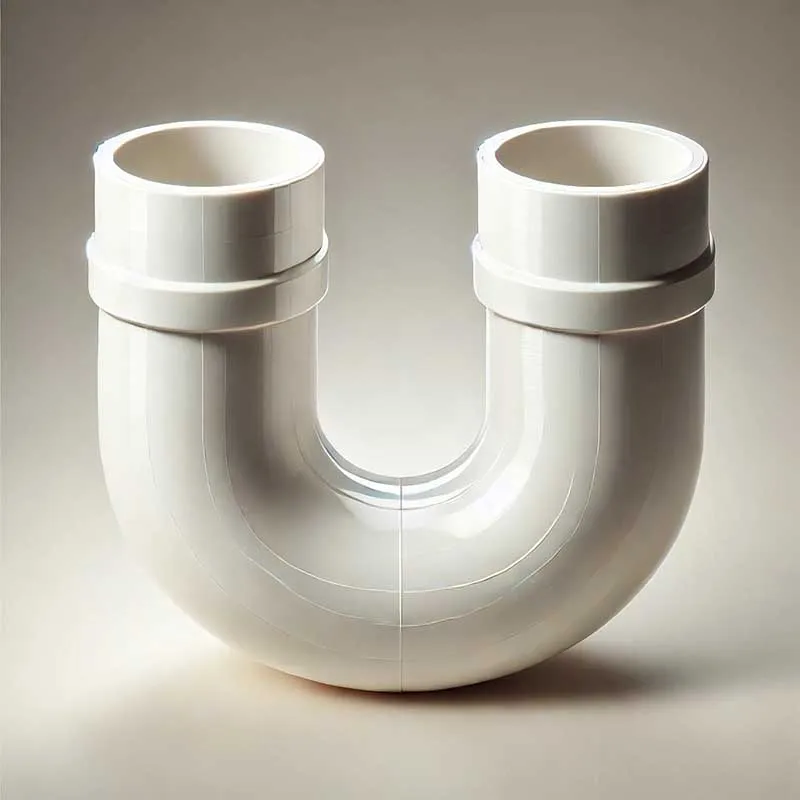
U-shaped design: used to change the flow direction of the pipeline, reduce fluid resistance in the pipeline, and optimize flow.
Smooth inner wall: reduce friction, prevent impurities from accumulating, and ensure circulation efficiency.
The connection end is often equipped with a socket (socket) or thread for easy installation and disassembly.
Strong sealing
Often used with sealing rings or adhesives to ensure that the connection does not leak water or air.
Environmentally friendly and safe
Non-toxic and harmless, suitable for drinking water pipes or food industry pipes.
Use of U-shaped PVC pipe
U-shaped PVC pipe is widely used in many fields due to its special bending shape and excellent material properties. The following is a detailed description of its main uses:
1. Drainage and sewage system
Use
In the drainage system of a building, it is used to change the direction of water flow, especially suitable for layout optimization of compact space.
In the sewage pipe, U-shaped PVC pipe can help reduce siltation and blockage while maintaining a stable flow of fluid.
Application scenario
Kitchen and bathroom drainage system.
Corner connection of urban underground sewage pipe network.
Advantages
The material is corrosion-resistant and is not affected by the acid and alkali components in sewage.
The smooth inner wall effectively prevents dirt deposition.
2. Industrial pipeline system
Use
Transport chemical liquids or gases, used in chemical, pharmaceutical and other industries.
In complex industrial pipeline layouts, the U-shaped design reduces connection points and improves system stability.
Application scenarios
Directional adjustment in liquid delivery pipelines in chemical plants.
In ventilation or gas delivery pipelines.
Advantages
Resistant to chemical corrosion, suitable for a variety of acidic and alkaline media.
Durable and easy to maintain.
3. Agricultural irrigation system
Use
In water-saving irrigation systems, used to connect water flow pipes in different directions.
Optimize farmland irrigation layout to ensure uniform water flow distribution.
Application scenarios
Branch pipe steering of drip irrigation and sprinkler irrigation systems.
Water pipe network in greenhouses or orchards.
Advantages
Lightweight and easy to install, suitable for complex terrain.
Strong weather resistance, adaptable to outdoor use environment.
4. Building piping system
Use
Used for water supply and drainage pipelines in residential and commercial buildings.
In air conditioning systems, used as part of the condensate discharge pipe.
Application scenarios
Diversion connection of water supply pipes inside buildings.
Used to optimize airflow paths in exhaust pipe systems.
Advantages
Lightweight, quick installation, suitable for high-rise buildings.
Good pressure resistance, adapt to changes in water supply pressure.
5. Cable protection system
Purpose
When wiring underground or in the wall, it is used to change the direction of the cable pipeline to avoid damage to the cable by sharp corners.
Provide additional protection and extend the service life of the cable.
Application scenarios
Protect cables from mechanical damage in power engineering.
Optical fiber protection in communication or network engineering.
Advantages
Smooth inner wall reduces cable wear.
Non-conductive, prevents leakage accidents.
6. Laboratory or medical field
Purpose
Transport experimental liquids, gases, or waste chemical liquid discharge.
In medical equipment pipelines, it is used as a special connection component.
Application scenarios
Medical wastewater discharge system.
Chemical fluid transportation in scientific research.
Advantages
The material is non-toxic and meets the requirements of laboratory and medical use.
Strong chemical resistance, can withstand high-purity reagent environment.
7. Landscape and decoration engineering
Use
In landscape design, U-shaped PVC pipes can be used for fluid diversion in waterscape fountain systems.
As part of the garden or irrigation network, it is used to beautify functional facilities.
Application scenarios
Design of garden sprinkler systems.
In small fish ponds or pool circulation systems.
Advantages
Beautiful and simple, suitable for hidden installation.
Corrosion-resistant, no frequent replacement required for long-term use.
Selection and installation characteristics of U-shaped PVC pipes
U-shaped PVC pipes need to consider a variety of factors during the purchase and installation process to ensure that their performance meets actual needs. The following is a detailed description:
I. Selection characteristics
1. Select materials according to purpose
General use: Select standard PVC material, suitable for general drainage and sewage use.
Special use: If the pipe needs to withstand high temperature or transport corrosive media, modified PVC (such as CPVC) material can be selected, which has better temperature resistance and chemical resistance.
2. Determine the pipe diameter specifications
Choose the appropriate pipe diameter according to project requirements:
Small diameter (16-50mm): suitable for household water supply and irrigation systems.
Medium and large diameter (75mm and above): mostly used for sewage and industrial transportation.
The radius of the U-shaped bend also needs to match the pipeline layout design.
3. Pay attention to wall thickness and pressure resistance
The thicker the wall thickness, the stronger the pressure resistance.
For high-pressure systems, thick-walled pipes that meet national standards (such as GB/T 5836.1 standard) should be selected.
4. Check the connection method
Socket connection: common in drainage systems, easy to install but requires the use of sealing rings or adhesives.
Threaded connection: suitable for detachable installation scenarios, easy to maintain.
5. Consider environmental adaptability
Indoor use: ordinary PVC can meet the needs.
Outdoor use: choose pipes with good UV resistance to avoid aging caused by long-term sun exposure.
6. Brand and certification
Choose a brand with quality certification, such as ISO, CE mark, to ensure reliable performance of the pipe.
Check whether the surface of the pipe is smooth and crack-free, and whether the port is neat.
II. Installation characteristics
1. Preparation before installation
Measurement and cutting: According to the actual pipeline layout, accurately measure and cut the pipe section of appropriate length to ensure the accurate installation position of the U-shaped pipe.
Clean the surface: remove dust and impurities from the connection part to ensure good sealing effect.
2. Installation steps
Socket connection:
Apply PVC special glue to the pipe interface, insert the U-shaped pipe port and gently rotate to increase the sealing effect.
Make sure that there is expansion space in the interface to adapt to the thermal expansion and contraction caused by temperature changes.
Flange connection (for industrial use):
Install the flange and fix it with bolts to ensure that the joint is firm and leak-free.
3. Support and fixation
Bracket arrangement: Install brackets at both ends and the middle of the U-shaped pipe to prevent the pipe from sagging or deformation.
Bending protection: Avoid excessive external force on the bending part to reduce the risk of rupture caused by stress concentration.
4. Sealing treatment
Use high-quality sealing rings or PVC glue to ensure that there is no leakage at the connection.
If threaded connection is used, the raw tape should be wrapped around the thread to increase the sealing effect.
5. Inspection and debugging
Perform a pressure test after installation to check whether the connection is leaking.
If used in sewage or drainage systems, actual operation should be simulated to ensure smooth discharge without blockage.
III. Precautions
1. Temperature limit
PVC pipes are generally suitable for a temperature range of -10℃ to 60℃. Insulation or protective measures may need to be installed in high or low temperature environments.
2. Avoid excessive stress
The U-shaped part should avoid excessive bending to avoid structural deformation or breakage.
Do not knock the pipe hard during installation to prevent damage to the surface.
3. Periodic inspection
Regularly check the interface and bend of the U-shaped pipe, clean the dirt that may accumulate, and ensure the long-term reliable operation of the system.
When purchasing U-shaped PVC pipes, you should focus on the material, specifications, connection method and environmental adaptability. During the installation process, you need to pay special attention to the sealing, fixed support and operation detection. Reasonable purchase and installation can not only improve the reliability of the pipeline system, but also extend its service life.
916.webp)
204.webp)
659.webp)
185.webp)
312.webp)
849.webp)
587.webp)
767.webp)